Vows and Journeys
BET Journal | August 01, 2024
Print This Article
View Original PDF

Vows and Journeys

BET Journal | June 25, 2025

Torah Tavlin

These are the journeys of the Jews... The meforshim express various opinions as to the Torah’s purpose in recording the journeys and the encampments of Bnei Yisroel during the years they traveled in the wilderness. The Rambam (Moreh Nevuchim) is of the opinion that the various journeys and encampments are recorded to emphasize that there was order and careful planning of their itinerary during these years. Bnei Yisroel were not moving haphazardly, disoriented and lost in the wilderness. The expression “wandering in the desert” is erroneous; “traveling in the desert” is more correct.

R’ Yosef Shaul Nathanson zt”l also provides a beautiful understanding. The Torah explicitly forbids a Jew to return and resettle in the Land of Egypt. From the moment the Jewish People were redeemed out of torturous slavery and unimaginable suffering, they were forbidden to return back to that awful land. Yet, in truth, we find hundreds of communities, thousands of people and even great tzaddikim that lived all, or parts of their lives in Egypt notwithstanding the prohibition against living there. These include the Rambam, the Arizal, and the Radvaz zt”l, to name just a few. How were they able to do so?

The answer is because the exact wording of the prohibition is: “You shall no longer return (to Egypt) on this road again” (Devarim 17,16). What is actually forbidden is for one to retrace the exact route that our ancestors took in the desert. For this reason, the Torah spells out very clearly and deliberately all 42 places in which the Jews camped, so that one can know and avoid returning to these places if he wishes to go back to Egypt. However, if one takes a different route, returning to Egypt is permissible.
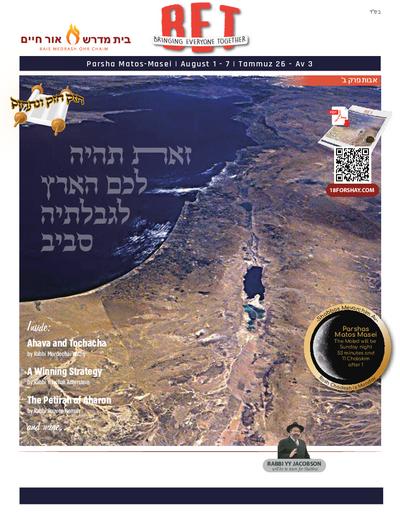

Torah Tavlin

These are the journeys of the Jews... The meforshim express various opinions as to the Torah’s purpose in recording the journeys and the encampments of Bnei Yisroel during the years they traveled in the wilderness. The Rambam (Moreh Nevuchim) is of the opinion that the various journeys and encampments are recorded to emphasize that there was order and careful planning of their itinerary during these years. Bnei Yisroel were not moving haphazardly, disoriented and lost in the wilderness. The expression “wandering in the desert” is erroneous; “traveling in the desert” is more correct.

R’ Yosef Shaul Nathanson zt”l also provides a beautiful understanding. The Torah explicitly forbids a Jew to return and resettle in the Land of Egypt. From the moment the Jewish People were redeemed out of torturous slavery and unimaginable suffering, they were forbidden to return back to that awful land. Yet, in truth, we find hundreds of communities, thousands of people and even great tzaddikim that lived all, or parts of their lives in Egypt notwithstanding the prohibition against living there. These include the Rambam, the Arizal, and the Radvaz zt”l, to name just a few. How were they able to do so?

The answer is because the exact wording of the prohibition is: “You shall no longer return (to Egypt) on this road again” (Devarim 17,16). What is actually forbidden is for one to retrace the exact route that our ancestors took in the desert. For this reason, the Torah spells out very clearly and deliberately all 42 places in which the Jews camped, so that one can know and avoid returning to these places if he wishes to go back to Egypt. However, if one takes a different route, returning to Egypt is permissible.

PDF Preview

