ABSTRACT לקוטי שיחות (Part 2)
Ben Chamesh L'Mikra | April 15, 2024
Print This Article
View Original PDF

ABSTRACT לקוטי שיחות (Part 2)

Ben Chamesh L'Mikra | June 27, 2025
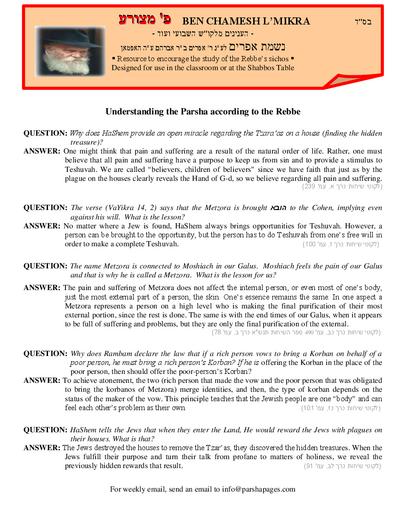
  • Teaches that if a person pledges to charity beyond one’s means, G-d assists
  • Teaches Jewish people are one “body” and can feel each other’s problem as their own
  • If a person vows to bring a sacrifice for another’s tzara’as sufferer, there are two elements:
    1. To fulfill the vow – one acts in that person’s place; then, rich or poor depends on the sufferer
    2. To achieve atonement – they merge identities and then, rich or poor depends on the status of the maker of the vow
  • Tzara’as of the houses reveals openly the unique purpose of “going down for the sake of elevation”
  • Tzara’as has a spiritual source that was misdirected; Tzara’as of the houses displays the great goodness that is “locked up” in the strong tumah of avodah zarah
  • Intention of Tzara’as is not to negate the bad talk (אמורי), but to turn one’s talk into (previously hidden) holy talks
  • Amorites knew their time for eviction had arrived when the Jews left Egypt; they hid their gold, since they hoped the Jews would sin, and then they would get their gold back
  • One accidental discharge becomes a Zav; this corresponds to strengthening the bad inclination even if not one’s fault
  • Second discharge must be intentional to become a Zav Ketana; this corresponds to the acute strengthening of the bad inclination when a person incites oneself to sin more
  • The third discharge (after any type of two earlier ones) can be unintentional; this corresponds to the effects of chronic strengthening of the bad inclination even without choosing to do so
  • The law is different for each stage; this corresponds to the need for a new type of Teshuvah at each stage
  • Teaches that if a person pledges to charity beyond one’s means, G-d assists
  • Teaches Jewish people are one “body” and can feel each other’s problem as their own
  • If a person vows to bring a sacrifice for another’s tzara’as sufferer, there are two elements:
    1. To fulfill the vow – one acts in that person’s place; then, rich or poor depends on the sufferer
    2. To achieve atonement – they merge identities and then, rich or poor depends on the status of the maker of the vow
  • Tzara’as of the houses reveals openly the unique purpose of “going down for the sake of elevation”
  • Tzara’as has a spiritual source that was misdirected; Tzara’as of the houses displays the great goodness that is “locked up” in the strong tumah of avodah zarah
  • Intention of Tzara’as is not to negate the bad talk (אמורי), but to turn one’s talk into (previously hidden) holy talks
  • Amorites knew their time for eviction had arrived when the Jews left Egypt; they hid their gold, since they hoped the Jews would sin, and then they would get their gold back
  • One accidental discharge becomes a Zav; this corresponds to strengthening the bad inclination even if not one’s fault
  • Second discharge must be intentional to become a Zav Ketana; this corresponds to the acute strengthening of the bad inclination when a person incites oneself to sin more
  • The third discharge (after any type of two earlier ones) can be unintentional; this corresponds to the effects of chronic strengthening of the bad inclination even without choosing to do so
  • The law is different for each stage; this corresponds to the need for a new type of Teshuvah at each stage
PDF Preview