Early Bedikas Chometz
Limuday Moshe | April 17, 2024
Print This Article
View Original PDF

Early Bedikas Chometz

Limuday Moshe | June 27, 2025

Being that this week is Shabbos HaGadol and Pesach is literally around the corner, this week will discuss a timely topic, as opposed to one connected to the parsha. We will discuss the mitzvah of bedikas chometz and in particular, the mitzvah of checking for chometz for somebody leaving his house before Pesach.

During Pesach, many go away from their homes either to family or to a hotel for the duration of the Yom Tov. Because they are not at home during Pesach, some think that they are exempt from checking the house for chometz. This is a mistake. As we will see, even those who are away from home for all of Pesach remain obligated (in many cases) to check for chometz.

The Obligation of an Early Bedikas Chometz

The Gemara states, citing Rabbi Yehuda in the name of Rav (Pesachim 6a): “Somebody who sets sail or journeys with a caravan: [if it is] before thirty days, he is not obligated to burn; [if it is] within thirty days, he is obligated to burn.”

The period of “thirty days” mentioned here and in additional halachos, defines a connection with the approaching Yom Tov. The Gemara itself explains: “As we find (in a beraisa): One should question and expound on the laws of Pesach thirty days before the Yom Tov.”

We see from the above Gemara that within thirty days of Pesach, even somebody who is leaving his home for Pesach is obligated to check his house for chometz.

The Gemara continues, citing a dispute among amora’im concerning the application of this halachah. According to Abaye, the obligation to check for chometz early is contingent on the fulfillment of two conditions. One is that the person leaves his house within thirty days of the Yom Tov. The second condition is that he is planning to come home during Pesach.

Rava maintains that there is no need for both conditions to be fulfilled, and either one is sufficient to require a search for chometz. Somebody who leaves his house within thirty days of the Yom Tov is thus obligated, according to Rava, to check for chometz, even if he won’t be returning home during Pesach. In addition, even if somebody leaves his home more than thirty days before Pesach, he must check for chometz if he plans to come home for Pesach.

The halachah, as we will clarify below, follows the opinion of Rava.

Leaving Chometz at Home

The halachah of checking for chometz within thirty days of Pesach raises an obvious question. There is an issur de’O’raisa [Torah prohibition] against having chometz in one’s possession during Pesach—the prohibition of ba’al yera’eh u-ba’al yematzeh. In view of this prohibition, how does leaving home more than thirty days before Pesach help? Surely one cannot have chometz in one’s possession at home, however early one leaves.

Rashi, according to one way of understanding (see the explanation given by the Maharshal), understands that one does not transgress the prohibition of ba’al yera’eh for “unknown chometz.” Therefore, only if he plans to come home during Pesach, whereupon he might find the chometz left behind at home, is there an obligation to check for chometz (see also Maharsha and Bach 436, who understand the opinion of Rashi differently).

According to the mainstream opinion in the Rishonim, however, the solution to the question of leaving chometz at home if one leaves before thirty days is the assumption that the owner of the chometz will perform bittul. On a de’O’raisa level, it is enough for a person to annul his chometz. By declaring it null and void, he escapes the Torah prohibition of ba’al yera’eh with respect to that chometz.

Rather than the de’O’raisa issue of having chometz in one’s possession, the Gemara’s discussion thus relates to the rabbinic obligation of bedikas chometz: Chazal did not wish a person to rely on annulment of his chometz, and therefore they said that a person must check for chometz, and actively remove it from his possession before Pesach. This rabbinic obligation applies on the eve of Pesach, and extends to thirty days before Yom Tov.

According to Rava, there is an additional obligation to check for chometz on somebody who leaves his home more than thirty days before Yom Tov, yet plans to come home for Pesach. This obligation is not related to the regular rabbinic obligation of checking for chometz, but is rather a new precaution, for fear that a person will come to eat chometz he finds at home.

Making a Berachah

The Ritva (d.h. lo amran) elucidates a practical ramification of the distinct obligations to check for one’s chometz.

One who leaves home within thirty days of Pesach is obligated in the basic mitzvah of bedikas chometz, and must therefore make a berachah over checking for chometz (like all rabbinic enactments, over which a berachah is recited).

However, somebody who leaves home more than thirty days before Pesach, yet intends to come home during Yom Tov, is obligated to check for chometz only out of the concern that he might come to eat chometz upon returning. In this case, his checking is only a precaution against the concern for eating chometz, and the original enactment of bedikas chometz is not being fulfilled. For this reason, no berachah is recited upon checking for chometz more than thirty days before Pesach.

The Kol-Bo cites a dissenting opinion, which rules that the berachah over checking for chometz is reserved for bedikas chometz on the day before Pesach, and is never recited for any early bedikah. This opinion is cited by the Rema (Orach Chaim 436:1). The Vilna Gaon explains that the berachah was enacted for the burning of the chometz and not for checking alone, which is why it is only recited when the search for chometz is juxtaposed to its burning (on Pesach eve).

The Mishnah Berurah (Biur Halachah, d.h. lo) mentions that according to several poskim a berachah is recited even for an early bedikas chometz (within thirty days), and leaves open the question whether one should recite a berachah since each opinion has the support of many others.

A Personal Obligation of Bedikas Chometz

The poskim dispute the halachic ruling for somebody who leaves his house within thirty days of Pesach if a non-Jew takes his place.

The Ra’avyah (426, as cited by the Mordechai, Pesachim 535) writes that in this case, if the Jew is leaving the house for a new domicile, he does not have to check the house he leaves for chometz, because he will fulfill the mitzvah in his new house.

However, if the departing Jew is not moving into a new house, but rather sailing the sea or journeying, he is obligated to check the house he is leaving for chometz, even though a non-Jew is taking his place.

The reason for this is that according to the Ra’avyah, there is a personal obligation to check for chometz. If a person has a home within thirty days of Pesach, and he won’t have another home after his departure, he is obligated to check the current home before he leaves—even though the non-Jew will surely bring in his own chometz.

The Tur (436) disputes this ruling, writing that there is no obligation to check for chometz. Even if chometz is left in the house, the chometz will not be in Jewish property, but rather in the property of the non-Jew who is moving in—and there is therefore no obligation to search for it.

The Shulchan Aruch (436:3) rules on this matter in favor of the Ra’avyah. The Rema, however, rules that there is no obligation to check a house into which a non-Jew is moving. The Mishnah Berurah (32) mentions further opinions, and rules that where a non-Jew is actually moving in, one can be lenient (and not check the house).

In our times, it is fairly common for people who leave their home for Pesach to arrange a sale of the chometz to a non-Jew, thereby exempting them from the obligation of bedikas chometz (see Mishnah Berurah 32 concerning whether a regular sale is sufficient, or whether the chometz must be sold before the time of bedikas chometz).

In view of the foregoing discussion, it is preferable for a person to leave some part of his house out of the sale, so that he will be able to perform the mitzvah of checking for chometz in that part of the house.

Coming Home before Pesach

The Shulchan Aruch (436:1) rules in accordance with Rava, meaning that somebody leaving home within thirty days of Pesach is obligated to check for chometz, even if he is not planning to come home during Pesach. In addition, somebody who leaves home earlier than thirty days before Pesach is, nonetheless obligated to check for chometz, if he is planning to come home for Pesach.

The Shulchan Aruch also rules like the Rambam, who states that even if the person’s intention is to come home before Pesach, he is obligated to check for chometz before leaving home (even when leaving more than thirty days before Yom Tov). The reason for this is due to the concern that he might come home late, and be unable to check for chometz.

Yet, the Shulchan Aruch (2) also mentions the opinion of the Ran (in the name of “some say”), who maintains that there is no obligation for somebody planning to come home before Pesach to check for chometz before he leaves home. The Mishnah Berurah (23) writes that later authorities side with the former opinion, but adds that under extenuating circumstances one can rely on the lenient opinion.

Nowadays, modern methods of transportation ensure that it is generally possible to return home, from virtually any point in the world, in a number of hours.

For this reason, there are stronger grounds for leniency today, and the obligation to check for chometz before leaving home (with intention of returning before Pesach) can be confined to somebody who intends to return shortly before the time for bedikas chometz (or to somebody sailing out to sea), where there is a realistic concern that a delay could prevent him from checking the house.

Leaving Others at Home

The discussion above concerning performing an “early bedikas chometz” for somebody leaving home applies specifically to somebody who will be leaving an empty house.

If a person leaves home, but leaves behind his wife and family members (over bar-mitzvah) who are able to check reliably for chometz, he has no obligation to check for chometz before leaving, and one of the members of the household should be appointed to check for chometz at the proper time on the eve of Pesach.

(Adapted from a halachah write-up written by R’ Yehoshua Pfeffer)
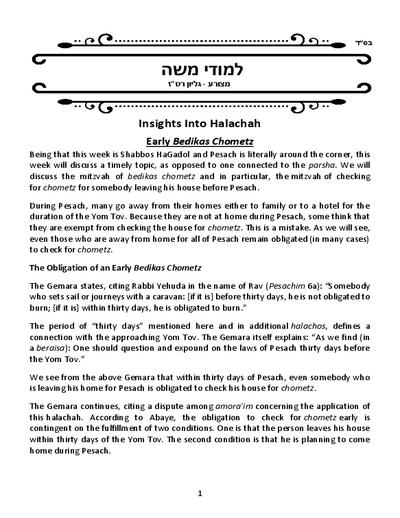
Being that this week is Shabbos HaGadol and Pesach is literally around the corner, this week will discuss a timely topic, as opposed to one connected to the parsha. We will discuss the mitzvah of bedikas chometz and in particular, the mitzvah of checking for chometz for somebody leaving his house before Pesach.

During Pesach, many go away from their homes either to family or to a hotel for the duration of the Yom Tov. Because they are not at home during Pesach, some think that they are exempt from checking the house for chometz. This is a mistake. As we will see, even those who are away from home for all of Pesach remain obligated (in many cases) to check for chometz.

The Obligation of an Early Bedikas Chometz

The Gemara states, citing Rabbi Yehuda in the name of Rav (Pesachim 6a): “Somebody who sets sail or journeys with a caravan: [if it is] before thirty days, he is not obligated to burn; [if it is] within thirty days, he is obligated to burn.”

The period of “thirty days” mentioned here and in additional halachos, defines a connection with the approaching Yom Tov. The Gemara itself explains: “As we find (in a beraisa): One should question and expound on the laws of Pesach thirty days before the Yom Tov.”

We see from the above Gemara that within thirty days of Pesach, even somebody who is leaving his home for Pesach is obligated to check his house for chometz.

The Gemara continues, citing a dispute among amora’im concerning the application of this halachah. According to Abaye, the obligation to check for chometz early is contingent on the fulfillment of two conditions. One is that the person leaves his house within thirty days of the Yom Tov. The second condition is that he is planning to come home during Pesach.

Rava maintains that there is no need for both conditions to be fulfilled, and either one is sufficient to require a search for chometz. Somebody who leaves his house within thirty days of the Yom Tov is thus obligated, according to Rava, to check for chometz, even if he won’t be returning home during Pesach. In addition, even if somebody leaves his home more than thirty days before Pesach, he must check for chometz if he plans to come home for Pesach.

The halachah, as we will clarify below, follows the opinion of Rava.

Leaving Chometz at Home

The halachah of checking for chometz within thirty days of Pesach raises an obvious question. There is an issur de’O’raisa [Torah prohibition] against having chometz in one’s possession during Pesach—the prohibition of ba’al yera’eh u-ba’al yematzeh. In view of this prohibition, how does leaving home more than thirty days before Pesach help? Surely one cannot have chometz in one’s possession at home, however early one leaves.

Rashi, according to one way of understanding (see the explanation given by the Maharshal), understands that one does not transgress the prohibition of ba’al yera’eh for “unknown chometz.” Therefore, only if he plans to come home during Pesach, whereupon he might find the chometz left behind at home, is there an obligation to check for chometz (see also Maharsha and Bach 436, who understand the opinion of Rashi differently).

According to the mainstream opinion in the Rishonim, however, the solution to the question of leaving chometz at home if one leaves before thirty days is the assumption that the owner of the chometz will perform bittul. On a de’O’raisa level, it is enough for a person to annul his chometz. By declaring it null and void, he escapes the Torah prohibition of ba’al yera’eh with respect to that chometz.

Rather than the de’O’raisa issue of having chometz in one’s possession, the Gemara’s discussion thus relates to the rabbinic obligation of bedikas chometz: Chazal did not wish a person to rely on annulment of his chometz, and therefore they said that a person must check for chometz, and actively remove it from his possession before Pesach. This rabbinic obligation applies on the eve of Pesach, and extends to thirty days before Yom Tov.

According to Rava, there is an additional obligation to check for chometz on somebody who leaves his home more than thirty days before Yom Tov, yet plans to come home for Pesach. This obligation is not related to the regular rabbinic obligation of checking for chometz, but is rather a new precaution, for fear that a person will come to eat chometz he finds at home.

Making a Berachah

The Ritva (d.h. lo amran) elucidates a practical ramification of the distinct obligations to check for one’s chometz.

One who leaves home within thirty days of Pesach is obligated in the basic mitzvah of bedikas chometz, and must therefore make a berachah over checking for chometz (like all rabbinic enactments, over which a berachah is recited).

However, somebody who leaves home more than thirty days before Pesach, yet intends to come home during Yom Tov, is obligated to check for chometz only out of the concern that he might come to eat chometz upon returning. In this case, his checking is only a precaution against the concern for eating chometz, and the original enactment of bedikas chometz is not being fulfilled. For this reason, no berachah is recited upon checking for chometz more than thirty days before Pesach.

The Kol-Bo cites a dissenting opinion, which rules that the berachah over checking for chometz is reserved for bedikas chometz on the day before Pesach, and is never recited for any early bedikah. This opinion is cited by the Rema (Orach Chaim 436:1). The Vilna Gaon explains that the berachah was enacted for the burning of the chometz and not for checking alone, which is why it is only recited when the search for chometz is juxtaposed to its burning (on Pesach eve).

The Mishnah Berurah (Biur Halachah, d.h. lo) mentions that according to several poskim a berachah is recited even for an early bedikas chometz (within thirty days), and leaves open the question whether one should recite a berachah since each opinion has the support of many others.

A Personal Obligation of Bedikas Chometz

The poskim dispute the halachic ruling for somebody who leaves his house within thirty days of Pesach if a non-Jew takes his place.

The Ra’avyah (426, as cited by the Mordechai, Pesachim 535) writes that in this case, if the Jew is leaving the house for a new domicile, he does not have to check the house he leaves for chometz, because he will fulfill the mitzvah in his new house.

However, if the departing Jew is not moving into a new house, but rather sailing the sea or journeying, he is obligated to check the house he is leaving for chometz, even though a non-Jew is taking his place.

The reason for this is that according to the Ra’avyah, there is a personal obligation to check for chometz. If a person has a home within thirty days of Pesach, and he won’t have another home after his departure, he is obligated to check the current home before he leaves—even though the non-Jew will surely bring in his own chometz.

The Tur (436) disputes this ruling, writing that there is no obligation to check for chometz. Even if chometz is left in the house, the chometz will not be in Jewish property, but rather in the property of the non-Jew who is moving in—and there is therefore no obligation to search for it.

The Shulchan Aruch (436:3) rules on this matter in favor of the Ra’avyah. The Rema, however, rules that there is no obligation to check a house into which a non-Jew is moving. The Mishnah Berurah (32) mentions further opinions, and rules that where a non-Jew is actually moving in, one can be lenient (and not check the house).

In our times, it is fairly common for people who leave their home for Pesach to arrange a sale of the chometz to a non-Jew, thereby exempting them from the obligation of bedikas chometz (see Mishnah Berurah 32 concerning whether a regular sale is sufficient, or whether the chometz must be sold before the time of bedikas chometz).

In view of the foregoing discussion, it is preferable for a person to leave some part of his house out of the sale, so that he will be able to perform the mitzvah of checking for chometz in that part of the house.

Coming Home before Pesach

The Shulchan Aruch (436:1) rules in accordance with Rava, meaning that somebody leaving home within thirty days of Pesach is obligated to check for chometz, even if he is not planning to come home during Pesach. In addition, somebody who leaves home earlier than thirty days before Pesach is, nonetheless obligated to check for chometz, if he is planning to come home for Pesach.

The Shulchan Aruch also rules like the Rambam, who states that even if the person’s intention is to come home before Pesach, he is obligated to check for chometz before leaving home (even when leaving more than thirty days before Yom Tov). The reason for this is due to the concern that he might come home late, and be unable to check for chometz.

Yet, the Shulchan Aruch (2) also mentions the opinion of the Ran (in the name of “some say”), who maintains that there is no obligation for somebody planning to come home before Pesach to check for chometz before he leaves home. The Mishnah Berurah (23) writes that later authorities side with the former opinion, but adds that under extenuating circumstances one can rely on the lenient opinion.

Nowadays, modern methods of transportation ensure that it is generally possible to return home, from virtually any point in the world, in a number of hours.

For this reason, there are stronger grounds for leniency today, and the obligation to check for chometz before leaving home (with intention of returning before Pesach) can be confined to somebody who intends to return shortly before the time for bedikas chometz (or to somebody sailing out to sea), where there is a realistic concern that a delay could prevent him from checking the house.

Leaving Others at Home

The discussion above concerning performing an “early bedikas chometz” for somebody leaving home applies specifically to somebody who will be leaving an empty house.

If a person leaves home, but leaves behind his wife and family members (over bar-mitzvah) who are able to check reliably for chometz, he has no obligation to check for chometz before leaving, and one of the members of the household should be appointed to check for chometz at the proper time on the eve of Pesach.

(Adapted from a halachah write-up written by R’ Yehoshua Pfeffer)

PDF Preview