Inheriting the Means and the Power of Jewish Unity
“Inheriting” the means
This difficulty is resolved though, through understanding the following idea:
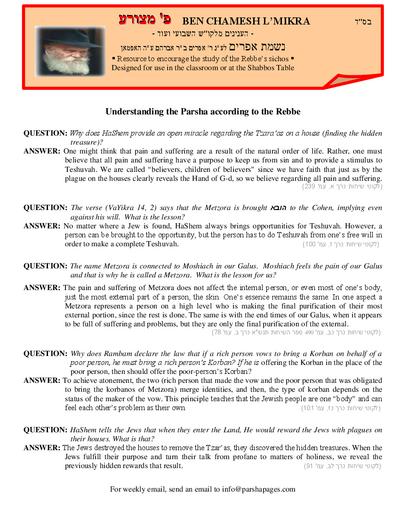
Although the one who made the oath to take upon the sacrifice of the Metzorah is an indigent, and the sacrifice should thus be established accordingly, nevertheless, since through his oath he became obligated in the sacrifice of a rich individual, it is considered as if he too has the ability to bring the sacrifice of a rich man.
When the poor person accepts to bring the sacrifice of a wealthy individual, it is considered as if he too is wealthy. He must therefore bring a more expensive sacrifice, as the wealthy person would have done, even though in actuality he is poor.
This is because the actual oath motivates the person to have the ability to bring the more expensive sacrifice.
The Talmud demonstrates the above idea as follows:
Text 9
I have sworn, and I will keep Your righteous judgments. But is he not under a perpetual oath from Mount Sinai? — But what [R. Giddal] teaches us is that one may stimulate himself. R. Giddal also said in Rav’s name: He who says, ‘I will rise early to study this chapter or this tractate,’ has vowed a great vow to the G-d of Israel. But he is under a perpetual oath from Mount Sinai, and an oath cannot fall upon another? Then [again] if he informs us that a person may thus stimulate himself.
Talmud, Nedarim 8a
When a person accepts upon himself the sacrifice of a wealthy individual, this itself gives him the ability to indeed find the means to indeed bring the sacrifice of a wealthy individual.
The lesson
Tehilim 119:106.
From this can be learned a tremendous lesson concerning the strength of Jewish unity.
Firstly, we can see the extent of the effect one can have on their fellow, in that through his own sacrifice he can bring atonement to another.
An individual is able to not only bring a sacrifice for his fellow when his fellow is poor, or doesn’t have the ability to bring it on his own, but even when the afflicted person is wealthy and has the means to bring the offering on his own, his friend can bring it in his stead.
This manifests in that when the one who made the oath to fulfill the sacrifice of his fellow, it is as if he himself is in need of atonement and we therefore follow what he can afford; it is as if he himself is obligated in the sacrifice.
Text 10
The verse states “You shall neither take revenge from nor bear a grudge against the members of your people.” When a person is cutting meat and he cuts himself, should he then cut his other hand?!
Talmud Yerushalmi, Nedarim 9:4
This is the true degree of the unity of the Jewish people—that we are all one corpus. It is for this reason that when there is a blemish in one Jew, it extends to his fellow; because another person’s pain, is in truth, his own.
This idea is expressed in the law that when a Jew gives of his own ability to affect an atonement in his fellow, although he is an indigent, the Torah places him in the category of a wealthy person, since they are all in truth like one individual.
Vayikra 19:18.
Were he himself to have been a Metzorah, he would not be obligated to bring the sacrifice of a wealthy person, but when he accepts the responsibility of another, he himself is considered rich!
When a person does indeed accept the sacrifice of a wealthy person, this opens channels that he too should be wealthy.
The story is told about the Previous Lubavitcher Rebbe: Once he requested from an individual a certain sum of money to print the works of the third Lubavitcher Rebbe. The individual from whom he requested the donation did not have the means, but he nevertheless accepted the project upon himself. The Rebbe blessed him and after a short time he became wealthy and was able to fulfill the full sum of the printing.
The resolution to give more than he was able to give itself, is what opened new channels for this individual, so that he could fulfill his resolution.
So too, in our scenario. When the Almighty sees that a person goes out of his limitations—notwithstanding that he himself is a pauper—and attempts to atone for his fellow who is rich, G-d opens new channels for him so that he can fulfill his obligation as a rich individual.
(Based on Likutei Sichos 27, Metzorah 1, reworked by Rabbi Dovid Markel. To see other projects and to partner in our work, see: www.Neirot.com.)
See Igros Kodesh, Previous Lubavitcher Rebbe 8:513.