Minhag Hamedinah Common Commercial Practice 16 Responsibility During Shipping
Business Weekly | April 18, 2024
Print This Article
View Original PDF

Minhag Hamedinah Common Commercial Practice 16 Responsibility During Shipping

Business Weekly | June 27, 2025

Q. I ordered a container of chametz from a manufacturer overseas. Due to disruptions in international shipping, the ship will be delayed till after Pesach. Is the chametz my responsibility?

A: As with other transactions, minhag hamedinah and the terms of contract play a role here. There are two primary contracts for shipping of commerce: c.i.f. (cost, insurance and freight) and f.o.b. (free/ freight on board).

In c.i.f. contracts, the seller assumes responsibility for the shipment and covers the cost of insurance until it reaches the buyer’s port of destination. When the goods pass the boat’s railing at the port of destination, ownership and liability transfer from the seller to the buyer.

In f.o.b. (origin) contracts, the buyer is responsible for the goods once the shipper loads the goods onto the freight carrier.

Accordingly, in c.i.f. contracts, the chametz is still considered in the seller’s possession during transit, whereas in f.o.b. (origin) contracts, the chametz is already considered yours (Pischei Choshen, Kinyanim 13:1[2]).
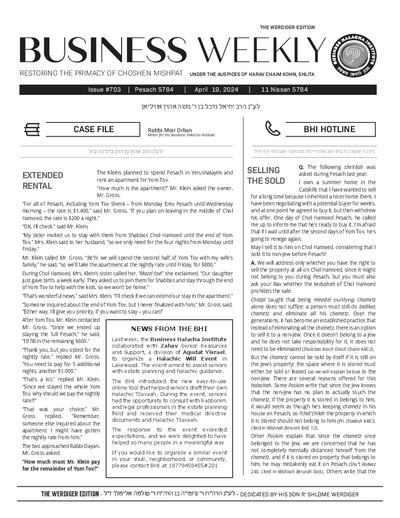
Q. I ordered a container of chametz from a manufacturer overseas. Due to disruptions in international shipping, the ship will be delayed till after Pesach. Is the chametz my responsibility?

A: As with other transactions, minhag hamedinah and the terms of contract play a role here. There are two primary contracts for shipping of commerce: c.i.f. (cost, insurance and freight) and f.o.b. (free/ freight on board).

In c.i.f. contracts, the seller assumes responsibility for the shipment and covers the cost of insurance until it reaches the buyer’s port of destination. When the goods pass the boat’s railing at the port of destination, ownership and liability transfer from the seller to the buyer.

In f.o.b. (origin) contracts, the buyer is responsible for the goods once the shipper loads the goods onto the freight carrier.

Accordingly, in c.i.f. contracts, the chametz is still considered in the seller’s possession during transit, whereas in f.o.b. (origin) contracts, the chametz is already considered yours (Pischei Choshen, Kinyanim 13:1[2]).

PDF Preview