Selling the Sold
Business Weekly | April 18, 2024
Print This Article
View Original PDF

Selling the Sold

Business Weekly | June 27, 2025

Q. The following she’eilah was asked during Pesach last year:

I own a summer home in the Catskills that I have wanted to sell for a long time because I inherited a nicer home there. I have been negotiating with a potential buyer for weeks, and at one point he agreed to buy it, but then withdrew his offer. One day of Chol Hamoed Pesach, he called me up to inform me that he’s ready to buy it. I’m afraid that if I wait until after the second days of Yom Tov, he’s going to renege again.

May I sell it to him on Chol Hamoed, considering that I sold it to non-Jew before Pesach?

A. We will address only whether you have the right to sell the property at all on Chol Hamoed, since it might not belong to you during Pesach, but you must also ask your Rav whether the kedushah of Chol Hamoed prohibits the sale.

Chazal taught that being mevatel (nullifying) chametz alone does not suffice; a person must still do bedikas chametz and eliminate all his chametz. Over the generations, it has become an established practice that instead of eliminating all the chametz, there is an option to sell it to a non-Jew. Once it doesn’t belong to a Jew and he does not take responsibility for it, it does not need to be eliminated (Shulchan Aruch Orach Chaim 440:2).

But the chametz cannot be sold by itself if it is still on the Jew’s property; the space where it is stored must either be sold or leased (as we will explain below) to the non-Jew. There are several reasons offered for this halachah. Some Poskim write that since the Jew knows that the non-Jew has no plan to actually touch the chametz, if the property it is stored in belongs to him, it would seem as though he’s keeping chametz in his house on Pesach, so l’chat’chilah the property in which it is stored should not belong to him (Pri Chadash 448:3, cited in Mishnah Berurah ibid. 12).

Other Poskim explain that since the chametz once belonged to the Jew, we are concerned that he has not completely mentally distanced himself from the chametz, and if it is stored on property that belongs to him, he may mistakenly eat it on Pesach (Shu”t Radvaz 240, cited in Mishnah Berurah ibid.). Others write that the reason the property must be sold or leased to the non-Jew is because he acquires the chametz through kinyan chatzer (via the property it is stored in, which he takes possession of first) or kinyan agav (as an addendum to the purchase of the property; see Chok Yaakov 448:14 and Ketzos 194:3).

There is a dispute as to whether the property must be sold to the non-Jew (Mekor Chaim 440:3, and 448:8), or whether it’s enough to lease it to him (Piskei Chasam Sofer, Mechiras Chometz 85:1; Shu”t Divrei Chaim v.2, Choshen Mishpat 40, among other Poskim). In fact, some Poskim say that’s it is better to lease it to the non-Jew, because a sale looks like a haaramah (deception) (Shu”t Avnei Tzedek, Orach Chaim 57; Shu”t Beis Shlomo, Orach Chaim 91).

Now, people who own an additional property that is far from their regular home, making it difficult to travel there to do bedikas chametz, will typically sell the entire property to a non-Jew for Pesach, and since the property does not belong to the Jew, he is not obligated to do bedikas chametz there.

Whether you will be able to sell the house on Chol Hamoed depends on how the contract transferring the property to the non-Jew was phrased. If you merely leased him your summer home, and only sold him the actual chametz inside it, then you may sell the house, just as a person may sell any property he has leased, and it is not considered selling something that doesn’t belong to him (davar she’eino shelo) (but the buyer cannot evict the tenant during the rental period) (Choshen Mishpat 312:1; see Nesivos 211:5).

But if the property was sold to the non-Jew, then it cannot be sold during Pesach (see Nesivos 60:11; Imrei Baruch ibid.; Imrei Binah, Halvaah 52; Yeshuos Yisrael 66:4). You may, however, commit to sell it as soon as it belongs to you again, as long as the contract is phrased correctly (see ibid. Nesivos 10; Imrei Binah ibid. 51; Erech Shai and Eimek Hamishpat 1:9).
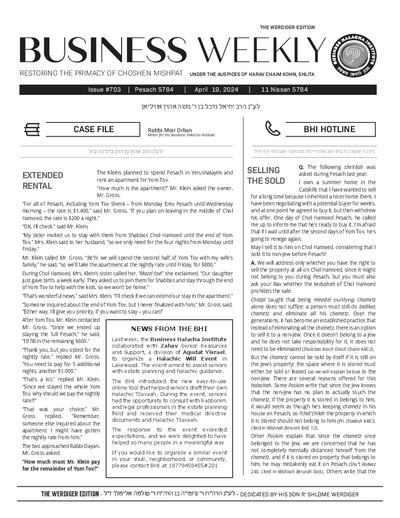
Q. The following she’eilah was asked during Pesach last year:

I own a summer home in the Catskills that I have wanted to sell for a long time because I inherited a nicer home there. I have been negotiating with a potential buyer for weeks, and at one point he agreed to buy it, but then withdrew his offer. One day of Chol Hamoed Pesach, he called me up to inform me that he’s ready to buy it. I’m afraid that if I wait until after the second days of Yom Tov, he’s going to renege again.

May I sell it to him on Chol Hamoed, considering that I sold it to non-Jew before Pesach?

A. We will address only whether you have the right to sell the property at all on Chol Hamoed, since it might not belong to you during Pesach, but you must also ask your Rav whether the kedushah of Chol Hamoed prohibits the sale.

Chazal taught that being mevatel (nullifying) chametz alone does not suffice; a person must still do bedikas chametz and eliminate all his chametz. Over the generations, it has become an established practice that instead of eliminating all the chametz, there is an option to sell it to a non-Jew. Once it doesn’t belong to a Jew and he does not take responsibility for it, it does not need to be eliminated (Shulchan Aruch Orach Chaim 440:2).

But the chametz cannot be sold by itself if it is still on the Jew’s property; the space where it is stored must either be sold or leased (as we will explain below) to the non-Jew. There are several reasons offered for this halachah. Some Poskim write that since the Jew knows that the non-Jew has no plan to actually touch the chametz, if the property it is stored in belongs to him, it would seem as though he’s keeping chametz in his house on Pesach, so l’chat’chilah the property in which it is stored should not belong to him (Pri Chadash 448:3, cited in Mishnah Berurah ibid. 12).

Other Poskim explain that since the chametz once belonged to the Jew, we are concerned that he has not completely mentally distanced himself from the chametz, and if it is stored on property that belongs to him, he may mistakenly eat it on Pesach (Shu”t Radvaz 240, cited in Mishnah Berurah ibid.). Others write that the reason the property must be sold or leased to the non-Jew is because he acquires the chametz through kinyan chatzer (via the property it is stored in, which he takes possession of first) or kinyan agav (as an addendum to the purchase of the property; see Chok Yaakov 448:14 and Ketzos 194:3).

There is a dispute as to whether the property must be sold to the non-Jew (Mekor Chaim 440:3, and 448:8), or whether it’s enough to lease it to him (Piskei Chasam Sofer, Mechiras Chometz 85:1; Shu”t Divrei Chaim v.2, Choshen Mishpat 40, among other Poskim). In fact, some Poskim say that’s it is better to lease it to the non-Jew, because a sale looks like a haaramah (deception) (Shu”t Avnei Tzedek, Orach Chaim 57; Shu”t Beis Shlomo, Orach Chaim 91).

Now, people who own an additional property that is far from their regular home, making it difficult to travel there to do bedikas chametz, will typically sell the entire property to a non-Jew for Pesach, and since the property does not belong to the Jew, he is not obligated to do bedikas chametz there.

Whether you will be able to sell the house on Chol Hamoed depends on how the contract transferring the property to the non-Jew was phrased. If you merely leased him your summer home, and only sold him the actual chametz inside it, then you may sell the house, just as a person may sell any property he has leased, and it is not considered selling something that doesn’t belong to him (davar she’eino shelo) (but the buyer cannot evict the tenant during the rental period) (Choshen Mishpat 312:1; see Nesivos 211:5).

But if the property was sold to the non-Jew, then it cannot be sold during Pesach (see Nesivos 60:11; Imrei Baruch ibid.; Imrei Binah, Halvaah 52; Yeshuos Yisrael 66:4). You may, however, commit to sell it as soon as it belongs to you again, as long as the contract is phrased correctly (see ibid. Nesivos 10; Imrei Binah ibid. 51; Erech Shai and Eimek Hamishpat 1:9).

PDF Preview