The Right Conditions
זכרון יעקב | April 18, 2024
Print This Article
View Original PDF

The Right Conditions

זכרון יעקב | June 27, 2025

This week’s parsha completes the laws of Tsora’as, a superficial discolouration that affects people, clothing and houses.

The Torah indicates a number of times that the adjudication of Tsora’as infection takes place only during the day.

Why specifically does everything take place during the day rather than at night?

Day and night refer the times in a person’s life. Day is when things are going well, and night is when things are challenging.

In a macro sense, day is when the world is at relative peace, generally people are prosperous, and things are going well. Night is when the opposite is happening.

When is best to judge? When times are tough, when decisions are made under duress, when emergency measures are being taken? Or when things are going well, people can see beyond the immediate, optimism is the air?

The Torah tells us that the time to see the truth is not when the situation is dire, when people do things that they normally would not countenance. At that point, the assessment may not be favourable.

The time is evaluate, is when things are going well, when choices are plentiful and people feel that they have the option to decide.

This contrast can be seen clearly in current events. While third world countries are struggling to feed their populations and maintain basic services, first world countries focus on inanities like diversity, equity and inclusiveness (DEI) to the exclusion of rationality. Imagine DEI being the key criterion for selecting a surgeon operating on a critically patient requiring expert care, or an airline pilot who holds the lives of hundreds in their hands or an engineer building a bridge that carries thousands of people each day, where the concept of 2+2=4 is considered racist!

Sadly, in the light of day, things do not look so good.
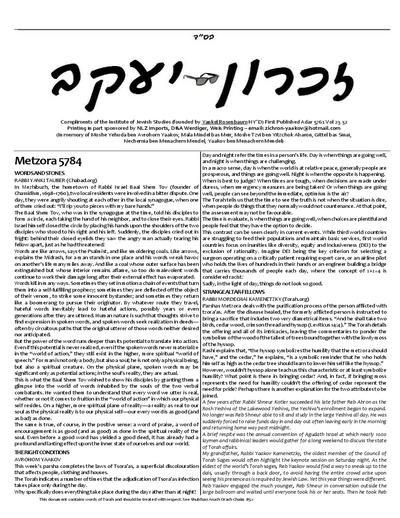
This week’s parsha completes the laws of Tsora’as, a superficial discolouration that affects people, clothing and houses.

The Torah indicates a number of times that the adjudication of Tsora’as infection takes place only during the day.

Why specifically does everything take place during the day rather than at night?

Day and night refer the times in a person’s life. Day is when things are going well, and night is when things are challenging.

In a macro sense, day is when the world is at relative peace, generally people are prosperous, and things are going well. Night is when the opposite is happening.

When is best to judge? When times are tough, when decisions are made under duress, when emergency measures are being taken? Or when things are going well, people can see beyond the immediate, optimism is the air?

The Torah tells us that the time to see the truth is not when the situation is dire, when people do things that they normally would not countenance. At that point, the assessment may not be favourable.

The time is evaluate, is when things are going well, when choices are plentiful and people feel that they have the option to decide.

This contrast can be seen clearly in current events. While third world countries are struggling to feed their populations and maintain basic services, first world countries focus on inanities like diversity, equity and inclusiveness (DEI) to the exclusion of rationality. Imagine DEI being the key criterion for selecting a surgeon operating on a critically patient requiring expert care, or an airline pilot who holds the lives of hundreds in their hands or an engineer building a bridge that carries thousands of people each day, where the concept of 2+2=4 is considered racist!

Sadly, in the light of day, things do not look so good.

PDF Preview