Accepting Responsibility
Ben Chamesh L'Mikra | December 10, 2023
Print This Article
View Original PDF

Accepting Responsibility

Ben Chamesh L'Mikra | December 31, 2025

Accepting responsibility

What still must be explained is why Reuven chose to say “Didn't I tell you... but you did not listen?” Why did Reuven need to stress their failure to follow his instructions not to sell Yosef, and they did not listen to him?

This can be understood through explaining a similar statement by Rambam, in his explanation as to why a person must repent for their actions and the correlation between free choice and repentance he makes the following remark:

Since free choice is in our hands

and our own decision [is what prompts us to] commit all these wrongs, it is proper for us to repent and abandon our wickedness, for this choice is presently in our hand. This is implied by the following verse: "Let us search and examine our ways and return [to G-d]."
Rambam, Laws of Teshuvah 5:2

Rambam explains that it is because the person had free choice in choosing to do evil, and that they did the evil through their own decision, that they should therefore repent for their sins.

In order for a person to do teshuvah, they must completely accept responsibility for their actions. All too often, people tend to attribute their faults to an outside influence which caused them to sin—a difficult situation they were in, a specific incident that happened to them, etc. They thus shirk some of the responsibility and do not fully repent.

Because the person believes that they are not completely responsible for their faults, they can never truly repent, as they have not yet accepted responsibility for their actions.

It is for this reason that a person is always responsible for their actions, no matter how difficult the challenge that they are facing is. For, no matter how difficult the challenge, the person is equipped with the tools to overcome his challenge.

When a person is truly honest with themselves, they will realize that it is their own decision that led them to sin. When a person has that realization, it is then that they are able to truly repent.

This is why Reuven adds, “Didn't I tell you...but you did not listen.” He was explaining to his brothers, that for them to properly do teshuvah it was necessary that it be accompanied by taking full responsibility for what they had done. If not, then their teshuvah could not be complete.

They needed to clearly recognize that their misdeeds were their own choices. Only when they accepted complete responsibility for their actions, did it become possible for them to repent for doing them.
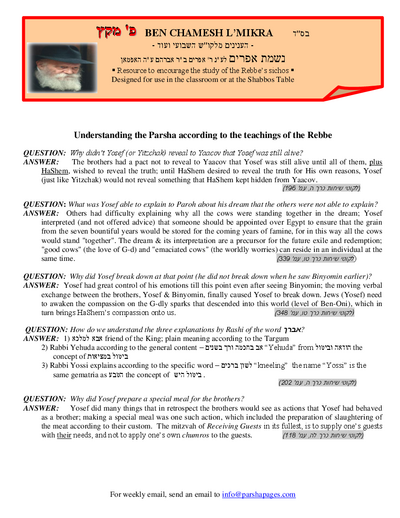
Accepting responsibility

What still must be explained is why Reuven chose to say “Didn't I tell you... but you did not listen?” Why did Reuven need to stress their failure to follow his instructions not to sell Yosef, and they did not listen to him?

This can be understood through explaining a similar statement by Rambam, in his explanation as to why a person must repent for their actions and the correlation between free choice and repentance he makes the following remark:

Since free choice is in our hands

and our own decision [is what prompts us to] commit all these wrongs, it is proper for us to repent and abandon our wickedness, for this choice is presently in our hand. This is implied by the following verse: "Let us search and examine our ways and return [to G-d]."
Rambam, Laws of Teshuvah 5:2

Rambam explains that it is because the person had free choice in choosing to do evil, and that they did the evil through their own decision, that they should therefore repent for their sins.

In order for a person to do teshuvah, they must completely accept responsibility for their actions. All too often, people tend to attribute their faults to an outside influence which caused them to sin—a difficult situation they were in, a specific incident that happened to them, etc. They thus shirk some of the responsibility and do not fully repent.

Because the person believes that they are not completely responsible for their faults, they can never truly repent, as they have not yet accepted responsibility for their actions.

It is for this reason that a person is always responsible for their actions, no matter how difficult the challenge that they are facing is. For, no matter how difficult the challenge, the person is equipped with the tools to overcome his challenge.

When a person is truly honest with themselves, they will realize that it is their own decision that led them to sin. When a person has that realization, it is then that they are able to truly repent.

This is why Reuven adds, “Didn't I tell you...but you did not listen.” He was explaining to his brothers, that for them to properly do teshuvah it was necessary that it be accompanied by taking full responsibility for what they had done. If not, then their teshuvah could not be complete.

They needed to clearly recognize that their misdeeds were their own choices. Only when they accepted complete responsibility for their actions, did it become possible for them to repent for doing them.

PDF Preview