Amen and Brachos in the Teachings of a Baal Hayahrtzeit
Vechol Maaminim | December 24, 2024
Print This Article
View Original PDF

Amen and Brachos in the Teachings of a Baal Hayahrtzeit

Vechol Maaminim | June 27, 2025

Amen – Immediate Acceptance of Emunah

The reason for the words of Chazal that the one who answers amen is greater than the mevarech is explained by Rav Chizkiyah Feivel Plaut, author of Likutei Chaver Ben Chaim, as follows:

When saying the brachah, the mevarech shows that the emunah in the Creator is ingrained in his heart, but the one who answers amen also expresses the way the emunah is accepted: He does not need time to deliberate and study it, there is no need to speak a lot to him, and to persuade him. As soon as he hears the dvar emunah from the mevarech, he accepts the words with the answering of amen. Emunah is so important in Shamayim and that is why Chazal say (Brachos 53b) that the oneh amen is greater than the mevarech.

The Likutei Chaver Ben Chaim adds that a Rav who instructs his son (ibid) “grab and make the brachah” admits that the virtue of the oneh amen is greater than the mevarech, but in any case, he thought that one who makes the brachah in the ears of one who answers amen to his brachah has a part in the answering of amen, because he caused him to answer. Therefore, specifically because of the virtue of answering amen, the reward of the mevarech who gave the merit to another person to answer amen is greater than the oneh amen. Therefore, it is fitting to seek out a brachah that will be answered with amen k’halachah. (Likutei Chaver Ben Chaim Vol. V, second part, page 60).

Amen to the Brachah of a Gentile

From the passuk (Devarim 7:14): “Baruch tihiyeh mikol ha’amim” Chazal explain (Yerushalmi Brachos 8 8): “If a gentile blesses you – answer amen after him.” In other words, “mikol ha’amim” is explained to mean “from all the nations” and therefore Chazal explain the passuk about a brachah that a gentile blesses Yisrael. But we still have to understand how we learn from this passuk that one should answer amen to the brachah of a non-Jew?

The Liktuei Chaver Ben Chaim explains: In the passuk it is explained that HaKadosh Baruch Hu agrees with the brachah of the gentile, because it does not say “kol ha’amim yevarchucha” – but rather “baruch tihiyeh mikol ha’amim,” and a brachah that HaKadosh Baruch Hu agrees with surely needs to be fulfilled with the answering of amen. (Likutei Chaver Ben Chaim, Vol. I, p. 18)
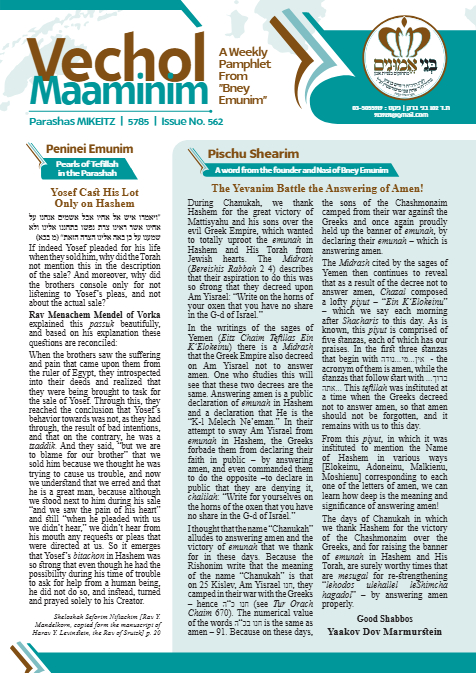
Amen – Immediate Acceptance of Emunah

The reason for the words of Chazal that the one who answers amen is greater than the mevarech is explained by Rav Chizkiyah Feivel Plaut, author of Likutei Chaver Ben Chaim, as follows:

When saying the brachah, the mevarech shows that the emunah in the Creator is ingrained in his heart, but the one who answers amen also expresses the way the emunah is accepted: He does not need time to deliberate and study it, there is no need to speak a lot to him, and to persuade him. As soon as he hears the dvar emunah from the mevarech, he accepts the words with the answering of amen. Emunah is so important in Shamayim and that is why Chazal say (Brachos 53b) that the oneh amen is greater than the mevarech.

The Likutei Chaver Ben Chaim adds that a Rav who instructs his son (ibid) “grab and make the brachah” admits that the virtue of the oneh amen is greater than the mevarech, but in any case, he thought that one who makes the brachah in the ears of one who answers amen to his brachah has a part in the answering of amen, because he caused him to answer. Therefore, specifically because of the virtue of answering amen, the reward of the mevarech who gave the merit to another person to answer amen is greater than the oneh amen. Therefore, it is fitting to seek out a brachah that will be answered with amen k’halachah. (Likutei Chaver Ben Chaim Vol. V, second part, page 60).

Amen to the Brachah of a Gentile

From the passuk (Devarim 7:14): “Baruch tihiyeh mikol ha’amim” Chazal explain (Yerushalmi Brachos 8 8): “If a gentile blesses you – answer amen after him.” In other words, “mikol ha’amim” is explained to mean “from all the nations” and therefore Chazal explain the passuk about a brachah that a gentile blesses Yisrael. But we still have to understand how we learn from this passuk that one should answer amen to the brachah of a non-Jew?

The Liktuei Chaver Ben Chaim explains: In the passuk it is explained that HaKadosh Baruch Hu agrees with the brachah of the gentile, because it does not say “kol ha’amim yevarchucha” – but rather “baruch tihiyeh mikol ha’amim,” and a brachah that HaKadosh Baruch Hu agrees with surely needs to be fulfilled with the answering of amen. (Likutei Chaver Ben Chaim, Vol. I, p. 18)

PDF Preview