An End to Darkness
Parsha B'Iyun | December 19, 2025
Print This Article
View Original PDF

An End to Darkness

Parsha B'Iyun | December 31, 2025

The weekly Parsha that will be read B'ezrat Hashem this Shabbat is Parshat Miketz. This Parsha falls during the days of Chanukah in most years, and because of this, all the commentators try to find the connection between Chanukah and Parshat Miketz. The Midrash (Bereishit Rabbah, 89:1) connects the Pasuk וַיְהִי מִקֵּץ שְׁנָתַיִם יָמִים – And it came to pass at the end of two years, with the Pasuk קֵץ שָׂם לַחֹשֶךְ – He sets an end to darkness (Iyov 28:3). It teaches that darkness symbolizes the presence of the yetzer hara – the evil inclination. As long as the yetzer hara exists, the world remains in shadow; and once it is uprooted, the darkness and gloom will vanish.

A second explanation applies this to Yosef HaTzaddik. Hakadosh Baruch Hu appointed a definite limit to his darkness – namely, the time he would remain imprisoned. Because Yosef placed his trust in flesh and blood, asking the Sar HaMashkim (chief cupbearer) to remember him, he was given two extra years in confinement. When that divinely fixed end date arrived, Pharaoh’s dream marked the moment of his release and redemption.

According to some commentators, Pharaoh dreams the same dream continuously for two years. If so, what is the meaning of the Midrash's words: כֵּיוָן שֶׁהִגִּיעַ הַקֵּץ חָלַם פַּרְעֹה חֲלוֹם – once the end arrived? The commentators say that a person needs to know that when he finds himself in darkness, his redemption has already begun. Just as, l’havdil, a person may have a certain illness and not even be aware of it – the same applies to a person at the time of his redemption; he doesn't know he's about to be redeemed. So too with Yosef. His time in prison had ended, and Hakadosh Baruch Hu was preparing his redemption through dreams that continued for two years!

In the last section of Parshat Vayeishev, the Meshech Chochma discusses the entry of the Sar HaMashkim and Sar HaOfim into prison, when Yosef was in his ninth year of imprisonment. According to his words there, the chief butler and chief baker weren't just 'waiters' in prison, but rather the chief butler was responsible for all beverages in Egypt, and the chief baker was responsible for all food in Egypt. One year before Yosef left prison, they were placed in the prison, and Rashi explains that they were in custody for twelve months. The question arises – why were they brought in only during Yosef's last year in prison? The answer is very simple. It is because their very entry into prison marked the beginning of Yosef's redemption. Why? Because according to Hakadosh Baruch Hu's plan, Yosef was meant to become viceroy to the king. Seemingly, how could a 17-year-old boy – who had been a yeshiva student with his father – have the ability to manage a country like Egypt?! Hakadosh Baruch Hu arranged for the Sar HaMashkim to have a fly fall into Pharaoh's cup, and for the Sar HaOfim to have a stone get into the dough, and then Pharaoh became angry and put them in the prison where Yosef was sitting. Yosef is the overseer of the prison and naturally asks both of them to tell him why they landed here, and from one thing to another they tell him how the country is managed – for a whole year they converse with Yosef, essentially training him for his future role!

A Prisoner's Perspective

A friend who once sat in prison told me that when he arrived at prison, he received a 'number' – from that day on they no longer called him 'Shlomo' but '182821'. In the cell there were four prisoners in bunk beds with a toilet on the side of the room. He put his bag aside and started walking back and forth in the cell. After fifteen minutes of walking back and forth in the cell, one of the prisoners noticed him – "Ahh, new here?" "Yes..." "Climb onto your bed and sit quietly!" "Why, is it forbidden to walk around here?" "Listen, here even if you're standing, you're called sitting – so sit down!"

What is there to do in prison? If you observe Torah and Mitzvot, then you have shuls – you sit and learn all day. There are people who have already completed the entire Shas there! But what does a person do when Torah and Mitzvot are not part of their equation? He walks back and forth all the time. Yosef arrives and meets the chief baker and chief butler, and then naturally he begins to interrogate them: Who are you? What are you?... The Meshech Chochma says, imagine if the chief butler and chief baker had dreamed their dreams three days after entering prison; they would have introduced themselves to Yosef, then they would have told him their dreams – to the chief butler he gives a good interpretation and to the chief baker a bad interpretation – naturally, the chief butler wouldn't have looked at him anymore, and consequently, he wouldn't have 'trained' Yosef to become the future viceroy!

The Meshech Chochma writes, It appears that it was divinely ordained that he should spend days with the chief butler and baker, to learn royal tactics and all the workings of authority that a ruler should know. Therefore, they dreamed only three days before their release, for if they had dreamed earlier, then the chief baker would have been angry with Yosef and wouldn't have taught him the secrets of royalty and its customs.

This is what Chazal tell us. קֵץ שָׂם לַחֹשֶךְ – although Yosef entered prison, all this was to prepare him to become viceroy of Egypt! On the same principle, the Ibn Ezra writes in Parshat Shemot, why did Divine Providence arrange for Batya, Pharaoh's daughter, to draw Moshe from the Nile and raise him in Pharaoh's palace? Why not one of the many others around? So that he would learn royal manners!

Redemption Through Divine Intervention

The Satmar Rebbe comes and asks, why did Hakadosh Baruch Hu keep Yosef in prison for two additional years? The words of Chazal are well known (Bereishit Rabbah, 89:3): אַשְׁרֵי הַגֶּבֶר אֲשֶׁר שָׂם ה' מִבְטַחוֹ (תהלים מ, ה), זֶה יוֹסֵף. וְלֹא פָנָה אֶל רְהָבִים, עַל יְדֵי שֶׁאָמַר לְשַׂר הַמַּשְׁקִים (בראשית מ, יד): זְכַרְתַּנִּי וְהִזְכַּרְתַּנִּי, נִתוֹסַף לוֹ שְׁתֵּי שָׁנִים. "Happy is the man who makes the Lord his trust" – this refers to Yosef. "And does not turn to the proud," because he said to the chief butler: "Remember me and mention me," two years were added to him.

The Satmar Rebbe says that Hakadosh Baruch Hu did not want Yosef to leave prison through a gentile; if the Sar HaMashkim had left prison and said to Pharaoh, "Listen, there's a righteous young man sitting in prison without any wrongdoing – he deserves a pardon!"; if Pharaoh had responded to him, it would mean he left prison through the merit of a gentile. But Hakadosh Baruch Hu did not want Yosef's redemption to come through the Sar HaMashkim because we say every Shabbat in the Musaf Kedusha (Nusach Sefard): הֵן גָּאַלְתִּי אֶתְכֶם אַחֲרִית כְּרֵאשִׁית – Behold, I will redeem you in the end as in the beginning. The future redemption will be exactly like the first redemption; the one who will redeem us will be Hakadosh Baruch Hu in His glory and by Himself! – and so too with Yosef, Hakadosh Baruch Hu wanted to take him out of exile. But in practice, it was the Sar HaMashkim who brought him out, when he said to Pharaoh: אֶת חֲטָאַי אֲנִי מַזְכִּיר הַיּוֹם – I mention my sins today.

The Midrash states (Bereishit Rabbah, 89:7), when the Sar HaMashkim saw Pharaoh whose soul was about to depart – Pharaoh was in such a troubled state that if they didn't interpret his dream he would die! – he calculated in his mind and said: “If this Pharaoh dies and another king arises, I don't know if he will keep me in my position or not. I need to tell Pharaoh in order to keep my Volvo!” Therefore, he stepped forward and said: “I have two sins; one that I didn't do good for Yosef and mention him before you, and another that I saw you distressed about the interpretation of a dream, and I didn't tell you about the man who knows its interpretation.”

Hakadosh Baruch Hu said: "He's worried about his position – I don't care about that. What I care about is that Yosef should leave through his merit from prison – and to this I don't agree! I personally take care of him! When his time comes to leave, I will take him out!" Therefore, Pharaoh dreams for two years, and when the Sar HaMashkim came it was already when Pharaoh was about to die, and thus Yosef's redemption came from Hakadosh Baruch Hu and not from the Sar HaMashkim, because his entire desire was to save his position.

The Avodah of Chanukah: The Power of Sight

With that, let's address a point many connect to Chanukah. Chazal say that the main Avodah of Chanukah revolves around the eyes: אֵין לָנוּ רְשׁוּת לְהִשְׁתַּמֵּשׁ בָּהֶם אֶלָּא לִרְאוֹתָן בִּלְבַד – we have no permission to use them, only to see them. We have something in Chanukah that doesn't exist in any other holiday – someone who sees another person who lit Chanukah candles also makes a Bracha. If a person is in prison, chas v’shalom, and sees people lighting Chanukah candles opposite him – he makes a Bracha! We don't find such a thing in any other holiday; when it comes to Chanukah, seeing enables Bracha. Chazal say (Bereishit Rabbah, 2:4): רַבִּי שִׁמְעוֹן בֶּן לָקִישׁ פָּתַר קְרָיָא בַּגָּלוּת, וְהָאָרֶץ הָיְתָה תֹהוּ, זֶה גָּלוּת בָּבֶל, שֶׁנֶּאֱמַר: רָאִיתִי אֶת הָאָרֶץ וְהִנֵּה תֹהוּ. וָבֹהוּ, זֶה גָּלוּת מָדַי: וַיְבַהִלוּ לְהָבִיא אֶת הָמָן. וְחֹשֶךְ, זֶה גָּלוּת יָוָן, שֶׁהֶחֱשִׁיכָה עֵינֵיהֶם שֶׁל יִשְׂרָאֵל בִּגְזֵרוֹתֵיהֶן, שֶׁהָיְתָה אוֹמֶרֶת לָהֶם, כִּתְבוּ עַל קֶרֶן הַשּׁוֹר שֶׁאֵין לָכֶם חֵלֶק בֵּא-לֹהֵי יִשְׂרָאֵל.

Rabbi Shimon ben Lakish interpreted the verse regarding the exiles: "And the earth was formless" – this is the Babylonian exile, as it says: "I looked at the earth and behold it was formless." "And void" – this is the Persian exile: "And they hastened to bring Haman." "And darkness" – this is the Greek exile, which darkened the eyes of Israel with their decrees, as they would say to them: Write on the horn of an ox that you have no portion in the G-d of Israel.

And what was their entire purpose in the decree of "Write on the horn of an ox that you have no portion in the G-d of Israel"? The Megaleh Amukot says that their entire purpose was to act against Yosef HaTzaddik who is called שׁוֹר (ox), as it is written: בְּכוֹר שׁוֹרוֹ הָדָר לוֹ – His firstborn ox has majesty.

Yosef and the Three Decrees

If this is the case, we can learn something wonderful that Rav Aharon of Belz says. The three decrees that the Greeks decreed upon us were: Shabbat, Rosh Chodesh – sanctification of the month, and Brit Milah. Yosef HaTzaddik is the representation of these three decrees.

Shabbat corresponds to Yosef, as we learn from the Pasuk in our Parsha that Yosef brought his brothers to the house and directed that preparations be made – preparations that Chazal say were Erev Shabbat preparations, as Yosef observed Shabbat even before the Mitzvah was formally given.

Kiddush HaChodesh corresponds to Yosef, for in the future they will sanctify the month through sight, and regarding Yosef it says: בֵּן פֹּרָת יוֹסֵף בֵּן פֹּרָת עֲלֵי עָיִן – A fruitful son is Yosef, a fruitful son by the eye.

Brit Milah corresponds to Yosef, as the well-known saying of Chazal states: הָעַיִן רוֹאָה וְהַלֵּב חוֹמֵד וּכְלֵי הַמַּעֲשֶׂה גוֹמְרִים – The eye sees and the heart desires and the instruments of action complete. Yosef, who overcame his desires, is called the middah of yesod. The Gemara states (Zevachim 118a) that in the Mishkan of Shiloh it was permitted to eat Kodshim Kalim and Ma’aser Sheini offerings anywhere from which Shiloh could be seen by the eye. Why? Because Shiloh was in the portion of Yosef, and Yosef guarded his eyes.

Because Yosef guarded his eyes, it is understood why we recite a Bracha on the seeing (of candles lit) during Chanukah, for the Greeks wanted to fight against Mitzvot that depend on seeing, such as Shabbat where we have the lighting of Shabbat candles, and also Kiddush HaChodesh. Therefore, on Chanukah we have no permission to use the candles other than to see them alone – for the Avodah of Chanukah is found in the element of seeing.

The Symbolism of the Hand and the Number 13

During the days of Chanukah, we mention יָד (hand) five times in our special Tefillah (עַל הַנִּסִּים). What is the meaning of this? Rav Naftali Zvi Horowitz of Ropshitz writes, it is written in the Parsha: וַתֵּרֶב מַשְׂאַת בִּנְיָמִן מִמַּשְׂאֹת כֻּלָּם חָמֵשׁ יָדוֹתָם – And he increased Binyamin's portion from all their Parshiot five hands. "Five hands" refers to: מָסַרְתָּ גִבּוֹרִים בְּיַד חַלָּשִׁים וְרַבִּים בְּיַד מְעַטִּים וּטְמֵאִים בְּיַד טְהוֹרִים וְרְשָׁעִים בְּיַד צַדִּיקִים וְזֵדִים בְּיַד עוֹסְקֵי תּוֹרָתֶךָ. You delivered the mighty into the hands of the weak, and the many into the hands of the few, and the impure into the hands of the pure, and the wicked into the hands of the righteous, and the arrogant into the hands of those who occupy themselves with Your Torah.

And why specifically did Yosef increase Binyamin's portion from all their portions ‘five hands’? It is very simple. The miracle of Chanukah was in the Beit Hamikdash, which was in Binyamin's portion!

The sefer Asicha B'chukecha finds a connection to Chanukah in the Parsha from a very interesting Pasuk. When Yehuda convinces Yaakov Avinu to send Binyamin, the Torah says: וַיֹּאמֶר יְהוּדָה אֶל יִשְׂרָאֵל אָבִיו שִׁלְחָה הַנַּעַר אִתִּי וְנָקוּמָה וְנֵלֵכָה וְנִחְיֶה וְלֹא נָמוּת גַּם אֲנַחְנוּ גַּם אַתָּה גַּם טַפֵּנוּ. And Yehuda said to Yisrael his father: Send the lad with me, and we will arise and go, and we will live and not die, both we and you and our little ones.

From the words וְנֵלֵכָה וְנִחְיֶה – and we will go and we will live, the word 'חנו כה' emerges in consecutive letters (in reverse order). When I saw this I got very excited. Why? Because when I was in yeshiva, on Rosh Chodesh Tamuz the Mashgiach said, "Rabbotai! The name תמו'ז is an acronym for זְמַנֵּי תְּשׁוּבָה מִשָּׁמַיִם וּבָאִים – Times of Repentance are Approaching. After the shiur, I approached him and said: "Excuse me Rebbe, if you had asked me what the acronym of Tamuz is, I would have told you ת'דליק מַ'זְגָן וְ'זֶהוּ זֶ'ה – Turn on the air conditioner and that's It. The Mashgiach said to me: "Everyone finds acronyms for what they're thinking about" – and then he told me a story: In the Turkish market, the merchants would sit outside their shops and whoever needed their merchandise would go inside the shop and take it. Everyone who passed through the market would look at something different; the tailor would look at the suits, the shoemaker at the shoes, the hat seller at the hats, etc. The Mashgiach then said to me: "A tzaddik constantly thinks about one thing – Teshuvah! When will I merit to return in complete Teshuva!" Therefore, when Tamuz came up for him, specifically these acronyms came up.

The Ba’al HaTurim also found a connection between the Parsha and Chanukah. The Ba'al HaTurim writes – we find the words בְּקָנֶה אֶחָד (on one stalk) three times in the Mesorah: Two times here, in Pharaoh’s dreams, and the other time with regards to the Menorah: שְׁלֹשָׁה גְבִעִים מְשֻׁקָּדִים בְּקָנֶה הָאֶחָד כַּפְתֹּר וָפֶרַח וּשְׁלשָׁה גְבִעִים מְשֻׁקָּדִים בְּקָנֶה אֶחָד ... כַּפְתֹּר וָפֶרַח כֵּן לְשֵׁשֶׁת הַקָּנִים הַיֹּצְאִים מִן הַמְּנוֹרָה.

The Chatam Sofer draws a symbolic contrast between the two Pesukim using the word קָנֶה – stalk or tube. He explains that a person has two such tubes; one is the esophagus, which brings in food and expels waste – symbolizing Eisav, who lives for physical sustenance. The other is the windpipe, linked to the Menorah’s stem, through which one takes in and shares words of Torah – symbolizing Yaakov Avinu, whose voice brings holiness into the world.

Additional hints between the Parsha and Chanukah are brought by Chazal: The Shiltei Giborim notes that the phrase וּטְבֹחַ טֶבַח וְהָכֵן hints to Chanukah – as its letters spell the word and their gematria equals 44, alluding to the total number of Chanukah candles including the shamash. The Imrei Noam reveals an astonishing idea – that Yosef’s brothers arrived before him on the fifth night of Chanukah! Yosef imprisoned them for three days, so they were released on Zot Chanukah (the eight day of Chanukah) when he said: עֲשׂוּ וִחְיוּ זֹאת – Do this and live.

The Greeks and the Number 13

After these ideas, I would like to open up a new topic. We said that the Greeks acted against Yosef and against the number 13 – and why specifically 13? There are many answers to this. We have 13 principles of faith (י"ג עִיקְרֵי אֱמוּנָה), 13 covenants that were made regarding Brit Milah, the total number of letters of the Avot is 13, and so too the total letters of the Imahot; and the love of Knesset Yisrael for Hakadosh Baruch Hu is expressed in the number 13, while Knesset Yisrael is compared to a rose and שׁוֹשַׁנָּה has a gematria of 661, which in Gematria Ketana is 13.

Rabbotai, I want to ask a question – how many ribs does a person have? The Mishna states (Ohalot 1:8) it is eleven ribs. The Tiferet Yisrael says, eleven ribs emerge from the spine, and the twelfth rib is not counted, because it is included with the vertebra to which it is attached. So the Mishna counts 11 ribs, and in Tiferet Yisrael it's brought that there are actually 12. When Hakadosh Baruch Hu created man, He afterwards cast a deep sleep upon him – and what did He do with him? He took a rib from him, from which He created the woman. If we add to this the teaching of the Mishna and the words of the Tiferet Yisrael, it implies that Adam had 13 ribs! The Targum Yonatan states: וּנְסִיב חֲדָא מֵעִלְעוֹהִי הוּא עִלָעָה תְּלִיסְרִית – and He took one of his ribs, which was the thirteenth rib. Meaning, Hakadosh Baruch Hu removed the thirteenth rib from Adam and from it created the woman. Therefore, the woman's number is 13!

The Greeks sought not only to oppress the Jewish people physically or spiritually, but to defile the sanctity of the Jewish home itself, by forcing every bride to first be with the governor (hegmon) before her wedding. They aimed to spiritually damage the divine source from which woman was created. They wished to damage the thirteenth rib from which Hakadosh Baruch Hu created the woman!

We mentioned in our previous shiur the dispute regarding what we say in the piyyut Echad Mi Yodea on Pesach: שְׁלשָׁה עָשָׂר מִי יוֹדֵעַ? שְׁלשָׁה עָשָׂר אֲנִי יוֹדֵעַ: שְׁלשָׁה עָשָׂר מִדּוֹת שֶׁל רַחֲמִים. Who knows thirteen? I know thirteen: Thirteen attributes of compassion.

There's a dispute whether this refers to the 13 Attributes of Mercy (י"ג מִדּוֹת שֶׁל רַחֲמִים), or whether the number 13 refers to the 13 methods through which the Torah is expounded. The Arizal comes and says that during the days of Chanukah we recite each Bracha with 13 words, and therefore we recite לְהַדְלִיק נֵר חֲנֻכָּה and not נֵר שֶׁל חֲנֻכָּה, because Chanukah is based on the number 13 – corresponding to the 13 Attributes of Mercy, where each day we have kavanah for one name. The question is, where do we start. According to the approach of Rabbeinu Tam, we begin with ה' ה' אֵל רַחוּם וְחַנּוּן etc. where even the two instances of Hakadosh Baruch Hu’s name count toward the 13 Attributes of Mercy. Most poskim, however, disagree with this approach, and hold that the 13 Attributes begin with אֵל רַחוּם וְחַנּוּן.

The Symbolism of the Cup and Goblet

In the dream of the Sar HaMashkim, he dreams that he puts a cup into Pharaoh's hand: וְכוֹס פַּרְעֹה בְּיָדִי וָאֶקַּח אֶת־הָעֲנָבִים וָאֶשְׂחַט אֹתָם אֶל־כּוֹס פַּרְעֹה וָאֶתֵּן אֶת־הַכּוֹס עַל־כַּף פַּרְעֹה׃ Pharaoh’s cup was in my hand, and I took the grapes, pressed them into Pharaoh’s cup, and placed the cup in Pharaoh’s hand.

In contrast, Yosef did not use a cup (כּוֹס) but rather a goblet (גָּבִיעַ). The question arises – what is the difference between a goblet and a cup, and why did Yosef use a גָּבִיעַ while Pharaoh used a כּוֹס?

The Tzror Hamor writes, in Egyptian etiquette it was written that no one could drink from a silver goblet except the king and his viceroy. The author of the Akeidat Yitzchak explains that most of Yosef's drinking vessels were made of gold, and when he says וְאֶת־גְּבִיעִי גְּבִיעַ הַכֶּסֶף – And my cup the silver cup, he means that he was accustomed to drinking from silver for some reason, perhaps out of respect for his father.

The Ben Ish Chai offers the following explanation. He examined the Pasuk "and my cup, the silver cup," questioning why the language is doubled, and explained that if Yosef brought one of the cups and placed it in Binyamin's sack, then when it was found with him later, they could say, "This is ours; we brought it from the land of Canaan and it was placed here." Therefore, Yosef was clever to bring a cup made of segments – a large cup attached to a small cup. The drinking cup was the large upper one, while the small cup served only as decoration, with the two connected by rings. This is what Rashi meant when he wrote a long cup – it was a segmented cup that was necessarily long because it consisted of two parts attached to each other. Yosef commanded the man in charge of his house not to place the entire cup in Binyamin's sack, but rather to separate it from the second part beneath it and place only the upper part, from which one drinks. However, the small cup, which served as the base and foot for the large cup, would remain with him in his lap. The idea was that if they said, "This is ours, which we brought from the land of Canaan," he could ask them, "And where is the second part?!" When they saw that the part in his possession fit together perfectly and aligned with the part found in Binyamin’s sack, it would be proven that the cup found was taken from Yosef's house. Therefore, he said, "and my cup, the silver cup, you shall place," mentioning two cups. He adds, the upper cup, from which one drinks, was made of silver, while the lower cup, which served as the base, was made of gold. Therefore, he said, "and my cup," – i.e., the one he drinks from, which is the silver cup.

Based on these explanations, I found something wonderful in the sefer Hogei Sha’ashuot: At the moment Pharaoh appointed Yosef as king, what exactly did he say to him? He said: אַתָּה תִּהְיֶה עַל בֵּיתִי וְעַל פִּיךָ יִשַּׁק כָּל עַמִּי – You shall be over my house, and by your word shall all my people be ruled. In other words, "You shall rule over all of Egypt. You shall be the treasurer and sign the checks. You shall be both the Minister of Health and Minister of Economic Affairs; You shall receive the powers of a Chief of Staff within the Chief of Staff’s office. You shall rule over everything, except for one thing!" What was that one thing? "
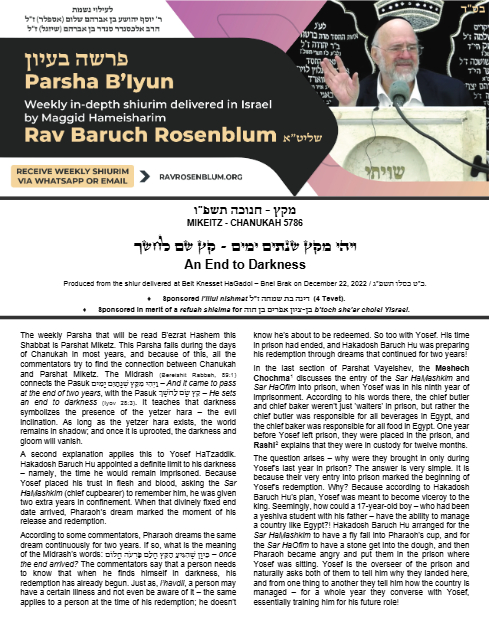
The weekly Parsha that will be read B'ezrat Hashem this Shabbat is Parshat Miketz. This Parsha falls during the days of Chanukah in most years, and because of this, all the commentators try to find the connection between Chanukah and Parshat Miketz. The Midrash (Bereishit Rabbah, 89:1) connects the Pasuk וַיְהִי מִקֵּץ שְׁנָתַיִם יָמִים – And it came to pass at the end of two years, with the Pasuk קֵץ שָׂם לַחֹשֶךְ – He sets an end to darkness (Iyov 28:3). It teaches that darkness symbolizes the presence of the yetzer hara – the evil inclination. As long as the yetzer hara exists, the world remains in shadow; and once it is uprooted, the darkness and gloom will vanish.

A second explanation applies this to Yosef HaTzaddik. Hakadosh Baruch Hu appointed a definite limit to his darkness – namely, the time he would remain imprisoned. Because Yosef placed his trust in flesh and blood, asking the Sar HaMashkim (chief cupbearer) to remember him, he was given two extra years in confinement. When that divinely fixed end date arrived, Pharaoh’s dream marked the moment of his release and redemption.

According to some commentators, Pharaoh dreams the same dream continuously for two years. If so, what is the meaning of the Midrash's words: כֵּיוָן שֶׁהִגִּיעַ הַקֵּץ חָלַם פַּרְעֹה חֲלוֹם – once the end arrived? The commentators say that a person needs to know that when he finds himself in darkness, his redemption has already begun. Just as, l’havdil, a person may have a certain illness and not even be aware of it – the same applies to a person at the time of his redemption; he doesn't know he's about to be redeemed. So too with Yosef. His time in prison had ended, and Hakadosh Baruch Hu was preparing his redemption through dreams that continued for two years!

In the last section of Parshat Vayeishev, the Meshech Chochma discusses the entry of the Sar HaMashkim and Sar HaOfim into prison, when Yosef was in his ninth year of imprisonment. According to his words there, the chief butler and chief baker weren't just 'waiters' in prison, but rather the chief butler was responsible for all beverages in Egypt, and the chief baker was responsible for all food in Egypt. One year before Yosef left prison, they were placed in the prison, and Rashi explains that they were in custody for twelve months. The question arises – why were they brought in only during Yosef's last year in prison? The answer is very simple. It is because their very entry into prison marked the beginning of Yosef's redemption. Why? Because according to Hakadosh Baruch Hu's plan, Yosef was meant to become viceroy to the king. Seemingly, how could a 17-year-old boy – who had been a yeshiva student with his father – have the ability to manage a country like Egypt?! Hakadosh Baruch Hu arranged for the Sar HaMashkim to have a fly fall into Pharaoh's cup, and for the Sar HaOfim to have a stone get into the dough, and then Pharaoh became angry and put them in the prison where Yosef was sitting. Yosef is the overseer of the prison and naturally asks both of them to tell him why they landed here, and from one thing to another they tell him how the country is managed – for a whole year they converse with Yosef, essentially training him for his future role!

A Prisoner's Perspective

A friend who once sat in prison told me that when he arrived at prison, he received a 'number' – from that day on they no longer called him 'Shlomo' but '182821'. In the cell there were four prisoners in bunk beds with a toilet on the side of the room. He put his bag aside and started walking back and forth in the cell. After fifteen minutes of walking back and forth in the cell, one of the prisoners noticed him – "Ahh, new here?" "Yes..." "Climb onto your bed and sit quietly!" "Why, is it forbidden to walk around here?" "Listen, here even if you're standing, you're called sitting – so sit down!"

What is there to do in prison? If you observe Torah and Mitzvot, then you have shuls – you sit and learn all day. There are people who have already completed the entire Shas there! But what does a person do when Torah and Mitzvot are not part of their equation? He walks back and forth all the time. Yosef arrives and meets the chief baker and chief butler, and then naturally he begins to interrogate them: Who are you? What are you?... The Meshech Chochma says, imagine if the chief butler and chief baker had dreamed their dreams three days after entering prison; they would have introduced themselves to Yosef, then they would have told him their dreams – to the chief butler he gives a good interpretation and to the chief baker a bad interpretation – naturally, the chief butler wouldn't have looked at him anymore, and consequently, he wouldn't have 'trained' Yosef to become the future viceroy!

The Meshech Chochma writes, It appears that it was divinely ordained that he should spend days with the chief butler and baker, to learn royal tactics and all the workings of authority that a ruler should know. Therefore, they dreamed only three days before their release, for if they had dreamed earlier, then the chief baker would have been angry with Yosef and wouldn't have taught him the secrets of royalty and its customs.

This is what Chazal tell us. קֵץ שָׂם לַחֹשֶךְ – although Yosef entered prison, all this was to prepare him to become viceroy of Egypt! On the same principle, the Ibn Ezra writes in Parshat Shemot, why did Divine Providence arrange for Batya, Pharaoh's daughter, to draw Moshe from the Nile and raise him in Pharaoh's palace? Why not one of the many others around? So that he would learn royal manners!

Redemption Through Divine Intervention

The Satmar Rebbe comes and asks, why did Hakadosh Baruch Hu keep Yosef in prison for two additional years? The words of Chazal are well known (Bereishit Rabbah, 89:3): אַשְׁרֵי הַגֶּבֶר אֲשֶׁר שָׂם ה' מִבְטַחוֹ (תהלים מ, ה), זֶה יוֹסֵף. וְלֹא פָנָה אֶל רְהָבִים, עַל יְדֵי שֶׁאָמַר לְשַׂר הַמַּשְׁקִים (בראשית מ, יד): זְכַרְתַּנִּי וְהִזְכַּרְתַּנִּי, נִתוֹסַף לוֹ שְׁתֵּי שָׁנִים. "Happy is the man who makes the Lord his trust" – this refers to Yosef. "And does not turn to the proud," because he said to the chief butler: "Remember me and mention me," two years were added to him.

The Satmar Rebbe says that Hakadosh Baruch Hu did not want Yosef to leave prison through a gentile; if the Sar HaMashkim had left prison and said to Pharaoh, "Listen, there's a righteous young man sitting in prison without any wrongdoing – he deserves a pardon!"; if Pharaoh had responded to him, it would mean he left prison through the merit of a gentile. But Hakadosh Baruch Hu did not want Yosef's redemption to come through the Sar HaMashkim because we say every Shabbat in the Musaf Kedusha (Nusach Sefard): הֵן גָּאַלְתִּי אֶתְכֶם אַחֲרִית כְּרֵאשִׁית – Behold, I will redeem you in the end as in the beginning. The future redemption will be exactly like the first redemption; the one who will redeem us will be Hakadosh Baruch Hu in His glory and by Himself! – and so too with Yosef, Hakadosh Baruch Hu wanted to take him out of exile. But in practice, it was the Sar HaMashkim who brought him out, when he said to Pharaoh: אֶת חֲטָאַי אֲנִי מַזְכִּיר הַיּוֹם – I mention my sins today.

The Midrash states (Bereishit Rabbah, 89:7), when the Sar HaMashkim saw Pharaoh whose soul was about to depart – Pharaoh was in such a troubled state that if they didn't interpret his dream he would die! – he calculated in his mind and said: “If this Pharaoh dies and another king arises, I don't know if he will keep me in my position or not. I need to tell Pharaoh in order to keep my Volvo!” Therefore, he stepped forward and said: “I have two sins; one that I didn't do good for Yosef and mention him before you, and another that I saw you distressed about the interpretation of a dream, and I didn't tell you about the man who knows its interpretation.”

Hakadosh Baruch Hu said: "He's worried about his position – I don't care about that. What I care about is that Yosef should leave through his merit from prison – and to this I don't agree! I personally take care of him! When his time comes to leave, I will take him out!" Therefore, Pharaoh dreams for two years, and when the Sar HaMashkim came it was already when Pharaoh was about to die, and thus Yosef's redemption came from Hakadosh Baruch Hu and not from the Sar HaMashkim, because his entire desire was to save his position.

The Avodah of Chanukah: The Power of Sight

With that, let's address a point many connect to Chanukah. Chazal say that the main Avodah of Chanukah revolves around the eyes: אֵין לָנוּ רְשׁוּת לְהִשְׁתַּמֵּשׁ בָּהֶם אֶלָּא לִרְאוֹתָן בִּלְבַד – we have no permission to use them, only to see them. We have something in Chanukah that doesn't exist in any other holiday – someone who sees another person who lit Chanukah candles also makes a Bracha. If a person is in prison, chas v’shalom, and sees people lighting Chanukah candles opposite him – he makes a Bracha! We don't find such a thing in any other holiday; when it comes to Chanukah, seeing enables Bracha. Chazal say (Bereishit Rabbah, 2:4): רַבִּי שִׁמְעוֹן בֶּן לָקִישׁ פָּתַר קְרָיָא בַּגָּלוּת, וְהָאָרֶץ הָיְתָה תֹהוּ, זֶה גָּלוּת בָּבֶל, שֶׁנֶּאֱמַר: רָאִיתִי אֶת הָאָרֶץ וְהִנֵּה תֹהוּ. וָבֹהוּ, זֶה גָּלוּת מָדַי: וַיְבַהִלוּ לְהָבִיא אֶת הָמָן. וְחֹשֶךְ, זֶה גָּלוּת יָוָן, שֶׁהֶחֱשִׁיכָה עֵינֵיהֶם שֶׁל יִשְׂרָאֵל בִּגְזֵרוֹתֵיהֶן, שֶׁהָיְתָה אוֹמֶרֶת לָהֶם, כִּתְבוּ עַל קֶרֶן הַשּׁוֹר שֶׁאֵין לָכֶם חֵלֶק בֵּא-לֹהֵי יִשְׂרָאֵל.

Rabbi Shimon ben Lakish interpreted the verse regarding the exiles: "And the earth was formless" – this is the Babylonian exile, as it says: "I looked at the earth and behold it was formless." "And void" – this is the Persian exile: "And they hastened to bring Haman." "And darkness" – this is the Greek exile, which darkened the eyes of Israel with their decrees, as they would say to them: Write on the horn of an ox that you have no portion in the G-d of Israel.

And what was their entire purpose in the decree of "Write on the horn of an ox that you have no portion in the G-d of Israel"? The Megaleh Amukot says that their entire purpose was to act against Yosef HaTzaddik who is called שׁוֹר (ox), as it is written: בְּכוֹר שׁוֹרוֹ הָדָר לוֹ – His firstborn ox has majesty.

Yosef and the Three Decrees

If this is the case, we can learn something wonderful that Rav Aharon of Belz says. The three decrees that the Greeks decreed upon us were: Shabbat, Rosh Chodesh – sanctification of the month, and Brit Milah. Yosef HaTzaddik is the representation of these three decrees.

Shabbat corresponds to Yosef, as we learn from the Pasuk in our Parsha that Yosef brought his brothers to the house and directed that preparations be made – preparations that Chazal say were Erev Shabbat preparations, as Yosef observed Shabbat even before the Mitzvah was formally given.

Kiddush HaChodesh corresponds to Yosef, for in the future they will sanctify the month through sight, and regarding Yosef it says: בֵּן פֹּרָת יוֹסֵף בֵּן פֹּרָת עֲלֵי עָיִן – A fruitful son is Yosef, a fruitful son by the eye.

Brit Milah corresponds to Yosef, as the well-known saying of Chazal states: הָעַיִן רוֹאָה וְהַלֵּב חוֹמֵד וּכְלֵי הַמַּעֲשֶׂה גוֹמְרִים – The eye sees and the heart desires and the instruments of action complete. Yosef, who overcame his desires, is called the middah of yesod. The Gemara states (Zevachim 118a) that in the Mishkan of Shiloh it was permitted to eat Kodshim Kalim and Ma’aser Sheini offerings anywhere from which Shiloh could be seen by the eye. Why? Because Shiloh was in the portion of Yosef, and Yosef guarded his eyes.

Because Yosef guarded his eyes, it is understood why we recite a Bracha on the seeing (of candles lit) during Chanukah, for the Greeks wanted to fight against Mitzvot that depend on seeing, such as Shabbat where we have the lighting of Shabbat candles, and also Kiddush HaChodesh. Therefore, on Chanukah we have no permission to use the candles other than to see them alone – for the Avodah of Chanukah is found in the element of seeing.

The Symbolism of the Hand and the Number 13

During the days of Chanukah, we mention יָד (hand) five times in our special Tefillah (עַל הַנִּסִּים). What is the meaning of this? Rav Naftali Zvi Horowitz of Ropshitz writes, it is written in the Parsha: וַתֵּרֶב מַשְׂאַת בִּנְיָמִן מִמַּשְׂאֹת כֻּלָּם חָמֵשׁ יָדוֹתָם – And he increased Binyamin's portion from all their Parshiot five hands. "Five hands" refers to: מָסַרְתָּ גִבּוֹרִים בְּיַד חַלָּשִׁים וְרַבִּים בְּיַד מְעַטִּים וּטְמֵאִים בְּיַד טְהוֹרִים וְרְשָׁעִים בְּיַד צַדִּיקִים וְזֵדִים בְּיַד עוֹסְקֵי תּוֹרָתֶךָ. You delivered the mighty into the hands of the weak, and the many into the hands of the few, and the impure into the hands of the pure, and the wicked into the hands of the righteous, and the arrogant into the hands of those who occupy themselves with Your Torah.

And why specifically did Yosef increase Binyamin's portion from all their portions ‘five hands’? It is very simple. The miracle of Chanukah was in the Beit Hamikdash, which was in Binyamin's portion!

The sefer Asicha B'chukecha finds a connection to Chanukah in the Parsha from a very interesting Pasuk. When Yehuda convinces Yaakov Avinu to send Binyamin, the Torah says: וַיֹּאמֶר יְהוּדָה אֶל יִשְׂרָאֵל אָבִיו שִׁלְחָה הַנַּעַר אִתִּי וְנָקוּמָה וְנֵלֵכָה וְנִחְיֶה וְלֹא נָמוּת גַּם אֲנַחְנוּ גַּם אַתָּה גַּם טַפֵּנוּ. And Yehuda said to Yisrael his father: Send the lad with me, and we will arise and go, and we will live and not die, both we and you and our little ones.

From the words וְנֵלֵכָה וְנִחְיֶה – and we will go and we will live, the word 'חנו כה' emerges in consecutive letters (in reverse order). When I saw this I got very excited. Why? Because when I was in yeshiva, on Rosh Chodesh Tamuz the Mashgiach said, "Rabbotai! The name תמו'ז is an acronym for זְמַנֵּי תְּשׁוּבָה מִשָּׁמַיִם וּבָאִים – Times of Repentance are Approaching. After the shiur, I approached him and said: "Excuse me Rebbe, if you had asked me what the acronym of Tamuz is, I would have told you ת'דליק מַ'זְגָן וְ'זֶהוּ זֶ'ה – Turn on the air conditioner and that's It. The Mashgiach said to me: "Everyone finds acronyms for what they're thinking about" – and then he told me a story: In the Turkish market, the merchants would sit outside their shops and whoever needed their merchandise would go inside the shop and take it. Everyone who passed through the market would look at something different; the tailor would look at the suits, the shoemaker at the shoes, the hat seller at the hats, etc. The Mashgiach then said to me: "A tzaddik constantly thinks about one thing – Teshuvah! When will I merit to return in complete Teshuva!" Therefore, when Tamuz came up for him, specifically these acronyms came up.

The Ba’al HaTurim also found a connection between the Parsha and Chanukah. The Ba'al HaTurim writes – we find the words בְּקָנֶה אֶחָד (on one stalk) three times in the Mesorah: Two times here, in Pharaoh’s dreams, and the other time with regards to the Menorah: שְׁלֹשָׁה גְבִעִים מְשֻׁקָּדִים בְּקָנֶה הָאֶחָד כַּפְתֹּר וָפֶרַח וּשְׁלשָׁה גְבִעִים מְשֻׁקָּדִים בְּקָנֶה אֶחָד ... כַּפְתֹּר וָפֶרַח כֵּן לְשֵׁשֶׁת הַקָּנִים הַיֹּצְאִים מִן הַמְּנוֹרָה.

The Chatam Sofer draws a symbolic contrast between the two Pesukim using the word קָנֶה – stalk or tube. He explains that a person has two such tubes; one is the esophagus, which brings in food and expels waste – symbolizing Eisav, who lives for physical sustenance. The other is the windpipe, linked to the Menorah’s stem, through which one takes in and shares words of Torah – symbolizing Yaakov Avinu, whose voice brings holiness into the world.

Additional hints between the Parsha and Chanukah are brought by Chazal: The Shiltei Giborim notes that the phrase וּטְבֹחַ טֶבַח וְהָכֵן hints to Chanukah – as its letters spell the word and their gematria equals 44, alluding to the total number of Chanukah candles including the shamash. The Imrei Noam reveals an astonishing idea – that Yosef’s brothers arrived before him on the fifth night of Chanukah! Yosef imprisoned them for three days, so they were released on Zot Chanukah (the eight day of Chanukah) when he said: עֲשׂוּ וִחְיוּ זֹאת – Do this and live.

The Greeks and the Number 13

After these ideas, I would like to open up a new topic. We said that the Greeks acted against Yosef and against the number 13 – and why specifically 13? There are many answers to this. We have 13 principles of faith (י"ג עִיקְרֵי אֱמוּנָה), 13 covenants that were made regarding Brit Milah, the total number of letters of the Avot is 13, and so too the total letters of the Imahot; and the love of Knesset Yisrael for Hakadosh Baruch Hu is expressed in the number 13, while Knesset Yisrael is compared to a rose and שׁוֹשַׁנָּה has a gematria of 661, which in Gematria Ketana is 13.

Rabbotai, I want to ask a question – how many ribs does a person have? The Mishna states (Ohalot 1:8) it is eleven ribs. The Tiferet Yisrael says, eleven ribs emerge from the spine, and the twelfth rib is not counted, because it is included with the vertebra to which it is attached. So the Mishna counts 11 ribs, and in Tiferet Yisrael it's brought that there are actually 12. When Hakadosh Baruch Hu created man, He afterwards cast a deep sleep upon him – and what did He do with him? He took a rib from him, from which He created the woman. If we add to this the teaching of the Mishna and the words of the Tiferet Yisrael, it implies that Adam had 13 ribs! The Targum Yonatan states: וּנְסִיב חֲדָא מֵעִלְעוֹהִי הוּא עִלָעָה תְּלִיסְרִית – and He took one of his ribs, which was the thirteenth rib. Meaning, Hakadosh Baruch Hu removed the thirteenth rib from Adam and from it created the woman. Therefore, the woman's number is 13!

The Greeks sought not only to oppress the Jewish people physically or spiritually, but to defile the sanctity of the Jewish home itself, by forcing every bride to first be with the governor (hegmon) before her wedding. They aimed to spiritually damage the divine source from which woman was created. They wished to damage the thirteenth rib from which Hakadosh Baruch Hu created the woman!

We mentioned in our previous shiur the dispute regarding what we say in the piyyut Echad Mi Yodea on Pesach: שְׁלשָׁה עָשָׂר מִי יוֹדֵעַ? שְׁלשָׁה עָשָׂר אֲנִי יוֹדֵעַ: שְׁלשָׁה עָשָׂר מִדּוֹת שֶׁל רַחֲמִים. Who knows thirteen? I know thirteen: Thirteen attributes of compassion.

There's a dispute whether this refers to the 13 Attributes of Mercy (י"ג מִדּוֹת שֶׁל רַחֲמִים), or whether the number 13 refers to the 13 methods through which the Torah is expounded. The Arizal comes and says that during the days of Chanukah we recite each Bracha with 13 words, and therefore we recite לְהַדְלִיק נֵר חֲנֻכָּה and not נֵר שֶׁל חֲנֻכָּה, because Chanukah is based on the number 13 – corresponding to the 13 Attributes of Mercy, where each day we have kavanah for one name. The question is, where do we start. According to the approach of Rabbeinu Tam, we begin with ה' ה' אֵל רַחוּם וְחַנּוּן etc. where even the two instances of Hakadosh Baruch Hu’s name count toward the 13 Attributes of Mercy. Most poskim, however, disagree with this approach, and hold that the 13 Attributes begin with אֵל רַחוּם וְחַנּוּן.

The Symbolism of the Cup and Goblet

In the dream of the Sar HaMashkim, he dreams that he puts a cup into Pharaoh's hand: וְכוֹס פַּרְעֹה בְּיָדִי וָאֶקַּח אֶת־הָעֲנָבִים וָאֶשְׂחַט אֹתָם אֶל־כּוֹס פַּרְעֹה וָאֶתֵּן אֶת־הַכּוֹס עַל־כַּף פַּרְעֹה׃ Pharaoh’s cup was in my hand, and I took the grapes, pressed them into Pharaoh’s cup, and placed the cup in Pharaoh’s hand.

In contrast, Yosef did not use a cup (כּוֹס) but rather a goblet (גָּבִיעַ). The question arises – what is the difference between a goblet and a cup, and why did Yosef use a גָּבִיעַ while Pharaoh used a כּוֹס?

The Tzror Hamor writes, in Egyptian etiquette it was written that no one could drink from a silver goblet except the king and his viceroy. The author of the Akeidat Yitzchak explains that most of Yosef's drinking vessels were made of gold, and when he says וְאֶת־גְּבִיעִי גְּבִיעַ הַכֶּסֶף – And my cup the silver cup, he means that he was accustomed to drinking from silver for some reason, perhaps out of respect for his father.

The Ben Ish Chai offers the following explanation. He examined the Pasuk "and my cup, the silver cup," questioning why the language is doubled, and explained that if Yosef brought one of the cups and placed it in Binyamin's sack, then when it was found with him later, they could say, "This is ours; we brought it from the land of Canaan and it was placed here." Therefore, Yosef was clever to bring a cup made of segments – a large cup attached to a small cup. The drinking cup was the large upper one, while the small cup served only as decoration, with the two connected by rings. This is what Rashi meant when he wrote a long cup – it was a segmented cup that was necessarily long because it consisted of two parts attached to each other. Yosef commanded the man in charge of his house not to place the entire cup in Binyamin's sack, but rather to separate it from the second part beneath it and place only the upper part, from which one drinks. However, the small cup, which served as the base and foot for the large cup, would remain with him in his lap. The idea was that if they said, "This is ours, which we brought from the land of Canaan," he could ask them, "And where is the second part?!" When they saw that the part in his possession fit together perfectly and aligned with the part found in Binyamin’s sack, it would be proven that the cup found was taken from Yosef's house. Therefore, he said, "and my cup, the silver cup, you shall place," mentioning two cups. He adds, the upper cup, from which one drinks, was made of silver, while the lower cup, which served as the base, was made of gold. Therefore, he said, "and my cup," – i.e., the one he drinks from, which is the silver cup.

Based on these explanations, I found something wonderful in the sefer Hogei Sha’ashuot: At the moment Pharaoh appointed Yosef as king, what exactly did he say to him? He said: אַתָּה תִּהְיֶה עַל בֵּיתִי וְעַל פִּיךָ יִשַּׁק כָּל עַמִּי – You shall be over my house, and by your word shall all my people be ruled. In other words, "You shall rule over all of Egypt. You shall be the treasurer and sign the checks. You shall be both the Minister of Health and Minister of Economic Affairs; You shall receive the powers of a Chief of Staff within the Chief of Staff’s office. You shall rule over everything, except for one thing!" What was that one thing? "

PDF Preview