Chanukah A Luminous Time
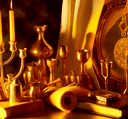
In the household of Reb Dovid of Tolna, hadlokas haneirois was a special event. His chassidim would gather excitedly in his house to take part in the lighting of his golden menora, which was an elaborate piece of artistic craftsmanship. One year, on the first night of Chanukah, when the tzaddik was ready to light it, he turned to one of his chassidim and said, “Your wife is short, isn’t she? When you want to speak to her, what do you do? Do you bend over towards her, or does she raise herself up to your height?” Without waiting for an answer, he recited the berachos and lit the menora. Needless to say, the chossid and all those present were very puzzled.
During this time, Reb Dovid’s great nephew, Reb Mordechai Dov of Hornisteipol, was staying at his home, and seeing the confusion of the chassidim, he explained: The Gemara says that “The Shechina does not descend lower than ten tefachim from the ground.” However, there is an exception to this rule, for the Chanuka menora is ideally required to be lower than ten tefachim, and it brings the Shechina itself here below. Reb Mordechai concluded by quoting from the AriZal that this is the deeper meaning of the words of the Gemara, ‘If your wife is short, you should bend over and whisper to her.’
The following evening, at the time of hadlokas haneiros, Reb Dovid again made some puzzling comment to one of his chassidim. Immediately, though he had not been told of the previous night’s explanation, he turned to Reb Mordechai and said, “This time, you will not understand as you did yesterday!”
(סיפורי חסידים זוין מועדים ע' 281)
In Haneiros Halalu we say that we have no permission to use the lights, only to look at them (“elo lir’oison bilvad”). This can mean that gazing at the lights is actually a benefit, healing any damage the eyes have incurred from seeing improper images, and protects one for the future. In fact many tzaddikim would sit and gaze at the licht as they burned.
(שו"ת שב יעקב סי' כב, זרע קודש – ראפשיץ)
After kindling the Chanukah licht, the Rebbe Rashab would sit near them for half an hour and learn, though at a slight distance, in order not to benefit from its light. He would learn Gemara, wherever he was holding in his learning of Shas.
The Rebbe explained that this practice highlights the special connection of Torah to light, and is a lesson for everyone – Chanukah is a time to increase one’s learning. Furthermore, since the Yevanim wished to prevent us from studying Torah, we respond by increasing our study.
(רשימות היומן ע' שכג, תו"מ תשמ"ב ח"ב ע' 618)
The Rebbe explained that Chanukah is an opportune time to increase one's Torah study and shemiras hamitzvos, since the nes was related to those ruchniyusdike matters. One should especially upgrade one's yiras Shomayim, for that is the purpose of Torah and mitzvos, and that was what the Yevanim were particularly opposed to.
This we can learn from the way in which we light an additional candle every night. During Chanukah, one should increase one's contributions to tzedaka and study more Torah than usual.
Through the mitzva of neirois Chanukah, one is granted the light of Torah.
(התוועדויות תשמ"ח ח"ב ע' 67, התוועדויות תשמ"ד ח"ב ע' 596)