Haftorah of the Week Meketz
Questions on the Sidra | December 14, 2023
Print This Article
View Original PDF

Haftorah of the Week Meketz

Questions on the Sidra | December 31, 2025

This week’s Haftorah is taken from the first Sefer Melochim, Chapter 3, verse 15 — Chapter 4, verse 1

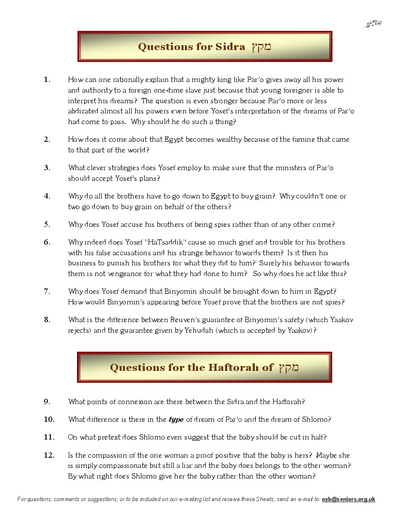
1. The connexion between the Sidra and the Haftorah is, in a word, “dreams.” That is, the first part of the Sidra is the account of the dream of Par’o (“Then Par’o awoke — and it was a dream!”) and the Haftorah opens with the same expression, “Then Shlomo awoke — and it was a dream!” A further connexion between the Sidra and the Haftorah is the divine wisdom that was granted to Yosef to interpret the dream of Par’o and govern the land of Egypt and in the Haftorah, the young King Shlomo is likewise blessed with divine inspiration to help him govern the Jewish People.

2. Our Chachommim tell us that there are various levels of prophecy and one of them is the prophetic dream. But prophetic dreams, too, consist of different components, so to speak. Within a prophetic dream there can be clear prophecy. That is, there will be a prediction of the future, clearly shown and quite normal, except that the event is going to happen in the future. Then there might be a prediction of the future but portrayed in an unreal picture. Being a dream, the vision that is shown might be of things happening that cannot happen in the real world. (Sheaves getting up and forming themselves into a circle and bowing down to one of their own in the middle of the circle; sun, stars and moon bowing down to somebody on earth.) In another kind of prophetic dream, the dreamer might be shown the reality of the spiritual world which is usually not visible in the physical world but is operating behind the scenes all the time nevertheless. (Angels going up and down the Heavenly Ladder in Yaakov’s dream; HaShem standing over Yaakov to protect him.) Sometimes a prophetic dream is in the form of a parable which needs the explanation of a Novvi. Sometimes symbols are shown to portray events or things. Sometimes the prophetic dream is a clear message, as with the dream of Par’o of this week’s Sidra, but it needs to be explained by someone with divine inspiration or prophecy who understands the dream indeed despite what the dreamer says he has seen (again, as with Par’o of this week’s Sidra). And sometimes HaShem uses a dream as a vehicle to warn, to inform, or to give instructions.

3. When King Dovid died, his son Shlomo succeeded him as king. He was only a young boy of twelve at the time, but he was righteous and G-d-fearing and of great noble character. In addition, he was endowed with intelligence way beyond his years and this, too, made him more prepared for the gift of prophecy. (HaShem does not make fools to be His spokesmen. If someone is naturally wise and he is worthy, HaShem might bless him with more wisdom and even with prophecy. But generally speaking, HaShem will not bestow prophecy upon social misfits nor on the physically or emotionally crippled. Our Chachommim tell us that prophecy rests only upon the wise, the well-adjusted and balanced individual, the socially secure and the physically well person.) For his part, Shlomo was determined to be everything that a Jewish king should be: a father and guide to all his people, a dispenser of true justice to all, a protector of the defenceless and a guide and example to all in how to serve HaShem and learn His Torah and observe His Mitzvos. This was King Shlomo’s only wish: to serve the people and help to elevate them to being the true People of G-d.

4. As soon as he became king, Shlomo made his way to Giv’on, where the great Mizbayach was, to offer up Korbonnos. While he was there, HaShem appeared to him in a dream and told him to choose what he wanted for his reign. Shlomo thanked HaShem for making him king and without hesitation asked that he be granted a wise and understanding heart so that he should be able to govern the people in justice and guide them in righteousness. HaShem was greatly pleased that Shlomo had asked for this rather than for long life, or for riches or for success over his enemies, and He said that he would grant him his wish — and as long as he kept the Torah and Mitzvos and followed in the ways of Dovid his father, the other things would be his, too. This prophetic message to Shlomo was so vivid that only when he awoke did he realize it was a dream. He understood that he had been shown a prophetic vision and he gave joyful thanks to HaShem for what He had promised him. His skill and wisdom in judging the people — even those of low social standing, for Shlomo genuinely cared for each person, whoever they were — was put to the test that very day.

5. Two women came before the king. One of them put their case. They shared a humble dwelling. Nobody else lived there. “I gave birth to a baby, a son, and three days later this other woman also gave birth to a baby son. But then she suffocated her baby in her sleep. When she realized what she had done, she took my baby while I was sleeping and placed her dead baby next to me and when I awoke in the morning to feed my baby, I saw straightaway that it was not my child and I realized what she had done!” The other woman counterclaimed and said, “Not so! My baby is the live one and yours is the dead one!” But the first woman said, “Not so! Your baby is the dead one and my son is the live one!”

6. The young king repeated their claims, to make sure that he had understood their words. It was indeed not possible to prove whose words were true. But, he reasoned aloud, in similar cases where there is doubt of ownership that cannot be proved or resolved, the law is that the two parties share the property equally. Because of lack of proof one way or the other, he said, let the same be done in this case. “Bring me a sharp sword!” One of the soldiers present offered his sword. Then the king commanded, “Cut the live child in half and each woman shall have an equal half of the child!”

7. At this, the woman whose child it was cried out. “No, my lord King, don’t! Let her have the child! Please don’t kill him!” But the other woman said stonily, “You heard what the King said! If that’s what the King commands, so be it! Neither you nor I shall have the child. Justice is justice! Go ahead! Do what His Majesty commands! Cut!”

8. Then King Shlomo said, “Give the child to the merciful woman. Of course you shall not kill it! It’s obvious that she is its mother!” And all the people saw the stark simplicity of the clever trick of the young king and how he was able to render true justice even in such a heartrending case. The other woman realized that she had given herself away and she tearfully owned up that her claim was false. And the Jewish people knew that they were fortunate indeed that HaShem had blessed them with such a wise king and that he was guided by divine wisdom.
This week’s Haftorah is taken from the first Sefer Melochim, Chapter 3, verse 15 — Chapter 4, verse 1

1. The connexion between the Sidra and the Haftorah is, in a word, “dreams.” That is, the first part of the Sidra is the account of the dream of Par’o (“Then Par’o awoke — and it was a dream!”) and the Haftorah opens with the same expression, “Then Shlomo awoke — and it was a dream!” A further connexion between the Sidra and the Haftorah is the divine wisdom that was granted to Yosef to interpret the dream of Par’o and govern the land of Egypt and in the Haftorah, the young King Shlomo is likewise blessed with divine inspiration to help him govern the Jewish People.

2. Our Chachommim tell us that there are various levels of prophecy and one of them is the prophetic dream. But prophetic dreams, too, consist of different components, so to speak. Within a prophetic dream there can be clear prophecy. That is, there will be a prediction of the future, clearly shown and quite normal, except that the event is going to happen in the future. Then there might be a prediction of the future but portrayed in an unreal picture. Being a dream, the vision that is shown might be of things happening that cannot happen in the real world. (Sheaves getting up and forming themselves into a circle and bowing down to one of their own in the middle of the circle; sun, stars and moon bowing down to somebody on earth.) In another kind of prophetic dream, the dreamer might be shown the reality of the spiritual world which is usually not visible in the physical world but is operating behind the scenes all the time nevertheless. (Angels going up and down the Heavenly Ladder in Yaakov’s dream; HaShem standing over Yaakov to protect him.) Sometimes a prophetic dream is in the form of a parable which needs the explanation of a Novvi. Sometimes symbols are shown to portray events or things. Sometimes the prophetic dream is a clear message, as with the dream of Par’o of this week’s Sidra, but it needs to be explained by someone with divine inspiration or prophecy who understands the dream indeed despite what the dreamer says he has seen (again, as with Par’o of this week’s Sidra). And sometimes HaShem uses a dream as a vehicle to warn, to inform, or to give instructions.

3. When King Dovid died, his son Shlomo succeeded him as king. He was only a young boy of twelve at the time, but he was righteous and G-d-fearing and of great noble character. In addition, he was endowed with intelligence way beyond his years and this, too, made him more prepared for the gift of prophecy. (HaShem does not make fools to be His spokesmen. If someone is naturally wise and he is worthy, HaShem might bless him with more wisdom and even with prophecy. But generally speaking, HaShem will not bestow prophecy upon social misfits nor on the physically or emotionally crippled. Our Chachommim tell us that prophecy rests only upon the wise, the well-adjusted and balanced individual, the socially secure and the physically well person.) For his part, Shlomo was determined to be everything that a Jewish king should be: a father and guide to all his people, a dispenser of true justice to all, a protector of the defenceless and a guide and example to all in how to serve HaShem and learn His Torah and observe His Mitzvos. This was King Shlomo’s only wish: to serve the people and help to elevate them to being the true People of G-d.

4. As soon as he became king, Shlomo made his way to Giv’on, where the great Mizbayach was, to offer up Korbonnos. While he was there, HaShem appeared to him in a dream and told him to choose what he wanted for his reign. Shlomo thanked HaShem for making him king and without hesitation asked that he be granted a wise and understanding heart so that he should be able to govern the people in justice and guide them in righteousness. HaShem was greatly pleased that Shlomo had asked for this rather than for long life, or for riches or for success over his enemies, and He said that he would grant him his wish — and as long as he kept the Torah and Mitzvos and followed in the ways of Dovid his father, the other things would be his, too. This prophetic message to Shlomo was so vivid that only when he awoke did he realize it was a dream. He understood that he had been shown a prophetic vision and he gave joyful thanks to HaShem for what He had promised him. His skill and wisdom in judging the people — even those of low social standing, for Shlomo genuinely cared for each person, whoever they were — was put to the test that very day.

5. Two women came before the king. One of them put their case. They shared a humble dwelling. Nobody else lived there. “I gave birth to a baby, a son, and three days later this other woman also gave birth to a baby son. But then she suffocated her baby in her sleep. When she realized what she had done, she took my baby while I was sleeping and placed her dead baby next to me and when I awoke in the morning to feed my baby, I saw straightaway that it was not my child and I realized what she had done!” The other woman counterclaimed and said, “Not so! My baby is the live one and yours is the dead one!” But the first woman said, “Not so! Your baby is the dead one and my son is the live one!”

6. The young king repeated their claims, to make sure that he had understood their words. It was indeed not possible to prove whose words were true. But, he reasoned aloud, in similar cases where there is doubt of ownership that cannot be proved or resolved, the law is that the two parties share the property equally. Because of lack of proof one way or the other, he said, let the same be done in this case. “Bring me a sharp sword!” One of the soldiers present offered his sword. Then the king commanded, “Cut the live child in half and each woman shall have an equal half of the child!”

7. At this, the woman whose child it was cried out. “No, my lord King, don’t! Let her have the child! Please don’t kill him!” But the other woman said stonily, “You heard what the King said! If that’s what the King commands, so be it! Neither you nor I shall have the child. Justice is justice! Go ahead! Do what His Majesty commands! Cut!”

8. Then King Shlomo said, “Give the child to the merciful woman. Of course you shall not kill it! It’s obvious that she is its mother!” And all the people saw the stark simplicity of the clever trick of the young king and how he was able to render true justice even in such a heartrending case. The other woman realized that she had given herself away and she tearfully owned up that her claim was false. And the Jewish people knew that they were fortunate indeed that HaShem had blessed them with such a wise king and that he was guided by divine wisdom.

PDF Preview

