Lessons from the Menorah
Lessons in Torah Or | December 17, 2025
Print This Article
View Original PDF

Lessons from the Menorah

Lessons in Torah Or | December 31, 2025

A lesson from Chanuka: We need to understand the following: Why did the Sages establish to commemorate the miracle of Chanuka through lighting the lamps of a Menorah? This is not how other miracles are commemorated:

On Pesach, when we celebrate the miracle of leaving Egypt, it is through “eating matzos” (Shemos 12:18), when we celebrate the miracle of Purim it is through “days of feasting and rejoicing” (Ester 9:22), these physical forms commemorating the miracle correspond to the fact that the exile which we were miraculously saved from was also a physical exile:

In Egypt we were physically enslaved with “mortar and bricks” (Shemos 1:14), in the time of Haman he sought physically “to destroy all the Jews on one day, and take their property as spoils” (Ester 3:13).

This is not the case with the story of Chanuka, when the Jewish People were still living on their own land and were not even exiled from their land, and were certainly not enslaved or threatened to physical destruction G-d forbid; rather the exile was a spiritual exile of the Torah, like we say in the additional prayers for Chanuka: “They wanted to cause us to forget Your Torah, and to cause us to transgress the precepts of Your Will.”

Therefore, the Sages established to commemorate this spiritual salvation through lighting lamps of a Menorah, based on what it says in the verse (Mishlei 6:23): “For a mitzvah is a lamp, the Torah is light, and the path of life is achieved through constructive criticism.”

We need to understand the meaning of this verse. In addition, we need to explain the meaning of the end of the verse that is written “and the path of life is achieved through constructive criticism”: which possible “path of life” could there be besides for the Torah and mitzvos mentioned earlier in the verse?

The idea is: The fact that the verse compares a mitzvah to a lamp and the Torah to light will be understood as follows:

We will bring an analogy for this from the following: A lamp or candle is referred to by the oil (or wax) that it burns, like our Sages refer to them as a “oil lamp” or a “wax candle”.

This is for the following reason: Even though the oil (or wax) itself doesn’t directly produce fire or light, in fact if fire falls into oil it becomes extinguished, nonetheless specifically from this oil is the flame of fire drawn forth which is held onto the wick through the small amount of oil that is drawn into the wick; we also see that the main source of the fire is the oil, since when the oil runs out the fire is automatically extinguished.

This is literally similar to the idea of a mitzvah: Even though it is the “Will of the King (Hashem)”, which is beyond any reason or knowledge, and it is not possible to grasp it at all, nonetheless specifically from it and through it there is drawn forth the Light of Wisdom of the Oral Torah, regarding which it says that “the Torah comes forth from Wisdom” (Zohar II 121a).

This Wisdom and understanding of the Oral Torah is only to understand and grasp the explanation and reason for the laws of the mitzvos, each Masechta (Tractate) explaining according to its topic (of which mitzvos to explain).

To summarize: Just like the main component of a lamp is specifically the oil, even the oil itself doesn’t directly produce fire or light, but the entire light and fire of the lamp is drawn forth from that oil through the wick. So too, even though the mitzvos themselves are not directly understandable, but the entire wisdom and knowledge of the Oral Torah derives from explaining how to fulfill the mitzvos properly, thus all the “spiritual” light and fire of the Gemara and other parts of the Oral Torah all derive essentially from the mitzvos themselves.

Service of Hashem During Prayer

To explain this concept further specifically in the service of Hashem during prayer:

It is written: “Every morning when he (the Cohen) will improve by lighting up the lamps of the Menorah he should burn the Ketores (incense), and when Ahraon will bring up the fire of the lamps of the Menorah in the afternoon he should again burn the Ketores.” (Shemos 30:7-8)

In the Beis Hamikdash the Menorah was lit twice, in the morning and in the afternoon. The time of lighting the Menorah corresponded to the time of performing a different service, the offering of the Ketores-Incense, which was also performed once in the morning and once in the afternoon.

We need to understand: Why is it that regarding lighting the Menorah in the morning it is written he will improve by lighting up the Menorah, whereas regarding the lighting the Menorah in the afternoon it is written he will bring up the fire of the lamps?

The Jewish People Compared to the Menorah

To explain this, we will describe the comparison of the Jewish People to the Menorah:

Now, the level of the inner dimension of Malchus of Atzilus, which is called “Knesses Yisrael-the Gathering of Yisrael” since it is the source of the souls of the Jewish People, is referred to as a “Menorah” in the prophecy of Zecharya (4:1-6), which is the Haftorah for Shabbos Chanuka.

Since the level which is the source of the Jewish souls is compared to the Menorah, we learn out that the entire Jewish People here below in this physical world are also compared to the Menorah.

The maamar will bring two examples of how the Jewish People are similar to the Menorah in the Beis Hamikdash:

  1. The Menorah was “one solid piece”, since the Jewish People are all collectively one single entity,
  2. The Menorah branched out into seven lamps, since, even though the Jewish People are divided up specifically into 600,000 general souls, and each of those 600,000 is further subdivided into 600,000 specific souls as mentioned in Tanya (chap. 37), nonetheless in more general terms the Jewish People are all included in the 70 souls of our ancestors who originally went down to Egypt, and these 70 souls can be further categorized in seven general categories referred to as “the seven lamps of the Menorah”.

Now that we established that the Jewish people are compared to the seven branches of the Menorah, we can go back to that analogy and learn out a lesson from the fact that Aharon was the one to light up these seven branches of the Menorah:

Now, Aharon who is referred to as “the escort of the queen”, it is this Aharon who is a Cohen that serves Hashem who is Exalted, and is one of the seven “Shepherds” of the Jewish People that nourish us spiritually and give over Hashem’s revelation into the Jewish People.

The term “escort of the queen” means that just like when a king and queen get married each has an escort that brings them to the marriage canopy (Chuppa), so too the Jewish People and Hashem have, as it were, “escorts” to enable them to come to together meaningfully. Moshe is called “the escort of the King” since he brings Hashem’s revelation down to us through the Torah, and Aharon is called “the escort of the queen”, since we -the Jewish People- are like Hashem’s “queen”, and Aharon enables us to go up spiritually towards Hashem through the service of prayer.

He nourishes us spiritually by causing the love of Hashem to shine in us with a fiery yearning to connect to Hashem so strong that we feel as though we could expire from the intensity of that love, this love goes up in our hearts like a flame that rises by itself after it is ignited, thereby fulfilling the mitzvah of loving Hashem that we accept when we say Shema every day.

He enables that this love that we strive for in Krias Shema should be experienced in absolute truth, and fixed in the heart of each and every Jew.

A person of his own accord -who is physical and involved in material matters- is not able to accomplish this if Hashem doesn’t help him, and this help is a love from Hashem from Above that draws the person towards Him, and this power comes to us through Aharon.

Part 2

This is the meaning of the two phrases 1- “he will bring up the fire of the lamps of the Menorah, and 2- “he will make better and light up the Menorah”:

Our Sages have said (Yoma 21b): “Even though there is a fire that descends from Heaven (onto the mizbei’ach (Altar) to consume the offering), it is still a mitzvah for a fire to be made (on the Mizbei’ach) from man-made effort.”

The deeper meaning of this is as follows:

The fire on the mizbei’ach that consumes the offerings is a metaphor for the love of Hashem in our heart that consumes the animal soul’s passions. Just like on the mizbei’ach there were two types of fire, a fire that came from Above, and a fire made by man, so too there are two types of fiery love of Hashem, one that is a gift from Above, and one that comes from man-made effort.

The fire that comes from man-made effort represents the love of Hashem that a person awakens in himself coming from a recognition of Hashem’s Kingship as it is found in the worlds, that Hashem is a great and awesome King over all worlds Above and below, and “the hosts of heaven bow to You” (Ezra 9:6), and “there are thousands and millions, and hundreds of millions of angels that stand before Hashem...” (Daniel 7:10), as it is explained in the Gemara and Zohar how many different types of worlds there are, which bring out Hashem’s greatness.

In a similar idea, we find that the Sages instituted to say “Blessed be the name of His Glorious Kingdom” after the first verse of Shema and before the next verse of “and you should love” Hashem, since, by contemplating on Hashem’s ‘glorious kingdom’ in the creation and supervision over millions of worlds and infinite creatures etc. a Jew will then be able to truly experience “and you should love” Hashem.

To explain: We say in the daily prayer of Baruch Sheamar: “He (Hashem) is the Only One, He is the Life of all worlds, He is the King; praised and glorified forever and ever is His Great Name, blessed are You Hashem, the King who is extolled with praises.”

The meaning of saying that Hashem is the “Only One” is higher than saying that Hashem is just plain “One”. Because the meaning of “One” is like our Sages say (Brachos 13b): “This means that He is One in the heavens and earth and the four directions.”

The word “One” is made up of three letters: א, ח, ד which represent that: Hashem is the One Master in the 8, referring to the 7 heavens and the 1 earth (which together add up to 8) and over 4 directions of north south east west. Thus, the word “One” represents how Hashem is the One Master over the heavens and earth.

For even all of the spiritual worlds Above (Heavens) have no significance to have any independent importance at all compared to Hashem, and “Before Him (Hashem) everything is like nothing, and compared to Hashem it is considered like literally non-existence.”
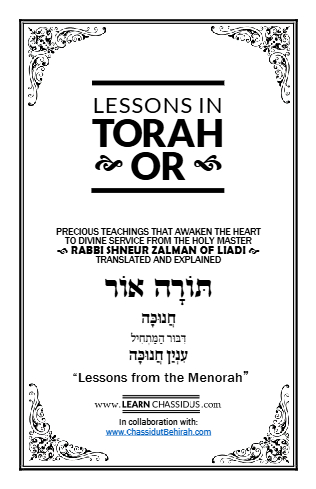
A lesson from Chanuka: We need to understand the following: Why did the Sages establish to commemorate the miracle of Chanuka through lighting the lamps of a Menorah? This is not how other miracles are commemorated:

On Pesach, when we celebrate the miracle of leaving Egypt, it is through “eating matzos” (Shemos 12:18), when we celebrate the miracle of Purim it is through “days of feasting and rejoicing” (Ester 9:22), these physical forms commemorating the miracle correspond to the fact that the exile which we were miraculously saved from was also a physical exile:

In Egypt we were physically enslaved with “mortar and bricks” (Shemos 1:14), in the time of Haman he sought physically “to destroy all the Jews on one day, and take their property as spoils” (Ester 3:13).

This is not the case with the story of Chanuka, when the Jewish People were still living on their own land and were not even exiled from their land, and were certainly not enslaved or threatened to physical destruction G-d forbid; rather the exile was a spiritual exile of the Torah, like we say in the additional prayers for Chanuka: “They wanted to cause us to forget Your Torah, and to cause us to transgress the precepts of Your Will.”

Therefore, the Sages established to commemorate this spiritual salvation through lighting lamps of a Menorah, based on what it says in the verse (Mishlei 6:23): “For a mitzvah is a lamp, the Torah is light, and the path of life is achieved through constructive criticism.”

We need to understand the meaning of this verse. In addition, we need to explain the meaning of the end of the verse that is written “and the path of life is achieved through constructive criticism”: which possible “path of life” could there be besides for the Torah and mitzvos mentioned earlier in the verse?

The idea is: The fact that the verse compares a mitzvah to a lamp and the Torah to light will be understood as follows:

We will bring an analogy for this from the following: A lamp or candle is referred to by the oil (or wax) that it burns, like our Sages refer to them as a “oil lamp” or a “wax candle”.

This is for the following reason: Even though the oil (or wax) itself doesn’t directly produce fire or light, in fact if fire falls into oil it becomes extinguished, nonetheless specifically from this oil is the flame of fire drawn forth which is held onto the wick through the small amount of oil that is drawn into the wick; we also see that the main source of the fire is the oil, since when the oil runs out the fire is automatically extinguished.

This is literally similar to the idea of a mitzvah: Even though it is the “Will of the King (Hashem)”, which is beyond any reason or knowledge, and it is not possible to grasp it at all, nonetheless specifically from it and through it there is drawn forth the Light of Wisdom of the Oral Torah, regarding which it says that “the Torah comes forth from Wisdom” (Zohar II 121a).

This Wisdom and understanding of the Oral Torah is only to understand and grasp the explanation and reason for the laws of the mitzvos, each Masechta (Tractate) explaining according to its topic (of which mitzvos to explain).

To summarize: Just like the main component of a lamp is specifically the oil, even the oil itself doesn’t directly produce fire or light, but the entire light and fire of the lamp is drawn forth from that oil through the wick. So too, even though the mitzvos themselves are not directly understandable, but the entire wisdom and knowledge of the Oral Torah derives from explaining how to fulfill the mitzvos properly, thus all the “spiritual” light and fire of the Gemara and other parts of the Oral Torah all derive essentially from the mitzvos themselves.

Service of Hashem During Prayer

To explain this concept further specifically in the service of Hashem during prayer:

It is written: “Every morning when he (the Cohen) will improve by lighting up the lamps of the Menorah he should burn the Ketores (incense), and when Ahraon will bring up the fire of the lamps of the Menorah in the afternoon he should again burn the Ketores.” (Shemos 30:7-8)

In the Beis Hamikdash the Menorah was lit twice, in the morning and in the afternoon. The time of lighting the Menorah corresponded to the time of performing a different service, the offering of the Ketores-Incense, which was also performed once in the morning and once in the afternoon.

We need to understand: Why is it that regarding lighting the Menorah in the morning it is written he will improve by lighting up the Menorah, whereas regarding the lighting the Menorah in the afternoon it is written he will bring up the fire of the lamps?

The Jewish People Compared to the Menorah

To explain this, we will describe the comparison of the Jewish People to the Menorah:

Now, the level of the inner dimension of Malchus of Atzilus, which is called “Knesses Yisrael-the Gathering of Yisrael” since it is the source of the souls of the Jewish People, is referred to as a “Menorah” in the prophecy of Zecharya (4:1-6), which is the Haftorah for Shabbos Chanuka.

Since the level which is the source of the Jewish souls is compared to the Menorah, we learn out that the entire Jewish People here below in this physical world are also compared to the Menorah.

The maamar will bring two examples of how the Jewish People are similar to the Menorah in the Beis Hamikdash:

  1. The Menorah was “one solid piece”, since the Jewish People are all collectively one single entity,
  2. The Menorah branched out into seven lamps, since, even though the Jewish People are divided up specifically into 600,000 general souls, and each of those 600,000 is further subdivided into 600,000 specific souls as mentioned in Tanya (chap. 37), nonetheless in more general terms the Jewish People are all included in the 70 souls of our ancestors who originally went down to Egypt, and these 70 souls can be further categorized in seven general categories referred to as “the seven lamps of the Menorah”.

Now that we established that the Jewish people are compared to the seven branches of the Menorah, we can go back to that analogy and learn out a lesson from the fact that Aharon was the one to light up these seven branches of the Menorah:

Now, Aharon who is referred to as “the escort of the queen”, it is this Aharon who is a Cohen that serves Hashem who is Exalted, and is one of the seven “Shepherds” of the Jewish People that nourish us spiritually and give over Hashem’s revelation into the Jewish People.

The term “escort of the queen” means that just like when a king and queen get married each has an escort that brings them to the marriage canopy (Chuppa), so too the Jewish People and Hashem have, as it were, “escorts” to enable them to come to together meaningfully. Moshe is called “the escort of the King” since he brings Hashem’s revelation down to us through the Torah, and Aharon is called “the escort of the queen”, since we -the Jewish People- are like Hashem’s “queen”, and Aharon enables us to go up spiritually towards Hashem through the service of prayer.

He nourishes us spiritually by causing the love of Hashem to shine in us with a fiery yearning to connect to Hashem so strong that we feel as though we could expire from the intensity of that love, this love goes up in our hearts like a flame that rises by itself after it is ignited, thereby fulfilling the mitzvah of loving Hashem that we accept when we say Shema every day.

He enables that this love that we strive for in Krias Shema should be experienced in absolute truth, and fixed in the heart of each and every Jew.

A person of his own accord -who is physical and involved in material matters- is not able to accomplish this if Hashem doesn’t help him, and this help is a love from Hashem from Above that draws the person towards Him, and this power comes to us through Aharon.

Part 2

This is the meaning of the two phrases 1- “he will bring up the fire of the lamps of the Menorah, and 2- “he will make better and light up the Menorah”:

Our Sages have said (Yoma 21b): “Even though there is a fire that descends from Heaven (onto the mizbei’ach (Altar) to consume the offering), it is still a mitzvah for a fire to be made (on the Mizbei’ach) from man-made effort.”

The deeper meaning of this is as follows:

The fire on the mizbei’ach that consumes the offerings is a metaphor for the love of Hashem in our heart that consumes the animal soul’s passions. Just like on the mizbei’ach there were two types of fire, a fire that came from Above, and a fire made by man, so too there are two types of fiery love of Hashem, one that is a gift from Above, and one that comes from man-made effort.

The fire that comes from man-made effort represents the love of Hashem that a person awakens in himself coming from a recognition of Hashem’s Kingship as it is found in the worlds, that Hashem is a great and awesome King over all worlds Above and below, and “the hosts of heaven bow to You” (Ezra 9:6), and “there are thousands and millions, and hundreds of millions of angels that stand before Hashem...” (Daniel 7:10), as it is explained in the Gemara and Zohar how many different types of worlds there are, which bring out Hashem’s greatness.

In a similar idea, we find that the Sages instituted to say “Blessed be the name of His Glorious Kingdom” after the first verse of Shema and before the next verse of “and you should love” Hashem, since, by contemplating on Hashem’s ‘glorious kingdom’ in the creation and supervision over millions of worlds and infinite creatures etc. a Jew will then be able to truly experience “and you should love” Hashem.

To explain: We say in the daily prayer of Baruch Sheamar: “He (Hashem) is the Only One, He is the Life of all worlds, He is the King; praised and glorified forever and ever is His Great Name, blessed are You Hashem, the King who is extolled with praises.”

The meaning of saying that Hashem is the “Only One” is higher than saying that Hashem is just plain “One”. Because the meaning of “One” is like our Sages say (Brachos 13b): “This means that He is One in the heavens and earth and the four directions.”

The word “One” is made up of three letters: א, ח, ד which represent that: Hashem is the One Master in the 8, referring to the 7 heavens and the 1 earth (which together add up to 8) and over 4 directions of north south east west. Thus, the word “One” represents how Hashem is the One Master over the heavens and earth.

For even all of the spiritual worlds Above (Heavens) have no significance to have any independent importance at all compared to Hashem, and “Before Him (Hashem) everything is like nothing, and compared to Hashem it is considered like literally non-existence.”

PDF Preview