May A Jewish Employee Attend the December Office Party in the Local Non Jewish Steak House
Limuday Moshe | December 26, 2024
Print This Article
View Original PDF

May A Jewish Employee Attend the December Office Party in the Local Non Jewish Steak House

Limuday Moshe | June 27, 2025

In this week’s parsha we continue to learn about the story of Yosef HaTzadik. In last week’s parsha we learnt that one of the things that sparked the brother’s hatred towards Yosef was that he spoke badly about them. One of the things that he told Yaakov was that they were eating eiver min hachai [limbs from a live animal]. We mentioned last week that this is extremely difficult, as surely the shevotim kept the Torah and would never have eaten eiver min hachai, and if they didn’t, then why would Yosef lie? We mentioned the Shlah who explains that the shevotim were eating an animal which they created with Sefer Yetzirah, and such animals don’t require shechitah [slaughtering]. Yosef, however, didn’t know this, therefore, he thought they were eating eiver min hachai. We see from here how careful one must be with how he conducts himself, as people can watch and easily jump to conclusions which may end up with dire consequences.

This week I would like to briefly discuss a topic related to this. It is very common this time of year, for businesses to arrange a get together with all their employees in a local steak house to celebrate the non-Jewish holiday. If a Yid works in such a company, is he allowed to attend (obviously making sure to only eat kosher food)? Or does one have to be worried that people may watch and jump to wrong conclusions, like what happened with Yosef HaTzadik and his brothers.

Igros Moshe

In Igros Moshe (Orach Chaim, 2:40), Rav Moshe Feinstein discusses whether it is permitted to eat in a restaurant that prepares only dairy foods but is owned by mechalelei Shabbos [Shabbos transgressors]. He explains that even there, various issurim may arise, such as the possibility of non-kosher fish, oil used for frying that may come from non-kosher animals, forbidden cheeses, or concerns of bishul akum. Therefore, even entering such a place to eat food that is certainly kosher is forbidden due to maris ayin and chashad. However, if one is in great distress from hunger and there is no other place to eat, he may enter and eat only food that is definitely kosher, provided this is done discreetly. This is based on the principle that in cases of great distress or loss (b’makom tzar or b’makom pseidah), Chazal did not apply their prohibitions, as we see from Kesubos 60a.

In practice, R’ Moshe writes that this means that there should not be people outside the restaurant who will recognize him, since those inside the restaurant, seeing that he takes only kosher food, will not suspect him of anything. If someone from the outside does recognize him, he must explain that he was in great distress and therefore entered to eat something kosher. However, if he is not in great distress, it is completely forbidden to enter such a place.

Emes L’Yaakov

On the opposing side, R’ Yaakov Kamenetsky zt”l held differently. In Emes L’Yaakov (Choshen Mishpat 425, note 27), he writes that if one needs to schedule a meeting in a non-kosher restaurant, there is no prohibition of maris ayin, because it is possible that he is entering such a restaurant to eat or drink kosher food or beverages, or to use the facilities. If someone is going to judge him l’kaf chovah [unfavorably]that is not his concern. On the contrary, he writes that if one is seated there and refrains from eating, it may even be considered a kiddush Hashem.

Nonetheless, most poskim follow the view of the Igros Moshe and do not rely on the lenient opinion of R’ Yaakov, even if it is only a question of a maris ayin on an issur d’rabanan (e.g., in a case where people will suspect him of violating the issur d’rabanan of bishul akum).

Therefore, where a holiday party is held in a non-kosher restaurant, one should not attend, even if there is a concern for eivah [animosity], because of maris ayin and the potential for chilul Hashem.

What If the Party Is in A Hotel?

However, in cases where the party is held in a hotel or similar location, there is no issue in attending, since there are multiple reasons a person might enter a hotel, and it does not necessarily imply he is eating forbidden foods. This was also the ruling of R’ Dovid Feinstein zt”l. He also ruled that if the party is held in the office, even if non-kosher food is served there, there is no concern for maris ayin for him to remain in his workplace and he is not obligated to leave. However, there is a halachah that one is not supposed to drink alcoholic beverages together with non-Jews (see Yoreh Deah 114:1), therefore, one should be careful not to do drink together with them.

(Based on a Teshuvah from R’ Yaakov Skoczylas shlita)

What to do about drinking alcoholic beverages is not so simple and there may be some heterim, especially if one brings his own beverage and not joining in may lead to eivah. Perhaps we will revisit this topic and discuss this at more length in the near future.
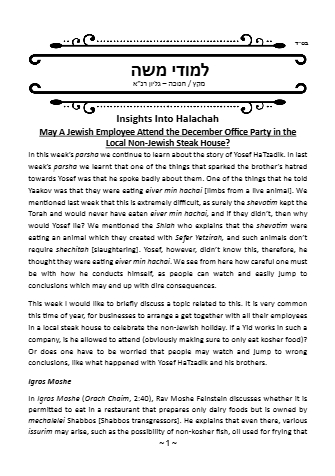

In this week’s parsha we continue to learn about the story of Yosef HaTzadik. In last week’s parsha we learnt that one of the things that sparked the brother’s hatred towards Yosef was that he spoke badly about them. One of the things that he told Yaakov was that they were eating eiver min hachai [limbs from a live animal]. We mentioned last week that this is extremely difficult, as surely the shevotim kept the Torah and would never have eaten eiver min hachai, and if they didn’t, then why would Yosef lie? We mentioned the Shlah who explains that the shevotim were eating an animal which they created with Sefer Yetzirah, and such animals don’t require shechitah [slaughtering]. Yosef, however, didn’t know this, therefore, he thought they were eating eiver min hachai. We see from here how careful one must be with how he conducts himself, as people can watch and easily jump to conclusions which may end up with dire consequences.

This week I would like to briefly discuss a topic related to this. It is very common this time of year, for businesses to arrange a get together with all their employees in a local steak house to celebrate the non-Jewish holiday. If a Yid works in such a company, is he allowed to attend (obviously making sure to only eat kosher food)? Or does one have to be worried that people may watch and jump to wrong conclusions, like what happened with Yosef HaTzadik and his brothers.

Igros Moshe

In Igros Moshe (Orach Chaim, 2:40), Rav Moshe Feinstein discusses whether it is permitted to eat in a restaurant that prepares only dairy foods but is owned by mechalelei Shabbos [Shabbos transgressors]. He explains that even there, various issurim may arise, such as the possibility of non-kosher fish, oil used for frying that may come from non-kosher animals, forbidden cheeses, or concerns of bishul akum. Therefore, even entering such a place to eat food that is certainly kosher is forbidden due to maris ayin and chashad. However, if one is in great distress from hunger and there is no other place to eat, he may enter and eat only food that is definitely kosher, provided this is done discreetly. This is based on the principle that in cases of great distress or loss (b’makom tzar or b’makom pseidah), Chazal did not apply their prohibitions, as we see from Kesubos 60a.

In practice, R’ Moshe writes that this means that there should not be people outside the restaurant who will recognize him, since those inside the restaurant, seeing that he takes only kosher food, will not suspect him of anything. If someone from the outside does recognize him, he must explain that he was in great distress and therefore entered to eat something kosher. However, if he is not in great distress, it is completely forbidden to enter such a place.

Emes L’Yaakov

On the opposing side, R’ Yaakov Kamenetsky zt”l held differently. In Emes L’Yaakov (Choshen Mishpat 425, note 27), he writes that if one needs to schedule a meeting in a non-kosher restaurant, there is no prohibition of maris ayin, because it is possible that he is entering such a restaurant to eat or drink kosher food or beverages, or to use the facilities. If someone is going to judge him l’kaf chovah [unfavorably]that is not his concern. On the contrary, he writes that if one is seated there and refrains from eating, it may even be considered a kiddush Hashem.

Nonetheless, most poskim follow the view of the Igros Moshe and do not rely on the lenient opinion of R’ Yaakov, even if it is only a question of a maris ayin on an issur d’rabanan (e.g., in a case where people will suspect him of violating the issur d’rabanan of bishul akum).

Therefore, where a holiday party is held in a non-kosher restaurant, one should not attend, even if there is a concern for eivah [animosity], because of maris ayin and the potential for chilul Hashem.

What If the Party Is in A Hotel?

However, in cases where the party is held in a hotel or similar location, there is no issue in attending, since there are multiple reasons a person might enter a hotel, and it does not necessarily imply he is eating forbidden foods. This was also the ruling of R’ Dovid Feinstein zt”l. He also ruled that if the party is held in the office, even if non-kosher food is served there, there is no concern for maris ayin for him to remain in his workplace and he is not obligated to leave. However, there is a halachah that one is not supposed to drink alcoholic beverages together with non-Jews (see Yoreh Deah 114:1), therefore, one should be careful not to do drink together with them.

(Based on a Teshuvah from R’ Yaakov Skoczylas shlita)

What to do about drinking alcoholic beverages is not so simple and there may be some heterim, especially if one brings his own beverage and not joining in may lead to eivah. Perhaps we will revisit this topic and discuss this at more length in the near future.

PDF Preview