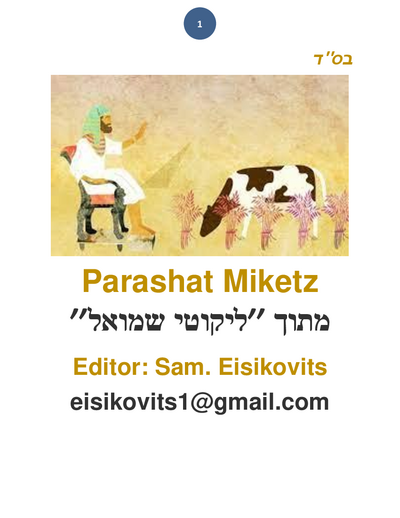
Parashat Miketz
From the very first moment they set foot on Egyptian soil, the sons of Jacob were supposed to suspect that something was wrong. It began with their puzzling summons to appear before the viceroy accusing them of espionage. Next, all the brothers except Simon are released, a merciful behavior uncharacteristic of tyrants in the ancient world. Later, the brothers discover that their money has been returned to them only to be reassured by the government representative that: “; Your God and the God of your ancestors gave you a treasure in your possession.”; Meanwhile, the brothers meet with Shimon and learn about the comfortable conditions in which he was held – again, contrary to the nature of the serious suspicions against them.
Later, the Viceroy invites them to a meal in his house and makes sure that they notice that the meat has been duly slaughtered and that the gid hanashe, the tendon which is forbidden to eat, has been properly separated. The viceroy also shows a compassionate interest in their elderly fathers situation, in contrast to the Egyptians generally hostility to the Hebrews. The feast only increases the question marks surrounding the strange viceroy. The brothers discover that Gods name is on his tongue; He seats them around the table according to their correct age; And he displays detailed knowledge of what was going on in Jacobs house.
How does Tzafnat all this information? What is the meaning of his unusual behavior? For each of these questions, a specific solution can be proposed. The Viceroy attributed his vast knowledge to the magical powers of his goblet, and Egypt is known after all for its magic and spells. As for the suspicion of espionage, that can be attributed to the traditional hostility of the Egyptians towards the Hebrews. Placing the money in their possession can be seen as a ruse designed to buy their hearts and make them give away their true intentions.
The thing is however that the mystery actually had an easy and simple solution. The brothers knew that Joseph was sold into slavery in Egypt 22 years earlier, and no one knows what happened to him since then (according to the Midrash, one of their goals in their descent to Egypt was to find out exactly this point). What could be simpler than adding one to one and coming to the reasonable conclusion that the man in front of them – despite his beard and royal jewels – is their prodigal brother, or at least someone who has a close acquaintance with their brother? And yet, at the moment of truth, when Joseph reveals himself to his brothers, they react with utter astonishment and disbelief. The Midrash emphasis this point by describing that when Joseph decided to reveal himself, he first exclaimed, Joseph! Joseph! and the brothers looked everywhere, never imagining that Joseph was the man in front of them.
It seems, therefore, that despite the preliminary signs, the possibility that the viceroy was Joseph did not occur to them at all. They were willing to accept various and strange solutions as to the nature of the man, yet not think of the obvious solution.
**
The wisest of all men says: A mans folly will pervert his ways, and his heart will frown upon the Lord; (Proverbs 19:3). The Gemara relates that the young son of the sage Rish Lakish found that this verse is hinted in the Torah in the behavior Josefs’ brothers (Taanit 9). The brothers were convinced that Joseph’s dreams were a lie and reflected his dangerous desire to gain control over them. On this basis they sentenced him to death. Rabbi Ovadia Sforno explains that at first, they made him a crook and an evil man (ויתנכלו אותו) and only after that could they issue such a severe sentence against him. The actions taken by the brothers were based on the conception that they were forced to do difficult and painful things in order to save the house of Jacob from an even graver danger.
To recognize that the viceroy who sits on the throne and holds their fate in their hands is none other than Joseph is to understand that his dreams were true and that the brothers made a terrible mistake in their treatment of him. It meant that there was no justification for the harsh measures they had taken, and that the terrible grief they inflicted on their father was for nothing. The identity of the viceroy was transparent to every observer. The writing was on the wall. But the price of admitting the mistake was so high that the brothers were willing to cling to any alternative explanation, however tenuous, as long as they did not have to look directly at the bitter truth. Regarding the fool, King Solomon says: “Crush a fool [אוויל] in a mortar with a pestle along with crushed grain, yet his folly will not depart from him (Proverbs 27:22). The sages explain the word;אווילfrom the root of maybe; [אולי]. The blows of the pestle that hit him are blamed on the fact that they may be aimed at the grain, not at him. As long as there is an alternative explanation that allows him to stay in his comfort zone, he will avoid changing his assumptions.
The mind is a powerful tool given to us by the Creator, but it can also paint a picture of reality that is convenient for us. Only through humility, honesty and Torah guidance can we read the map correctly and adhere to the truth.