Parshat Miketz Accepting the Blame
Ben Chamesh L'Mikra | December 10, 2023
Print This Article
View Original PDF

Parshat Miketz Accepting the Blame

Ben Chamesh L'Mikra | December 31, 2025

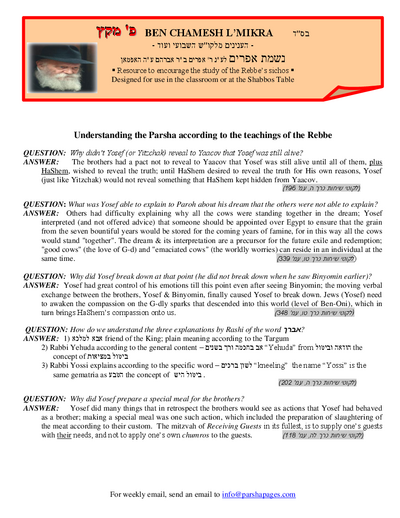
When Yosef’s brothers arrive in Egypt to buy provisions during the hunger, Yosef makes things difficult for them and challenges his brothers as being spies. The brothers realize that these troubles are a G-d-given punishment for their misdeeds in selling him. Upon hearing their remorse, Reuven further rebukes them. This Sicha gives a deeper understanding to Reuven’s harsh words, and reveals the tremendous power of true repentance.

This week’s parsha continues with the saga of Yosef and his brothers. Yosef has now become the viceroy to Pharaoh in Egypt. A hunger breaks out in the surrounding lands, including the land of Israel, and Yosef’s brothers go down to Egypt to buy food. When they arrive, Yosef recognizes his brothers and accuses them of being spies. They defend their position by explaining that they are not spies, but siblings who have come to buy food and look for their brother.

In order to prove their innocence, Yosef demands that they bring their youngest brother Binyamin to Egypt. Furthermore, he insists that one of the brothers, Shimon, remains in prison in Egypt, to ensure their return with their youngest sibling. The brothers realize that the troubles that have befallen them must be a punishment from G-d, as a result of their ill-treatment toward Yosef.

Text 1

And they said to one another, "Indeed, we are guilty for our brother, that we witnessed the distress of his soul when he begged us, and we did not listen. That is why this trouble has come upon us."
Bereishis 42:21

The brothers concluded that their current predicament was due to their hard-heartedness toward Yosef. He had begged them to be merciful towards him and they did not heed his cries. When Reuven, who was not directly involved with the selling of Yosef, heard his brothers admitting to their wrongdoings, he added to their guilt and reprimanded them for the way that they had dealt with him. He told them that not only were they wrong for being callous against Yosef, but that the decision to sell him was wrong as well.

Text 2

And Reuven answered them, saying, "Didn't I tell you, saying, ‘Don’t sin against the lad,' but you did not listen. And his blood as well—behold!—is being demanded."
Bereishis 42:22

Reuven added salt to their wound by attaching a further reason for their guilt: “And his blood as well—behold!—is being demanded,” alluding to the additional transgression of selling Yosef. Curiously, instead of consoling them at the moment of their remorse, Reuven elected to rebuke his brothers even more sternly for the injustices that they had committed.

Possible explanation

To properly understand the conversation between Reuven and his brothers, we must examine the meaning of his brothers’ words, and attempt to understand the intent of their terse exchange. The brothers had said, “Indeed, we are guilty...that is why this trouble has come upon us.” Reuven then responded, “Do not sin against the lad.” Each of them were making a point as to the way that one should act when he is faced with distress.

The brothers articulated, that when faced with troubles, a person should realize that all G-d does has a reason. If a person is faced with adversities, it is justified by a wrongdoing that they had committed, as the pain serves to cleanse them of their sin. Reuven, however, was imparting to them that it was not enough to exclaim that G-d was justified for the way that he was conducting their lives, but they must repent for their actions as well.

Justice and repentance

In the brothers’ exclamation, “Indeed, we are guilty...that is why this trouble has come upon us,” they expressed a justification of G-d’s actions towards them. They realized that all that was happening in Egypt was not by chance, and that they were deserving of all the hardships that they were presently facing, because of the hard-heartedness that they had shown towards Yosef. They were essentially expressing the same trait of G-d’s justness that is expressed by Moshe Rabeinu, when he praises the Almighty in the song of Haazinu:

Text 3

The deeds of the [Mighty] Rock are perfect, for all His ways are just; a faithful G-d, without injustice, He is righteous and upright.
Devarim 32:4

The Almighty is perfect and just, faithful, righteous and upright. When a person is faced with hardships, it is not by chance, but as a result of an injustice that they themselves committed. The brothers attested to this justness of G-d, and realized that their actions had warranted this consequence. Reuven’s perspective however, was that though it was proper that the brothers had voiced this recognition, and had accepted the punishment, they had only achieved the first step. He believed that recognizing that G-d’s actions were just was not enough. He therefore encouraged them not to be satisfied with this admittance, but to repent as well. His words, “Didn't I tell you, saying, 'Do not sin against the lad,'” were therefore not meant to

add insult to injury, but on the contrary, his intention was to help his brothers do complete. Reuven communicated that the hardships a person receives is not just retribution from G-d for a misdeed that he has made, but it should serve as a wakeup call to repent as well. This idea is aptly expressed by Rambam. He explains, that when troubles happen to a person, he should recognize that they are 1) a result of the person’s own actions, and 2) that they serve as a call to remind a person to repent for his ways:

Text 4

This practice is one of the paths of repentance; for when a trouble arises, and the people cry out [to G-d] and sound the trumpets, everyone will realize that [the trouble] occurred because of their evil conduct, as [Yirmiyahu, 5:25] states: "Your sins have turned away [the rains and the harvest climate]." This [realization] will cause the removal of this trouble from upon them.
Rambam, Laws of Fasts 1:2

Ultimately, it is not good enough to realize that the troubles are a punishment from G-d, but a person must realize that he must repent as well. It is the teshuvah that will bring about the removal of the troubles from the person’s midst. This is what Reuven was telling his brothers—that in order to take away these hardships, they must atone for the way they had acted towards Yosef. Once Reuven was inspiring his brothers to properly repent for their sins, he specified which actions these were, in order for their teshuvah to be a complete one. He therefore informed them that they needed to also be remorseful for the act of selling Yosef—not only for their lack of pity toward him.

The difficulty

There is, however, a difficulty with the above elucidation. According to what was explained regarding Reuven’s intention to help his brothers, there seem to be additional words in Reuven’s exchange, which don’t seem to fit with the tone of helping them repent. Reuven says, "Didn't I tell you, saying, 'Do not sin against the lad.'” He does not only inform them that they had sinned, but he adds as well, “didn’t I tell you.” This does not seem to teach his brothers anything. It merely appears to be a declaration that he had been right all along. It seems inconceivable, that at a time of shame for his brothers, Reuven would praise himself by contrasting his righteousness with theirs. Based on the above difficulty, it is clear that in Reuven’s words there must be another meaning, which sheds light on this seemingly harsh statement.

A path to repentance

It was explained previously that the brothers’ declaration, "Indeed, we are guilty for our brother,” was not a statement of repentance, but a declaration that G-d was just in the way that he punished them. It was further explained that Reuven’s statement, “Didn't I tell you, saying, 'Do not sin against the lad,'” was informing them that they must repent as well. It is plausible to explain however, that in fact, by the brothers’ above declaration, they were not only recognizing the Almighty’s just actions, but they were doing teshuvah as well. By the brothers’ utterance, “Indeed, we are guilty,” they were admitting guilt, and repenting for the way that they had acted.

These words do not only express that G-d is justified in punishing them, but it is primarily a declaration of their own faults, and was thus an act of repentance. Reuven, too, was educating them regarding the path to true repentance. Once he observed that they sincerely wished to repent, he wanted to guide them as to the proper method of doing so. In his statement, “Didn't I tell you, saying, 'Do not sin against the lad,' but you did not listen,” he was placing the blame on them. This too, was to teach them to properly repent. When a person accepts that it is their fault, they are truly ready to do teshuvah. For, as long as a person does not accept the fact that they are responsible for their actions, they have no reason to repent. In this light, Reuven was not accentuating their sin, or saying that he had been right all along, but on the contrary, he was merely helping them do teshuvah in a complete way, by showing them their blame.

Free choice

The idea that man has free choice to choose on his own volition, all his actions, and the concept of repentance, are intrinsically linked. In order for repentance to be possible, a person must have free choice over the actions that they choose to do. In the Laws of Teshuvah, Rambam inserts an explanation regarding the concept of free choice, as it relates to repentance. He states the following:

Text 5

Free will is granted to all men. If one desires to turn himself to the path of good and be righteous, the choice is his. Should he desire to turn to the path of evil and be wicked, the choice is his...Therefore, it is proper for a person to cry and mourn for his sins and for what he has done to his soul, the evil consequences, he brought upon it. This is implied by the following verse: "Of what should a living man be aggrieved? [A man of his sins.]" [The prophet] continues explaining, since free choice is in our hands and our own decision [is what prompts us to] commit all these wrongs, it is proper for us to repent and abandon our wickedness, for this choice is presently in our hand. This is implied by the following verse: "Let us search and examine our ways and return [to G-d].”
Rambam, Laws of Teshuvah 5:1-2

When Yosef’s brothers arrive in Egypt to buy provisions during the hunger, Yosef makes things difficult for them and challenges his brothers as being spies. The brothers realize that these troubles are a G-d-given punishment for their misdeeds in selling him. Upon hearing their remorse, Reuven further rebukes them. This Sicha gives a deeper understanding to Reuven’s harsh words, and reveals the tremendous power of true repentance.

This week’s parsha continues with the saga of Yosef and his brothers. Yosef has now become the viceroy to Pharaoh in Egypt. A hunger breaks out in the surrounding lands, including the land of Israel, and Yosef’s brothers go down to Egypt to buy food. When they arrive, Yosef recognizes his brothers and accuses them of being spies. They defend their position by explaining that they are not spies, but siblings who have come to buy food and look for their brother.

In order to prove their innocence, Yosef demands that they bring their youngest brother Binyamin to Egypt. Furthermore, he insists that one of the brothers, Shimon, remains in prison in Egypt, to ensure their return with their youngest sibling. The brothers realize that the troubles that have befallen them must be a punishment from G-d, as a result of their ill-treatment toward Yosef.

Text 1

And they said to one another, "Indeed, we are guilty for our brother, that we witnessed the distress of his soul when he begged us, and we did not listen. That is why this trouble has come upon us."
Bereishis 42:21

The brothers concluded that their current predicament was due to their hard-heartedness toward Yosef. He had begged them to be merciful towards him and they did not heed his cries. When Reuven, who was not directly involved with the selling of Yosef, heard his brothers admitting to their wrongdoings, he added to their guilt and reprimanded them for the way that they had dealt with him. He told them that not only were they wrong for being callous against Yosef, but that the decision to sell him was wrong as well.

Text 2

And Reuven answered them, saying, "Didn't I tell you, saying, ‘Don’t sin against the lad,' but you did not listen. And his blood as well—behold!—is being demanded."
Bereishis 42:22

Reuven added salt to their wound by attaching a further reason for their guilt: “And his blood as well—behold!—is being demanded,” alluding to the additional transgression of selling Yosef. Curiously, instead of consoling them at the moment of their remorse, Reuven elected to rebuke his brothers even more sternly for the injustices that they had committed.

Possible explanation

To properly understand the conversation between Reuven and his brothers, we must examine the meaning of his brothers’ words, and attempt to understand the intent of their terse exchange. The brothers had said, “Indeed, we are guilty...that is why this trouble has come upon us.” Reuven then responded, “Do not sin against the lad.” Each of them were making a point as to the way that one should act when he is faced with distress.

The brothers articulated, that when faced with troubles, a person should realize that all G-d does has a reason. If a person is faced with adversities, it is justified by a wrongdoing that they had committed, as the pain serves to cleanse them of their sin. Reuven, however, was imparting to them that it was not enough to exclaim that G-d was justified for the way that he was conducting their lives, but they must repent for their actions as well.

Justice and repentance

In the brothers’ exclamation, “Indeed, we are guilty...that is why this trouble has come upon us,” they expressed a justification of G-d’s actions towards them. They realized that all that was happening in Egypt was not by chance, and that they were deserving of all the hardships that they were presently facing, because of the hard-heartedness that they had shown towards Yosef. They were essentially expressing the same trait of G-d’s justness that is expressed by Moshe Rabeinu, when he praises the Almighty in the song of Haazinu:

Text 3

The deeds of the [Mighty] Rock are perfect, for all His ways are just; a faithful G-d, without injustice, He is righteous and upright.
Devarim 32:4

The Almighty is perfect and just, faithful, righteous and upright. When a person is faced with hardships, it is not by chance, but as a result of an injustice that they themselves committed. The brothers attested to this justness of G-d, and realized that their actions had warranted this consequence. Reuven’s perspective however, was that though it was proper that the brothers had voiced this recognition, and had accepted the punishment, they had only achieved the first step. He believed that recognizing that G-d’s actions were just was not enough. He therefore encouraged them not to be satisfied with this admittance, but to repent as well. His words, “Didn't I tell you, saying, 'Do not sin against the lad,'” were therefore not meant to

add insult to injury, but on the contrary, his intention was to help his brothers do complete. Reuven communicated that the hardships a person receives is not just retribution from G-d for a misdeed that he has made, but it should serve as a wakeup call to repent as well. This idea is aptly expressed by Rambam. He explains, that when troubles happen to a person, he should recognize that they are 1) a result of the person’s own actions, and 2) that they serve as a call to remind a person to repent for his ways:

Text 4

This practice is one of the paths of repentance; for when a trouble arises, and the people cry out [to G-d] and sound the trumpets, everyone will realize that [the trouble] occurred because of their evil conduct, as [Yirmiyahu, 5:25] states: "Your sins have turned away [the rains and the harvest climate]." This [realization] will cause the removal of this trouble from upon them.
Rambam, Laws of Fasts 1:2

Ultimately, it is not good enough to realize that the troubles are a punishment from G-d, but a person must realize that he must repent as well. It is the teshuvah that will bring about the removal of the troubles from the person’s midst. This is what Reuven was telling his brothers—that in order to take away these hardships, they must atone for the way they had acted towards Yosef. Once Reuven was inspiring his brothers to properly repent for their sins, he specified which actions these were, in order for their teshuvah to be a complete one. He therefore informed them that they needed to also be remorseful for the act of selling Yosef—not only for their lack of pity toward him.

The difficulty

There is, however, a difficulty with the above elucidation. According to what was explained regarding Reuven’s intention to help his brothers, there seem to be additional words in Reuven’s exchange, which don’t seem to fit with the tone of helping them repent. Reuven says, "Didn't I tell you, saying, 'Do not sin against the lad.'” He does not only inform them that they had sinned, but he adds as well, “didn’t I tell you.” This does not seem to teach his brothers anything. It merely appears to be a declaration that he had been right all along. It seems inconceivable, that at a time of shame for his brothers, Reuven would praise himself by contrasting his righteousness with theirs. Based on the above difficulty, it is clear that in Reuven’s words there must be another meaning, which sheds light on this seemingly harsh statement.

A path to repentance

It was explained previously that the brothers’ declaration, "Indeed, we are guilty for our brother,” was not a statement of repentance, but a declaration that G-d was just in the way that he punished them. It was further explained that Reuven’s statement, “Didn't I tell you, saying, 'Do not sin against the lad,'” was informing them that they must repent as well. It is plausible to explain however, that in fact, by the brothers’ above declaration, they were not only recognizing the Almighty’s just actions, but they were doing teshuvah as well. By the brothers’ utterance, “Indeed, we are guilty,” they were admitting guilt, and repenting for the way that they had acted.

These words do not only express that G-d is justified in punishing them, but it is primarily a declaration of their own faults, and was thus an act of repentance. Reuven, too, was educating them regarding the path to true repentance. Once he observed that they sincerely wished to repent, he wanted to guide them as to the proper method of doing so. In his statement, “Didn't I tell you, saying, 'Do not sin against the lad,' but you did not listen,” he was placing the blame on them. This too, was to teach them to properly repent. When a person accepts that it is their fault, they are truly ready to do teshuvah. For, as long as a person does not accept the fact that they are responsible for their actions, they have no reason to repent. In this light, Reuven was not accentuating their sin, or saying that he had been right all along, but on the contrary, he was merely helping them do teshuvah in a complete way, by showing them their blame.

Free choice

The idea that man has free choice to choose on his own volition, all his actions, and the concept of repentance, are intrinsically linked. In order for repentance to be possible, a person must have free choice over the actions that they choose to do. In the Laws of Teshuvah, Rambam inserts an explanation regarding the concept of free choice, as it relates to repentance. He states the following:

Text 5

Free will is granted to all men. If one desires to turn himself to the path of good and be righteous, the choice is his. Should he desire to turn to the path of evil and be wicked, the choice is his...Therefore, it is proper for a person to cry and mourn for his sins and for what he has done to his soul, the evil consequences, he brought upon it. This is implied by the following verse: "Of what should a living man be aggrieved? [A man of his sins.]" [The prophet] continues explaining, since free choice is in our hands and our own decision [is what prompts us to] commit all these wrongs, it is proper for us to repent and abandon our wickedness, for this choice is presently in our hand. This is implied by the following verse: "Let us search and examine our ways and return [to G-d].”
Rambam, Laws of Teshuvah 5:1-2

PDF Preview