Pharaoh’s Dreams and Perceptions
מגדל אור | December 13, 2023
Print This Article
View Original PDF

Pharaoh’s Dreams and Perceptions

מגדל אור | December 31, 2025

Thought of the week:
We seldom lose our faith by a blow out; usually it is just a slow leak.

“And behold, seven ears, thin and wind-blasted, sprouted after them.” (Beraishis 41:6)

Pharoah’s dreams, which are the focal point of the beginning of the parsha, were quite full of imagery. His impressions were just as much a part of the dreams as the details themselves. Here we find that after the seven good ears of corn grew on a single stalk, indicating years of peace and prosperity, with goodwill amongst people, seven withered ears of corn sprouted, though not on a single stalk.

The description of the ears as being blasted by the East wind seems odd, for the posuk tells us they grew this way. There was no wind to speak of, nor did any time elapse for the wind to harm otherwise good corn. Instead, it was as if it instantly sprouted this way, having already suffered the harm.

The Ramban and Tur address this and says that Pharaoh did not actually see the ears growing. Rather, they suddenly appeared, as if they sprouted from nowhere, indicating the speed with which the dreams would come to fruition. Therefore, though we do not hear of any wind or disease affecting ears that grew normally, we can understand that his impression of them were as though they had been through that.

With this description of Pharaoh’s impression, we can learn something about our perceptions. Sometimes we can see a situation as it is and imagine that it is completely new. We don’t consider that perhaps it was something that started some time in the past, and has proceeded through various stages to get to where it is now. Instead, we are completely surprised and caught off guard.

However, it wasn’t true that this sprung up suddenly. Rather, we were not aware of it before, or else we did not take notice of it. The warning signs or the damage could have been there the whole time but because it didn’t enter our field of vision, we are stymied by how it happened so quickly.

A lesson, perhaps, is that we ought to take time to look around and notice things. Maybe we have to work on noticing people, events, nuances, and almost imperceptible changes in the world around us that will one day have large consequences. Looking back at the results, we can see the damage that had been ongoing, but then it may be too late to do anything about it.

Yes, Pharaoh was self-centered and focused on the world in terms of how it affected him or served his needs. We ought to learn from his mistakes and think of the world in terms of how we affect it and serve the needs of others. In this way, we can be fruitful and good, promoting peace and prosperity on earth and beyond.
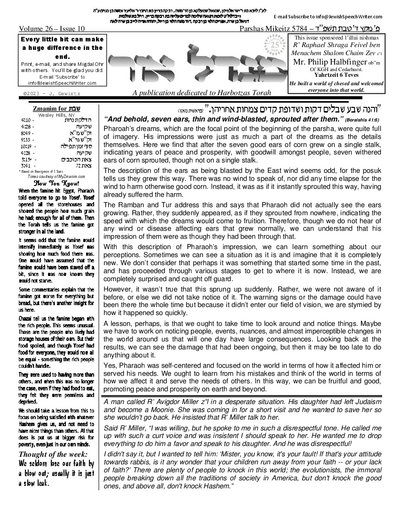

Thought of the week:
We seldom lose our faith by a blow out; usually it is just a slow leak.

“And behold, seven ears, thin and wind-blasted, sprouted after them.” (Beraishis 41:6)

Pharoah’s dreams, which are the focal point of the beginning of the parsha, were quite full of imagery. His impressions were just as much a part of the dreams as the details themselves. Here we find that after the seven good ears of corn grew on a single stalk, indicating years of peace and prosperity, with goodwill amongst people, seven withered ears of corn sprouted, though not on a single stalk.

The description of the ears as being blasted by the East wind seems odd, for the posuk tells us they grew this way. There was no wind to speak of, nor did any time elapse for the wind to harm otherwise good corn. Instead, it was as if it instantly sprouted this way, having already suffered the harm.

The Ramban and Tur address this and says that Pharaoh did not actually see the ears growing. Rather, they suddenly appeared, as if they sprouted from nowhere, indicating the speed with which the dreams would come to fruition. Therefore, though we do not hear of any wind or disease affecting ears that grew normally, we can understand that his impression of them were as though they had been through that.

With this description of Pharaoh’s impression, we can learn something about our perceptions. Sometimes we can see a situation as it is and imagine that it is completely new. We don’t consider that perhaps it was something that started some time in the past, and has proceeded through various stages to get to where it is now. Instead, we are completely surprised and caught off guard.

However, it wasn’t true that this sprung up suddenly. Rather, we were not aware of it before, or else we did not take notice of it. The warning signs or the damage could have been there the whole time but because it didn’t enter our field of vision, we are stymied by how it happened so quickly.

A lesson, perhaps, is that we ought to take time to look around and notice things. Maybe we have to work on noticing people, events, nuances, and almost imperceptible changes in the world around us that will one day have large consequences. Looking back at the results, we can see the damage that had been ongoing, but then it may be too late to do anything about it.

Yes, Pharaoh was self-centered and focused on the world in terms of how it affected him or served his needs. We ought to learn from his mistakes and think of the world in terms of how we affect it and serve the needs of others. In this way, we can be fruitful and good, promoting peace and prosperity on earth and beyond.

PDF Preview

