The Exceedingly Precious Mitzvah of Lighting Chanukah Candles
טיב הקהילה English | December 16, 2025
Print This Article
View Original PDF

The Exceedingly Precious Mitzvah of Lighting Chanukah Candles

טיב הקהילה English | December 31, 2025

He answers in his holy words: “It seems that the primary purpose of the miracle was to demonstrate Hashem’s love for Klal Yisrael. We find that such miracles were often performed, as noted in Avos (5:2), where it says that no disqualifying factors were ever found in the Omer offering or the Two Loaves [of the lechem hapanim], and so on. Similarly, this miracle was performed with the oil of the Menorah, which serves as testimony to Yisrael that the Shechinah dwells among them. In those days, a time of favor, this miracle was meant to show that they had returned to their original beloved status.”

Following the holy path of the Pnei Yehoshua, I suggested, with Hashem‘s help, an explanation for the words of our master the Rambam (Hilchos Chanukah 4:12): “The mitzvah of lighting Chanukah candles is exceedingly precious, and one must take great care to publicize the miracle, increasing in praise of Hashem and thanksgiving for the miracles He performed for us. Even if one has nothing to eat but from charity, he should borrow or sell his clothing to purchase oil and candles to light.”

We do not find such language of “exceedingly precious” regarding any other mitzvah throughout Rambam‘ s writings. Indeed, every word and letter in Rambam‘ s language is precise and invaluable. Even regarding the four cups of wine on Passover night—where the Rambam similarly learns the obligation for the poor, as explained by the Maggid Mishneh here—he does not use the term “precious mitzvah.” He simply rules plainly that a person should not have fewer than four cups (Hilchos Chametz U’Matzah 7:7). What, then, distinguishes the mitzvah of lighting Chanukah candles that Rambam calls it “exceedingly precious” more than other mitzvah?

Upon reflection, we can begin to understand. During all other Yamim Tovim, we are like the beloved son during his severe illness, when the father was compelled to save him from death. All the miracles and wonders performed on those occasions were, as it were, necessary to save Yisrael from destruction, transforming their fate from death to life and from slavery to redemption. Without those miracles, no remnant or survivor would have remained among the enemies of Yisrael, as in the exodus from Mitzrayim celebrated on Pesach, the downfall of Haman on Purim, and similar events.

Therefore, even though the mitzvos associated with other festivals undoubtedly foster great love between Yisrael and Hashem due to the miraculous efforts that Hashem undertook to save them— similar to the way a son‘s love for his father grows when he witnesses the father‘s tremendous care to rescue and heal him during illness—this still does not compare to the miracle of Chanukah. Chazal specifically established it to commemorate the miracle of the oil container, as concluded in the discussion of, “What is Chanukah?” (Shabbos 21b; Rashi).

The Pnei Yehoshua explains that the miracle of the oil was not one of necessity. There was no threat to life, no grave illness, but rather a minor inconvenience akin to a mere weakness. The miracle of the oil was not required to save Yisrael, nor was it needed for the service of the Menorah in the Beis Hamikdash, since impure oils could have sufficed due to the principle that “impurity (tumah) is permitted in communal offerings.” This situation is akin to the day the beloved son felt slightly weak, where there was no illness or danger but only minor fatigue. The Jewish people could have resolved the issue themselves, using the impure oils that the Greeks had defiled. Nevertheless, out of His immense love for Yisrael and to demonstrate their elevated status, akin to a father‘s extraordinary care for his son even on a day of minor weakness, Hashem performed this wondrous miracle, enabling them to light the Menorah with pure oil for eight days.

This perspective helps clarify Rambam‘s precise wording, where he describes the mitzvah of lighting Chanukah candles as “exceedingly precious.” The institution of Chanukah, which is based on the miracle of the oil container, signifies unparalleled affection, even more than other Yamim Tovim. It is comparable to the son‘s heightened love for his father on the day of minor weakness, surpassing even the gratitude felt for his father ‘s devoted care during a critical illness. This explanation aligns beautifully be’ezras Hashem Yisbarach.
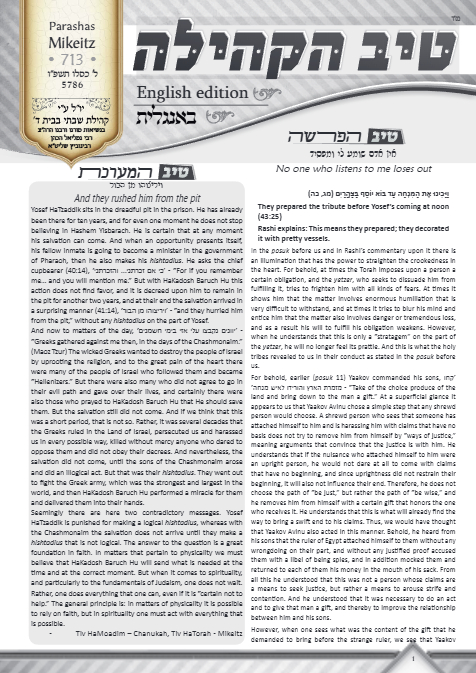
He answers in his holy words: “It seems that the primary purpose of the miracle was to demonstrate Hashem’s love for Klal Yisrael. We find that such miracles were often performed, as noted in Avos (5:2), where it says that no disqualifying factors were ever found in the Omer offering or the Two Loaves [of the lechem hapanim], and so on. Similarly, this miracle was performed with the oil of the Menorah, which serves as testimony to Yisrael that the Shechinah dwells among them. In those days, a time of favor, this miracle was meant to show that they had returned to their original beloved status.”

Following the holy path of the Pnei Yehoshua, I suggested, with Hashem‘s help, an explanation for the words of our master the Rambam (Hilchos Chanukah 4:12): “The mitzvah of lighting Chanukah candles is exceedingly precious, and one must take great care to publicize the miracle, increasing in praise of Hashem and thanksgiving for the miracles He performed for us. Even if one has nothing to eat but from charity, he should borrow or sell his clothing to purchase oil and candles to light.”

We do not find such language of “exceedingly precious” regarding any other mitzvah throughout Rambam‘ s writings. Indeed, every word and letter in Rambam‘ s language is precise and invaluable. Even regarding the four cups of wine on Passover night—where the Rambam similarly learns the obligation for the poor, as explained by the Maggid Mishneh here—he does not use the term “precious mitzvah.” He simply rules plainly that a person should not have fewer than four cups (Hilchos Chametz U’Matzah 7:7). What, then, distinguishes the mitzvah of lighting Chanukah candles that Rambam calls it “exceedingly precious” more than other mitzvah?

Upon reflection, we can begin to understand. During all other Yamim Tovim, we are like the beloved son during his severe illness, when the father was compelled to save him from death. All the miracles and wonders performed on those occasions were, as it were, necessary to save Yisrael from destruction, transforming their fate from death to life and from slavery to redemption. Without those miracles, no remnant or survivor would have remained among the enemies of Yisrael, as in the exodus from Mitzrayim celebrated on Pesach, the downfall of Haman on Purim, and similar events.

Therefore, even though the mitzvos associated with other festivals undoubtedly foster great love between Yisrael and Hashem due to the miraculous efforts that Hashem undertook to save them— similar to the way a son‘s love for his father grows when he witnesses the father‘s tremendous care to rescue and heal him during illness—this still does not compare to the miracle of Chanukah. Chazal specifically established it to commemorate the miracle of the oil container, as concluded in the discussion of, “What is Chanukah?” (Shabbos 21b; Rashi).

The Pnei Yehoshua explains that the miracle of the oil was not one of necessity. There was no threat to life, no grave illness, but rather a minor inconvenience akin to a mere weakness. The miracle of the oil was not required to save Yisrael, nor was it needed for the service of the Menorah in the Beis Hamikdash, since impure oils could have sufficed due to the principle that “impurity (tumah) is permitted in communal offerings.” This situation is akin to the day the beloved son felt slightly weak, where there was no illness or danger but only minor fatigue. The Jewish people could have resolved the issue themselves, using the impure oils that the Greeks had defiled. Nevertheless, out of His immense love for Yisrael and to demonstrate their elevated status, akin to a father‘s extraordinary care for his son even on a day of minor weakness, Hashem performed this wondrous miracle, enabling them to light the Menorah with pure oil for eight days.

This perspective helps clarify Rambam‘s precise wording, where he describes the mitzvah of lighting Chanukah candles as “exceedingly precious.” The institution of Chanukah, which is based on the miracle of the oil container, signifies unparalleled affection, even more than other Yamim Tovim. It is comparable to the son‘s heightened love for his father on the day of minor weakness, surpassing even the gratitude felt for his father ‘s devoted care during a critical illness. This explanation aligns beautifully be’ezras Hashem Yisbarach.

PDF Preview