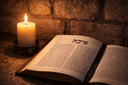
The lamp as a symbol of the soul and Torah
The lamp as a symbol of the soul and Torah
That a lamp generally alludes to one’s soul; as the Possuk states “Man's soul is Hashem's lamp”, and the lamp also alludes to Torah and Mitzvos; as the Possuk states; “For a commandment is a lamp, and the Torah is light.” And so, just as a lamp comprises four elements: The oil, the wick, and the light which subdivides into two colours, a white flame and a black flame.
Symbolism of the Lamp
The lamp signifies the victory in the war. Because what did we actually win? The war was an attempt to extinguish the flame of the Jews’ Neshomoh soul, so we won the war meaning we won the right to kindle the Jewish flame and illuminate the Jewish soul.
The Yiddishe Neshomoh is a lamp. The war was an attempt to extinguish the flame of the Jews’ passion to study Torah and perform Hashem’s Mitzvos. so we won the war meaning we won the right to kindle the Jewish flame and light up the world with our Torah study and Mitzvah performance.
Mitzvahs and Torah as Light
Mitzvahs are compared to lamps and Torah is compared to light. So the lamps of the Menorah represent the Jews and Judaism. Regular simple Jews and regular Torah and Mitzvahs performance. So we are lighting lamps to celebrate the victory which allowed us to light up the lamps of Jewish souls so that they in turn can ignite their lamps of Mitzvahs and of Torah in their regular every day Judaism.
Components of a Lamp
So now we need to analyse the lamps. If we have linked the lighting of a lamp to Torah and Mitzvohs we need to fully understand all the components of a lamp. Which symbolises Yiddishkiet and Yidden. Which constitutes giving up of ourselves and receiving of Hashem. In giving of ourselves we are giving our struggles and giving our holiness. And the gifts of Hashem that reach us are the gifts of Hashem that affects our struggle and the gifts from Hashem which bring us peace. Which is the concept of white light.
Two dimensions of the four aspects of a candle are given by the person and two dimensions are given by Hashem. We give oil which is our Neshomoh soul and we give the wick which is our body. And our Neshomoh soul burns through our body. Hashem gives us a light at a level of light which burns the wick meaning it has a connection with this world. And a level of light which is beyond any connection to this world. So there are four aspects to the lamp highest being the white light, then the black light, then the oil and then the wick. Because the wick represents the body and the animal soul and the place of struggle. The black light is only black because of its relationship to the wick. The oil which is also a part of the person is the purity in the person which only lights up because there is a body in between.
White and Black Flames
Because they are different and distinct parts of a flame of different temperatures and in fact are two separate entities working together. As the Zohar writes in Bereishis 86-249: In the flame itself there are two lights: one white and luminous, and the other black, or blue. The white light is the higher of the two and rises steadily. The black or blue light is underneath the other, which rests on the wick as on a pedestal. The two are inseparably connected, the white resting and being enthroned upon the black. This blue or black base is in turn attached to something beneath it which keeps it in flame and impels it to cling to the white light above...... The lower light, ...... is a connecting link between the white light to which it is attached above and to the concrete body to which it is attached below, and which keeps it alight.
This is discussed at length in Torah Ohr: The closer the flame is to the wick the darker the colour, almost like a black or very deep blue which turns into a yellow and it disappears and becomes a white light. The part of the flame next to the wick is the black light and the further away from the wick the brighter and the more transparent it becomes. This is explained to mean that light which has a connection to materialism and light which is above a connection to materialism. In other words, black light is lower than white light but black light also refines, it struggles with materialism and tries to illuminate it. Accordingly white light would be one level higher than black light. Because white light means it is pure, even though it is burning because of the fuel, the light is pure. Black light means that even though light is always pure but since the light is being conducted and being contained and being held by the fuel, the fuel gives the light a colour which highlights the constant struggle between spirituality and materialism. With regards to the oil and the wick the wick is closer to the fire than the oil. The wick draws the oil up through itself to create the constant fire. What’s burning is not the wick what’s burning is the fuel but it burns through the wick. The wick and the fuel symbolise the person. The wick is the animal soul. Which is the dimension of Yiddishkiet which is a struggle. And the oil goes on the Neshomoh soul which is pure. The Neshomoh soul is creating the fire but it needs the animal soul as an intermediary.
Related Articles