The Sar HaMashkims Reward for Confessing
Parsha Plus | December 15, 2023
Print This Article
View Original PDF

The Sar HaMashkims Reward for Confessing

Parsha Plus | December 31, 2025

Pharaoh had troubling dreams. None of his sorcerers or dream interpreters could satisfactorily explain them. Finally, the Sar HaMashkim (wine butler), who had been released from prison a couple of years prior, popped up and told Pharaoh “Es chata’ai ani mazkir hayom” (“I remember my iniquity this day...”) He related the story of how he and the royal baker had been thrown into prison, and how they each had dreams that were interpreted by a Hebrew lad in prison. Yosef’s interpretations came true 100%. Pharaoh summoned Yosef from prison and gave him a shot at interpreting the dreams.

The precise translation of the words “Es chata’ai ani mazkir hayom” is actually not “I remember my iniquity this day” because the word chata’ai is plural! The correct translation is: I remember my initquities today. Now, according to the well know Medrash, this Sar HaMashkim had but a single aveira (sin) – namely serving to Pharaoh a wine goblet, into which a fly had fallen. What then is the implication of the plural chata’ai?

The Alshich shares a very interesting idea: This Sar HaMashkim, as despicable of a character as he may have been, will go down in history as having a tremendous zechus (merit)—because of him, Yosef was released from prison. People received great reward for a lot less throughout Tanach. We have a principle that zechus comes to those who merit it (Megalgelim zechus al yedei zakai). What prior zechus allowed the Sar HaMashkim to gain the additional zechus of being the one to free Yosef from prison?

The Alschich quotes the Riva that the “two aveiros” mentioned by the Sar HaMashkim were (1) the incident of the fly falling into the royal goblet and (2) that it took two years for him to remember the fact that Yosef asked him to mention his plight to Pharaoh. The Alshich writes it was for the sense of guilt that he felt for his negligence in not mentioning Yosef to Pharaoh for two years after his own release that the Sar HaMashkim was rewarded by being able to be the enabler for Yosef getting out of prison.

The pasuk in Mishlei states: “He who covers his sins will not succeed, but one who confesses and abandons them will receive mercy (from Hashem).” (Mishlei 28:13) The Sar HaMashkim was rewarded for his sense of submission and his confession to Pharaoh of this dual negligence, and in that zechus, he was the enabler who was able to cause Yosef to be released from prison.
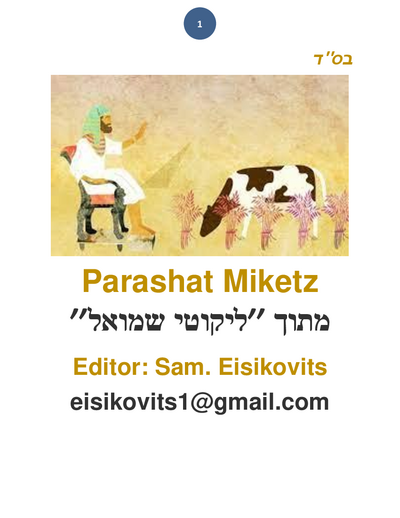

Pharaoh had troubling dreams. None of his sorcerers or dream interpreters could satisfactorily explain them. Finally, the Sar HaMashkim (wine butler), who had been released from prison a couple of years prior, popped up and told Pharaoh “Es chata’ai ani mazkir hayom” (“I remember my iniquity this day...”) He related the story of how he and the royal baker had been thrown into prison, and how they each had dreams that were interpreted by a Hebrew lad in prison. Yosef’s interpretations came true 100%. Pharaoh summoned Yosef from prison and gave him a shot at interpreting the dreams.

The precise translation of the words “Es chata’ai ani mazkir hayom” is actually not “I remember my iniquity this day” because the word chata’ai is plural! The correct translation is: I remember my initquities today. Now, according to the well know Medrash, this Sar HaMashkim had but a single aveira (sin) – namely serving to Pharaoh a wine goblet, into which a fly had fallen. What then is the implication of the plural chata’ai?

The Alshich shares a very interesting idea: This Sar HaMashkim, as despicable of a character as he may have been, will go down in history as having a tremendous zechus (merit)—because of him, Yosef was released from prison. People received great reward for a lot less throughout Tanach. We have a principle that zechus comes to those who merit it (Megalgelim zechus al yedei zakai). What prior zechus allowed the Sar HaMashkim to gain the additional zechus of being the one to free Yosef from prison?

The Alschich quotes the Riva that the “two aveiros” mentioned by the Sar HaMashkim were (1) the incident of the fly falling into the royal goblet and (2) that it took two years for him to remember the fact that Yosef asked him to mention his plight to Pharaoh. The Alshich writes it was for the sense of guilt that he felt for his negligence in not mentioning Yosef to Pharaoh for two years after his own release that the Sar HaMashkim was rewarded by being able to be the enabler for Yosef getting out of prison.

The pasuk in Mishlei states: “He who covers his sins will not succeed, but one who confesses and abandons them will receive mercy (from Hashem).” (Mishlei 28:13) The Sar HaMashkim was rewarded for his sense of submission and his confession to Pharaoh of this dual negligence, and in that zechus, he was the enabler who was able to cause Yosef to be released from prison.

PDF Preview