The Yevanim Battle the Answering of Amen
Vechol Maaminim | December 24, 2024
Print This Article
View Original PDF

The Yevanim Battle the Answering of Amen

Vechol Maaminim | June 27, 2025

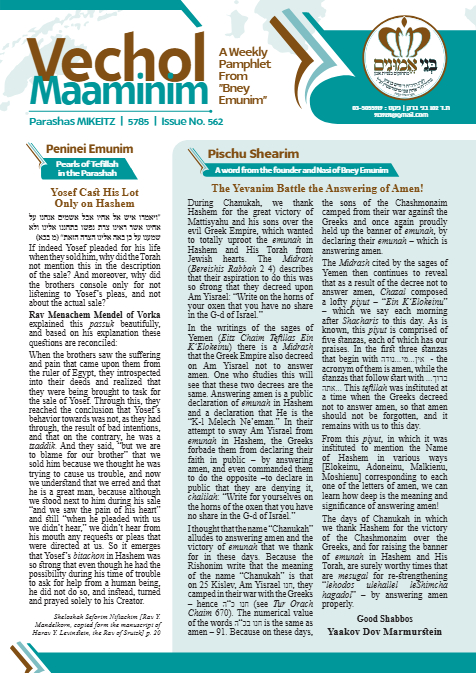
During Chanukah, we thank Hashem for the great victory of Mattisyahu and his sons over the evil Greek Empire, which wanted to totally uproot the emunah in Hashem and His Torah from Jewish hearts. The Midrash (Bereishis Rabbah 2 4) describes that their aspiration to do this was so strong that they decreed upon Am Yisrael: “Write on the horns of your oxen that you have no share in the G-d of Israel.”

In the writings of the sages of Yemen (Eitz Chaim Tefillas Ein K’Elokeinu) there is a Midrash that the Greek Empire also decreed on Am Yisrael not to answer amen. One who studies this will see that these two decrees are the same. Answering amen is a public declaration of emunah in Hashem and a declaration that He is the “K-l Melech Ne’eman.” In their attempt to sway Am Yisrael from emunah in Hashem, the Greeks forbade them from declaring their faith in public – by answering amen, and even commanded them to do the opposite –to declare in public that they are denying it, chalilah: “Write for yourselves on the horns of the oxen that you have no share in the G-d of Israel.”

I thought that the name “Chanukah” alludes to answering amen and the victory of emunah that we thank for in these days. Because the Rishonim write that the meaning of the name “Chanukah” is that on 25 Kislev, Am Yisrael חנו, they camped in their war with the Greeks – hence ה“חנו כ (see Tur Orach Chaim 670). The numerical value of the words ה“חנו בכ is the same as amen – 91. Because on these days, the sons of the Chashmonaim camped from their war against the Greeks and once again proudly held up the banner of emunah, by declaring their emunah – which is answering amen.

The Midrash cited by the sages of Yemen then continues to reveal that as a result of the decree not to answer amen, Chazal composed a lofty piyut – “Ein K’Elokeinu” – which we say each morning after Shacharis to this day. As is known, this piyut is comprised of five stanzas, each of which has our praises. In the first three stanzas that begin with אין...מי...נודה - the acronym of them is amen, while the stanzas that follow start with ...ברוך אתה... This tefillah was instituted at a time when the Greeks decreed not to answer amen, so that amen should not be forgotten, and it remains with us to this day.

From this piyut, in which it was instituted to mention the Name of Hashem in various ways [Elokeinu, Adoneinu, Malkienu, Moshienu] corresponding to each one of the letters of amen, we can learn how deep is the meaning and significance of answering amen!

The days of Chanukah in which we thank Hashem for the victory of the Chashmonaim over the Greeks, and for raising the banner of emunah in Hashem and His Torah, are surely worthy times that are mesugal for re-strengthening “lehodos ulehallel leShimcha hagadol” – by answering amen properly.

Good Shabbos
Yaakov Dov Marmurstein
ת.ד 102 בני ברק | פקס : 03-5055919
[email protected]
During Chanukah, we thank Hashem for the great victory of Mattisyahu and his sons over the evil Greek Empire, which wanted to totally uproot the emunah in Hashem and His Torah from Jewish hearts. The Midrash (Bereishis Rabbah 2 4) describes that their aspiration to do this was so strong that they decreed upon Am Yisrael: “Write on the horns of your oxen that you have no share in the G-d of Israel.”

In the writings of the sages of Yemen (Eitz Chaim Tefillas Ein K’Elokeinu) there is a Midrash that the Greek Empire also decreed on Am Yisrael not to answer amen. One who studies this will see that these two decrees are the same. Answering amen is a public declaration of emunah in Hashem and a declaration that He is the “K-l Melech Ne’eman.” In their attempt to sway Am Yisrael from emunah in Hashem, the Greeks forbade them from declaring their faith in public – by answering amen, and even commanded them to do the opposite –to declare in public that they are denying it, chalilah: “Write for yourselves on the horns of the oxen that you have no share in the G-d of Israel.”

I thought that the name “Chanukah” alludes to answering amen and the victory of emunah that we thank for in these days. Because the Rishonim write that the meaning of the name “Chanukah” is that on 25 Kislev, Am Yisrael חנו, they camped in their war with the Greeks – hence ה“חנו כ (see Tur Orach Chaim 670). The numerical value of the words ה“חנו בכ is the same as amen – 91. Because on these days, the sons of the Chashmonaim camped from their war against the Greeks and once again proudly held up the banner of emunah, by declaring their emunah – which is answering amen.

The Midrash cited by the sages of Yemen then continues to reveal that as a result of the decree not to answer amen, Chazal composed a lofty piyut – “Ein K’Elokeinu” – which we say each morning after Shacharis to this day. As is known, this piyut is comprised of five stanzas, each of which has our praises. In the first three stanzas that begin with אין...מי...נודה - the acronym of them is amen, while the stanzas that follow start with ...ברוך אתה... This tefillah was instituted at a time when the Greeks decreed not to answer amen, so that amen should not be forgotten, and it remains with us to this day.

From this piyut, in which it was instituted to mention the Name of Hashem in various ways [Elokeinu, Adoneinu, Malkienu, Moshienu] corresponding to each one of the letters of amen, we can learn how deep is the meaning and significance of answering amen!

The days of Chanukah in which we thank Hashem for the victory of the Chashmonaim over the Greeks, and for raising the banner of emunah in Hashem and His Torah, are surely worthy times that are mesugal for re-strengthening “lehodos ulehallel leShimcha hagadol” – by answering amen properly.

Good Shabbos
Yaakov Dov Marmurstein
ת.ד 102 בני ברק | פקס : 03-5055919
[email protected]

PDF Preview