True Teshuvah and Free Choice
Ben Chamesh L'Mikra | December 10, 2023
Print This Article
View Original PDF

True Teshuvah and Free Choice

Ben Chamesh L'Mikra | December 31, 2025

Although free choice is an important axiom concerning all of the Torah, Rambam chooses to explain it at length, specifically within the laws of teshuvah because of its particular importance concerning teshuvah.

This is because the entire idea of teshuvah is not possible without choice. Concerning other commandments, even if there would be no concept of choice, a person would be able to do the commandment, albeit without freewill. (Without choice, it is impossible that the commandment be a commandment. By very definition, a commandment is something that the person does on his own because he was directed to do so. If there is no concept of free choice, there cannot be a command and there cannot be reward or punishment—however, the actual act is possible.)

This is not so in regard to the mitzvah of teshuvah. For a person to repent, they must feel guilt and remorse for their actions, and decide that they no longer desire to act in this evil manner. Without free choice, there can be no regret and remorse for the actions that they have done, and there can be no decision to rectify them in the future. Without free choice, the very concept of repentance makes no sense.

In addition to this correlation between repentance and free choice, there is as well, a deeper connection between the two ideas, which Rambam alludes to by explaining the concept of choice in the chapters of teshuvah. It is this deeper correlation between the two subjects that Reuven was imparting to his brothers in his statement of, “Didn't I tell you, saying, ‘Don’t sin against the lad,' but you did not listen. And his blood as well—behold!—is being demanded.”

True teshuvah

True teshuvah is when a person completely returns to G-d, with their full heart. This occurs when a person repents from their wrong-doing completely on their own volition, without any external cause motivating them.

If there is an outside force that is driving the individual or coercing them, then it is not they who are doing the teshuvah, but the situation in which they find themselves. It cannot truly be said that they are returning to G-d, as something pushed them to repent.

In such a case, the teshuvah has not permeated the person in a real way, and it is not coming from his heart.

Rambam explains, that for a person do to true teshuvah, it needs to come completely from within himself and be done without any coercion whatsoever. In his words:

What constitutes teshuvah?

That a sinner should abandon his sins and remove them from his thoughts, resolving in his heart, never to commit them again, as the verse states: "May the wicked abandon his ways...." Similarly, he must regret the past, as the verse states: "After I returned, I regretted." [He must reach the level where] He who knows the hidden will testify concerning him that he will never return to this sin again.
Rambam, Laws of Teshuvah 2:2

For a person to do teshuvah, it must be in a way that “[He must reach the level where] He who knows the hidden will testify concerning him that he will never return to this sin again.” He cannot merely repent because he no longer has strength to sin, or that he is scared of retribution. It must be that at his very essence he has become a person who no longer wishes to act against the Almighty’s will.

This is the correlation between the concept of free will and repentance—for teshuvah can only come through free choice. It must be that the person himself is motivated purely by an intent to return to G-d, and not only to save himself from divine retribution.

This is, therefore, the meaning of Reuven’s message to his brothers. When his brothers had acknowledged that they were responsible for the disturbing circumstances which befell them, and began to repent for their sin, Reuven advised them to fulfill the mitzvah of teshuvah in its most complete form.

The brothers had said, "Indeed, we are guilty for our brother...that is why this trouble has come upon us." They repented, but only because they were now being punished. Reuven was instructing them to return to the Almighty with authentic teshuvah. He therefore told them, "Didn't I tell you, saying, 'Do not sin against the lad,' but you did not listen.” He explained to them that they should not do teshuvah because now they were facing punishment, they should rather do teshuvah because the act had been wrong from the onset.

This is why Reuven chose to express, “And his blood as well—behold!—is being demanded,” hinting that these troubles which were coming now, on account of the wrong-doings to Yosef, were an additional matter. This was only an “and.” The reason that they should do teshuvah, is not because they were being punished, but because they had sinned. True teshuvah cannot be a response to consequences, it must be an end to itself.
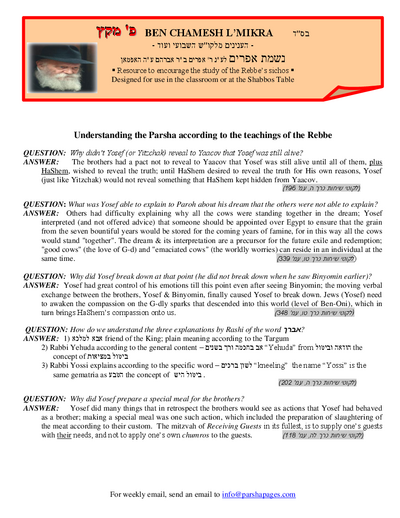
Although free choice is an important axiom concerning all of the Torah, Rambam chooses to explain it at length, specifically within the laws of teshuvah because of its particular importance concerning teshuvah.

This is because the entire idea of teshuvah is not possible without choice. Concerning other commandments, even if there would be no concept of choice, a person would be able to do the commandment, albeit without freewill. (Without choice, it is impossible that the commandment be a commandment. By very definition, a commandment is something that the person does on his own because he was directed to do so. If there is no concept of free choice, there cannot be a command and there cannot be reward or punishment—however, the actual act is possible.)

This is not so in regard to the mitzvah of teshuvah. For a person to repent, they must feel guilt and remorse for their actions, and decide that they no longer desire to act in this evil manner. Without free choice, there can be no regret and remorse for the actions that they have done, and there can be no decision to rectify them in the future. Without free choice, the very concept of repentance makes no sense.

In addition to this correlation between repentance and free choice, there is as well, a deeper connection between the two ideas, which Rambam alludes to by explaining the concept of choice in the chapters of teshuvah. It is this deeper correlation between the two subjects that Reuven was imparting to his brothers in his statement of, “Didn't I tell you, saying, ‘Don’t sin against the lad,' but you did not listen. And his blood as well—behold!—is being demanded.”

True teshuvah

True teshuvah is when a person completely returns to G-d, with their full heart. This occurs when a person repents from their wrong-doing completely on their own volition, without any external cause motivating them.

If there is an outside force that is driving the individual or coercing them, then it is not they who are doing the teshuvah, but the situation in which they find themselves. It cannot truly be said that they are returning to G-d, as something pushed them to repent.

In such a case, the teshuvah has not permeated the person in a real way, and it is not coming from his heart.

Rambam explains, that for a person do to true teshuvah, it needs to come completely from within himself and be done without any coercion whatsoever. In his words:

What constitutes teshuvah?

That a sinner should abandon his sins and remove them from his thoughts, resolving in his heart, never to commit them again, as the verse states: "May the wicked abandon his ways...." Similarly, he must regret the past, as the verse states: "After I returned, I regretted." [He must reach the level where] He who knows the hidden will testify concerning him that he will never return to this sin again.
Rambam, Laws of Teshuvah 2:2

For a person to do teshuvah, it must be in a way that “[He must reach the level where] He who knows the hidden will testify concerning him that he will never return to this sin again.” He cannot merely repent because he no longer has strength to sin, or that he is scared of retribution. It must be that at his very essence he has become a person who no longer wishes to act against the Almighty’s will.

This is the correlation between the concept of free will and repentance—for teshuvah can only come through free choice. It must be that the person himself is motivated purely by an intent to return to G-d, and not only to save himself from divine retribution.

This is, therefore, the meaning of Reuven’s message to his brothers. When his brothers had acknowledged that they were responsible for the disturbing circumstances which befell them, and began to repent for their sin, Reuven advised them to fulfill the mitzvah of teshuvah in its most complete form.

The brothers had said, "Indeed, we are guilty for our brother...that is why this trouble has come upon us." They repented, but only because they were now being punished. Reuven was instructing them to return to the Almighty with authentic teshuvah. He therefore told them, "Didn't I tell you, saying, 'Do not sin against the lad,' but you did not listen.” He explained to them that they should not do teshuvah because now they were facing punishment, they should rather do teshuvah because the act had been wrong from the onset.

This is why Reuven chose to express, “And his blood as well—behold!—is being demanded,” hinting that these troubles which were coming now, on account of the wrong-doings to Yosef, were an additional matter. This was only an “and.” The reason that they should do teshuvah, is not because they were being punished, but because they had sinned. True teshuvah cannot be a response to consequences, it must be an end to itself.

PDF Preview