Wake Up Calls
L’Chaim | December 24, 2024
Print This Article
View Original PDF

Wake Up Calls

L’Chaim | June 27, 2025

from the teachings of the Rebbe on the Torah portion

Last week's Torah portion dealt with the subject of dreams—those of Joseph and Pharaoh's officers. This week, in the Torah portion of Miketz, we continue to delve into dreams, but this time, those of Pharaoh, king of Egypt.

The common denominator shared by all these dreams is that they collectively portrayed the various stages and factors which caused Jacob and his sons to go to Egypt. As a direct result, the Jewish people were exiled there.

Every word in the Torah is necessary and precise. If the subject of dreams receives so much emphasis and we are told such a wealth of detail, there must be a fundamental connection between the concept of dreams and the concept of exile. Furthermore, by understanding the significance of dreams, we will be better able to overcome the difficulties we endure during our own prolonged exile.

Chasidic philosophy explains that a most outstanding characteristic of dreams is the ability for diametrically opposed opposites to coexist, something which cannot take place in reality. The Talmud gives as an example the image of "an elephant passing through the eye of a needle," which may appear not at all out of the ordinary in a dream.

This is also true of our own exile, an unnatural and abnormal situation, but one seemingly natural and normal to us. It is of such long duration, we can no longer feel the contradictions inherent in the galut itself.

The same contradictions also apply to our spiritual galut. It is understood that self-love and the pursuit of worldly pleasures are the opposite of cultivating a love of G-d and holiness. Yet, we often perform mitzvot under the illusion that we are doing so out of love of G-d and are in close proximity to Him, all the while caring only for our own egos and self-fulfillment. We simply don't perceive the contradiction in this.

Another example of our lack of logic is found in prayer. While praying, the Jew's innate love and emotional attachment to G-d can be aroused, but as soon as he finishes, it is as if he had never experienced this arousal as he returns to his preoccupation with day-to-day life. Although he stood on such a high spiritual level while actually communing with G-d, the feelings dissipate as the individual finds himself led after the cravings of the animal soul.

Thus our very lives are lived as if we are dreaming. The spiritual exile is full of contradictions, yet we must not be discouraged and think that we perform mitzvot and pray in vain, for every positive deed leaves its mark even if its influence is not always easily felt.

Adapted from the works of the Lubavitcher Rebbe.
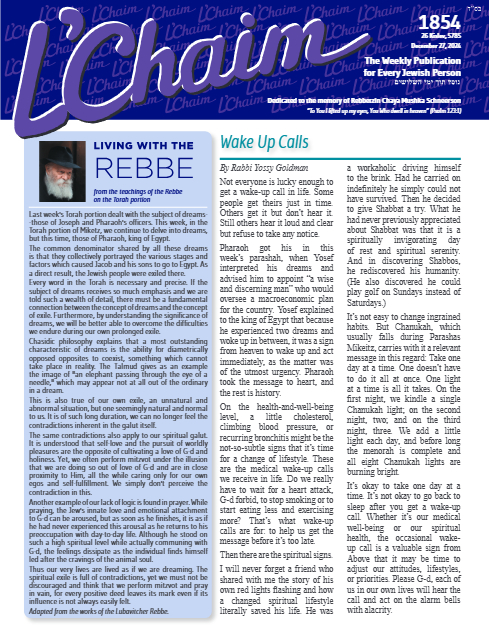
from the teachings of the Rebbe on the Torah portion

Last week's Torah portion dealt with the subject of dreams—those of Joseph and Pharaoh's officers. This week, in the Torah portion of Miketz, we continue to delve into dreams, but this time, those of Pharaoh, king of Egypt.

The common denominator shared by all these dreams is that they collectively portrayed the various stages and factors which caused Jacob and his sons to go to Egypt. As a direct result, the Jewish people were exiled there.

Every word in the Torah is necessary and precise. If the subject of dreams receives so much emphasis and we are told such a wealth of detail, there must be a fundamental connection between the concept of dreams and the concept of exile. Furthermore, by understanding the significance of dreams, we will be better able to overcome the difficulties we endure during our own prolonged exile.

Chasidic philosophy explains that a most outstanding characteristic of dreams is the ability for diametrically opposed opposites to coexist, something which cannot take place in reality. The Talmud gives as an example the image of "an elephant passing through the eye of a needle," which may appear not at all out of the ordinary in a dream.

This is also true of our own exile, an unnatural and abnormal situation, but one seemingly natural and normal to us. It is of such long duration, we can no longer feel the contradictions inherent in the galut itself.

The same contradictions also apply to our spiritual galut. It is understood that self-love and the pursuit of worldly pleasures are the opposite of cultivating a love of G-d and holiness. Yet, we often perform mitzvot under the illusion that we are doing so out of love of G-d and are in close proximity to Him, all the while caring only for our own egos and self-fulfillment. We simply don't perceive the contradiction in this.

Another example of our lack of logic is found in prayer. While praying, the Jew's innate love and emotional attachment to G-d can be aroused, but as soon as he finishes, it is as if he had never experienced this arousal as he returns to his preoccupation with day-to-day life. Although he stood on such a high spiritual level while actually communing with G-d, the feelings dissipate as the individual finds himself led after the cravings of the animal soul.

Thus our very lives are lived as if we are dreaming. The spiritual exile is full of contradictions, yet we must not be discouraged and think that we perform mitzvot and pray in vain, for every positive deed leaves its mark even if its influence is not always easily felt.

Adapted from the works of the Lubavitcher Rebbe.

PDF Preview