Aliyah LaRegel why
זכרו תורת משה | February 12, 2026
Print This Article
View Original PDF

Aliyah LaRegel why

זכרו תורת משה | February 13, 2026

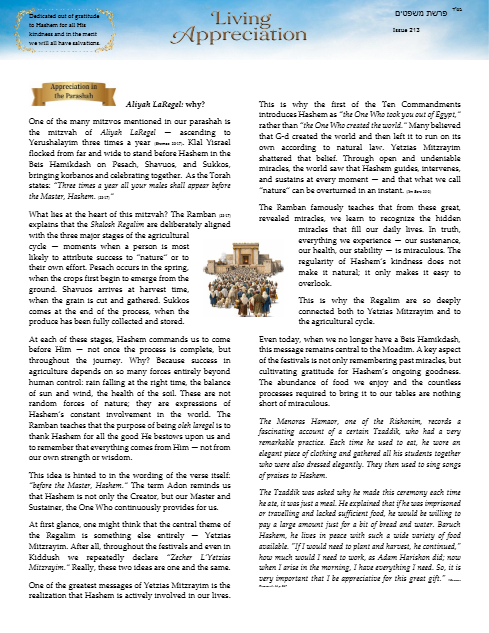
One of the many mitzvos mentioned in our parashah is the mitzvah of Aliyah LaRegel — ascending to Yerushalayim three times a year (Shemos 23:17). Klal Yisrael flocked from far and wide to stand before Hashem in the Beis Hamikdash on Pesach, Shavuos, and Sukkos, bringing korbanos and celebrating together. As the Torah states: “Three times a year all your males shall appear before the Master, Hashem. (23:17)”

What lies at the heart of this mitzvah? The Ramban (23:17) explains that the Shalosh Regalim are deliberately aligned with the three major stages of the agricultural cycle — moments when a person is most likely to attribute success to “nature” or to their own effort. Pesach occurs in the spring, when the crops first begin to emerge from the ground. Shavuos arrives at harvest time, when the grain is cut and gathered. Sukkos comes at the end of the process, when the produce has been fully collected and stored.

At each of these stages, Hashem commands us to come before Him — not once the process is complete, but throughout the journey. Why? Because success in agriculture depends on so many forces entirely beyond human control: rain falling at the right time, the balance of sun and wind, the health of the soil. These are not random forces of nature; they are expressions of Hashem’s constant involvement in the world. The Ramban teaches that the purpose of being oleh laregel is to thank Hashem for all the good He bestows upon us and to remember that everything comes from Him — not from our own strength or wisdom.

This idea is hinted to in the wording of the verse itself: “before the Master, Hashem.” The term Adon reminds us that Hashem is not only the Creator, but our Master and Sustainer, the One Who continuously provides for us.

At first glance, one might think that the central theme of the Regalim is something else entirely — Yetzias Mitzrayim. After all, throughout the festivals and even in Kiddush we repeatedly declare “Zecher L’Yetzias Mitzrayim.” Really, these two ideas are one and the same. One of the greatest messages of Yetzias Mitzrayim is the realization that Hashem is actively involved in our lives. This is why the first of the Ten Commandments introduces Hashem as “the One Who took you out of Egypt,” rather than “the One Who created the world.” Many believed that G-d created the world and then left it to run on its own according to natural law. Yetzias Mitzrayim shattered that belief. Through open and undeniable miracles, the world saw that Hashem guides, intervenes, and sustains at every moment — and that what we call “nature” can be overturned in an instant. (Ibn Ezra 20:2)

The Ramban famously teaches that from these great, revealed miracles, we learn to recognize the hidden miracles that fill our daily lives. In truth, everything we experience — our sustenance, our health, our stability — is miraculous. The regularity of Hashem’s kindness does not make it natural; it only makes it easy to overlook.

This is why the Regalim are so deeply connected both to Yetzias Mitzrayim and to the agricultural cycle.

Even today, when we no longer have a Beis Hamikdash, this message remains central to the Moadim. A key aspect of the festivals is not only remembering past miracles, but cultivating gratitude for Hashem’s ongoing goodness. The abundance of food we enjoy and the countless processes required to bring it to our tables are nothing short of miraculous.

The Menoras Hamaor, one of the Rishonim, records a fascinating account of a certain Tzaddik, who had a very remarkable practice. Each time he used to eat, he wore an elegant piece of clothing and gathered all his students together who were also dressed elegantly. They then used to sing songs of praises to Hashem.

The Tzaddik was asked why he made this ceremony each time he ate, it was just a meal. He explained that if he was imprisoned or travelling and lacked sufficient food, he would be willing to pay a large amount just for a bit of bread and water. Baruch Hashem, he lives in peace with such a wide variety of food available. "If I would need to plant and harvest, he continued," how much would I need to work, as Adam Harishon did; now when I arise in the morning, I have everything I need. So, it is very important that I be appreciative for this great gift." (Menoras Hamaor ch. 14 p. 247)

One of the many mitzvos mentioned in our parashah is the mitzvah of Aliyah LaRegel — ascending to Yerushalayim three times a year (Shemos 23:17). Klal Yisrael flocked from far and wide to stand before Hashem in the Beis Hamikdash on Pesach, Shavuos, and Sukkos, bringing korbanos and celebrating together. As the Torah states: “Three times a year all your males shall appear before the Master, Hashem. (23:17)”

What lies at the heart of this mitzvah? The Ramban (23:17) explains that the Shalosh Regalim are deliberately aligned with the three major stages of the agricultural cycle — moments when a person is most likely to attribute success to “nature” or to their own effort. Pesach occurs in the spring, when the crops first begin to emerge from the ground. Shavuos arrives at harvest time, when the grain is cut and gathered. Sukkos comes at the end of the process, when the produce has been fully collected and stored.

At each of these stages, Hashem commands us to come before Him — not once the process is complete, but throughout the journey. Why? Because success in agriculture depends on so many forces entirely beyond human control: rain falling at the right time, the balance of sun and wind, the health of the soil. These are not random forces of nature; they are expressions of Hashem’s constant involvement in the world. The Ramban teaches that the purpose of being oleh laregel is to thank Hashem for all the good He bestows upon us and to remember that everything comes from Him — not from our own strength or wisdom.

This idea is hinted to in the wording of the verse itself: “before the Master, Hashem.” The term Adon reminds us that Hashem is not only the Creator, but our Master and Sustainer, the One Who continuously provides for us.

At first glance, one might think that the central theme of the Regalim is something else entirely — Yetzias Mitzrayim. After all, throughout the festivals and even in Kiddush we repeatedly declare “Zecher L’Yetzias Mitzrayim.” Really, these two ideas are one and the same. One of the greatest messages of Yetzias Mitzrayim is the realization that Hashem is actively involved in our lives. This is why the first of the Ten Commandments introduces Hashem as “the One Who took you out of Egypt,” rather than “the One Who created the world.” Many believed that G-d created the world and then left it to run on its own according to natural law. Yetzias Mitzrayim shattered that belief. Through open and undeniable miracles, the world saw that Hashem guides, intervenes, and sustains at every moment — and that what we call “nature” can be overturned in an instant. (Ibn Ezra 20:2)

The Ramban famously teaches that from these great, revealed miracles, we learn to recognize the hidden miracles that fill our daily lives. In truth, everything we experience — our sustenance, our health, our stability — is miraculous. The regularity of Hashem’s kindness does not make it natural; it only makes it easy to overlook.

This is why the Regalim are so deeply connected both to Yetzias Mitzrayim and to the agricultural cycle.

Even today, when we no longer have a Beis Hamikdash, this message remains central to the Moadim. A key aspect of the festivals is not only remembering past miracles, but cultivating gratitude for Hashem’s ongoing goodness. The abundance of food we enjoy and the countless processes required to bring it to our tables are nothing short of miraculous.

The Menoras Hamaor, one of the Rishonim, records a fascinating account of a certain Tzaddik, who had a very remarkable practice. Each time he used to eat, he wore an elegant piece of clothing and gathered all his students together who were also dressed elegantly. They then used to sing songs of praises to Hashem.

The Tzaddik was asked why he made this ceremony each time he ate, it was just a meal. He explained that if he was imprisoned or travelling and lacked sufficient food, he would be willing to pay a large amount just for a bit of bread and water. Baruch Hashem, he lives in peace with such a wide variety of food available. "If I would need to plant and harvest, he continued," how much would I need to work, as Adam Harishon did; now when I arise in the morning, I have everything I need. So, it is very important that I be appreciative for this great gift." (Menoras Hamaor ch. 14 p. 247)

PDF Preview