An Envelope as a Gift
Hashgacha Pratis | February 08, 2024
Print This Article
View Original PDF

An Envelope as a Gift

Hashgacha Pratis | December 10, 2025

In Reb Dovid’s shiurim we hear him saying many different variations of the idea that one should not ask, “Why did I do that? Where was my head?” One should not lay blame, but rather should know that the mistakes too are heavenly ordained. So we don’t ask why; nevertheless, sometimes we get a response showing us why it entered the head of a wise, respectable person to act in a totally irresponsible way.

My job is to collect tuition from the parents of the Talmud Torah of London. In our school, parents don’t arrange an automatic withdrawal from their bank account; rather, I need to call them to remind them and make sure the money comes in. Before Pesach, I called one of the parents, a prominent Jew, and reminded him that he had a tuition debt, and we wanted to pay the melamdim before Pesach, so they would be able to cover their Yom Tov expenses. The gvir agreed that this was very important. “I’m bringing the money today,” he concluded.

The day passed, and the money did not arrive. Several more days passed, Pesach passed, we counted the omer and lit a bonfire for Rabi Shimon, and the money still hadn’t arrived.

Just before Shavuos I called the gvir again and asked him, “Where’s the money?” “What do you mean, where’s the money?” he asked. “I brought it to you on that very day.” “Impossible.” “What’s impossible? I myself came with my car to your house. I saw your son, a small child, going out of the house, and I gave him the envelope with the money. There were 2,000 pounds sterling in there!”

“Okay, I’ll ask my son,” I said, and with great difficulty I held back from lashing out at the gvir and offering my opinion of his behavior. Since when does anyone give over such a large sum through a small child, and depend on him to deliver the sum to the right place? Where was his head? We were talking about the equivalent of tens of thousands of shekels. It didn’t make sense that he would act so irresponsibly!

My son remembered nothing of the whole affair, and I decided to try asking the Jewish neighbors in the area if they had seen the envelope. I knocked on house after house, until we came to the home of an avreich, and I asked him, “Did you see an envelope with money here on Erev Pesach?” “You’re talking about an envelope containing 2,000 pounds sterling?” “Yes, yes,” my eyes lit up. “Exactly that.”

“Listen to what was going on then,” the avreich related. “Right before Pesach I was fired from my job. I had no income, and I had absolutely no idea what I would do. How would I cover Pesach expenses? I stood and davened to the Creator of all worlds and asked Him to help me. Immediately afterwards, I went out to the yard and discovered an envelope there with 2,000 pounds inside. This was simply a gift from Shamayim. I took the money with joy and bought everything we needed for Yom Tov.”

“That money was tuition, meant to be used to pay the melamdim,” I told him. “We need to return the money to the Talmud Torah.” “I don’t have such a large sum now,” said the avreich, “but I can pay it back in installments.”

I called the gvir immediately and told him, “I found the money. An avreich who lives in my neighborhood saw the envelope on his lawn and thought that this was a gift from Shamayim in honor of Pesach, and he said he’d return the sum in installments.” “He doesn’t have to pay it back,” the gvir answered. “The money is completely a gift to him. I’ll give you a new envelope.”

This time the envelope came all the way to me without any intermediaries in the form of young children. Only the message echoes on: Sometimes Hakadosh Baruch Hu makes a person lose his proper logic in order to carry out a hidden mission, in order to uplift someone who is poor or unfortunate.
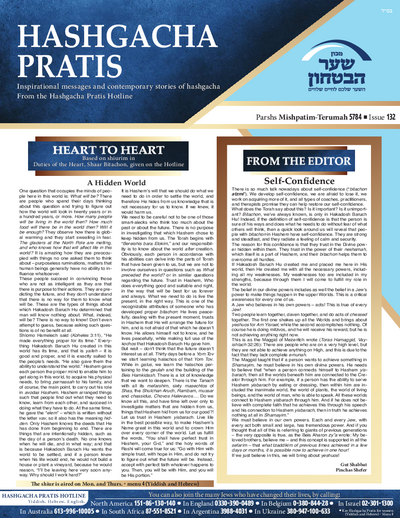

In Reb Dovid’s shiurim we hear him saying many different variations of the idea that one should not ask, “Why did I do that? Where was my head?” One should not lay blame, but rather should know that the mistakes too are heavenly ordained. So we don’t ask why; nevertheless, sometimes we get a response showing us why it entered the head of a wise, respectable person to act in a totally irresponsible way.

My job is to collect tuition from the parents of the Talmud Torah of London. In our school, parents don’t arrange an automatic withdrawal from their bank account; rather, I need to call them to remind them and make sure the money comes in. Before Pesach, I called one of the parents, a prominent Jew, and reminded him that he had a tuition debt, and we wanted to pay the melamdim before Pesach, so they would be able to cover their Yom Tov expenses. The gvir agreed that this was very important. “I’m bringing the money today,” he concluded.

The day passed, and the money did not arrive. Several more days passed, Pesach passed, we counted the omer and lit a bonfire for Rabi Shimon, and the money still hadn’t arrived.

Just before Shavuos I called the gvir again and asked him, “Where’s the money?” “What do you mean, where’s the money?” he asked. “I brought it to you on that very day.” “Impossible.” “What’s impossible? I myself came with my car to your house. I saw your son, a small child, going out of the house, and I gave him the envelope with the money. There were 2,000 pounds sterling in there!”

“Okay, I’ll ask my son,” I said, and with great difficulty I held back from lashing out at the gvir and offering my opinion of his behavior. Since when does anyone give over such a large sum through a small child, and depend on him to deliver the sum to the right place? Where was his head? We were talking about the equivalent of tens of thousands of shekels. It didn’t make sense that he would act so irresponsibly!

My son remembered nothing of the whole affair, and I decided to try asking the Jewish neighbors in the area if they had seen the envelope. I knocked on house after house, until we came to the home of an avreich, and I asked him, “Did you see an envelope with money here on Erev Pesach?” “You’re talking about an envelope containing 2,000 pounds sterling?” “Yes, yes,” my eyes lit up. “Exactly that.”

“Listen to what was going on then,” the avreich related. “Right before Pesach I was fired from my job. I had no income, and I had absolutely no idea what I would do. How would I cover Pesach expenses? I stood and davened to the Creator of all worlds and asked Him to help me. Immediately afterwards, I went out to the yard and discovered an envelope there with 2,000 pounds inside. This was simply a gift from Shamayim. I took the money with joy and bought everything we needed for Yom Tov.”

“That money was tuition, meant to be used to pay the melamdim,” I told him. “We need to return the money to the Talmud Torah.” “I don’t have such a large sum now,” said the avreich, “but I can pay it back in installments.”

I called the gvir immediately and told him, “I found the money. An avreich who lives in my neighborhood saw the envelope on his lawn and thought that this was a gift from Shamayim in honor of Pesach, and he said he’d return the sum in installments.” “He doesn’t have to pay it back,” the gvir answered. “The money is completely a gift to him. I’ll give you a new envelope.”

This time the envelope came all the way to me without any intermediaries in the form of young children. Only the message echoes on: Sometimes Hakadosh Baruch Hu makes a person lose his proper logic in order to carry out a hidden mission, in order to uplift someone who is poor or unfortunate.

PDF Preview