Charity, Holiness, and Following the Majority
Ba'er Heitev | February 13, 2026
Print This Article
View Original PDF

Charity, Holiness, and Following the Majority

Ba'er Heitev | February 13, 2026

Charity and Lending

When you lend money to My people, to the person who is with you, do not act toward him as a creditor; do not lay interest upon him. (Shemos 22:24)

Alternative interpretation: “... את העני עמך - even when poverty is with you.” The commandments to give Tzedokah and to extend loans without charging interest apply even at times “when poverty is with you.” Even if you yourself are short of money, you must still set aside part of what you have for the poor. With regard to the verse “תֶא דֵבַּכּ-˃ְנוֹהֵמ 'ה” (Mishlei [Proverbs] 3:9) - “Honor Hashem with your wealth”, the Sages say: “Read not me-honecha - ‘with (or from) your wealth’ but mi-geronecha - ‘from your throat’.” This means that you must give charity, even if it means depriving your own stomach.

Rav Shmelkoh of Nikolsburg

One must always remember and not forget – The עני ohny. The Poor man riding on the Donkey, he is The Melech HaMoshiach:

Reb Menashe of Veretzky, Alfei Menashe

Reb Shlomah Chaim of Koidenov expounds in his Sefer Divrei Sholom on the words of The Possuk, the poor man – with you. Only the money that you give to the poor man – will be with you, remain with you, and escort you to Ollom Habboh

Pininei HaTorah

Holiness in Action

People of holiness shall you be to Me; etc. (22:30)

In the name of the Kotzker Rebbe ZY"A, on this Possuk, it shall be the safeguard of Kedushoh (holiness) in a person's actions and activities. As to say, there is no shortage of Heavenly Malochim, Serofim and Chayos HaKodesh (types of Angels), to Hashem. Rather Hashem wants human Kedushoh.

Sefer Sefas Emes

Following the Majority

The Possuk in Mishpotim tells us "Achrei Rabim Lihatos" (23:2) to follow the majority. The famous question asked is that since most of the world does not follow Hashem and abide by the laws of the Torah why aren't we obligated to follow the majority? The Chasam Sofer's explanation of this Posuk answers this question. "Lo Si'yeh Achrei Rabim Lira'os"; there are things that are absolutely, positively bad. Do not follow the majority in their wickedness and foolishness. When do you follow the majority? "Lihatos" when there is doubt in which way to turn. Then go with the Rabim. If you understand this, then "Vilo Saaneh Al Riv" says the Posuk. You will not be caught up in debate about avodah zoroh and other bad ways of the world because the guidelines are clear to you. Reb Elchonon Wasserman ZY”a HY”D answered that it says a few Psukim later (23:8) that bribery blinds the wise. The majority of the world is bribed by their desires and even if they are wise they have become blind and cannot be followed.
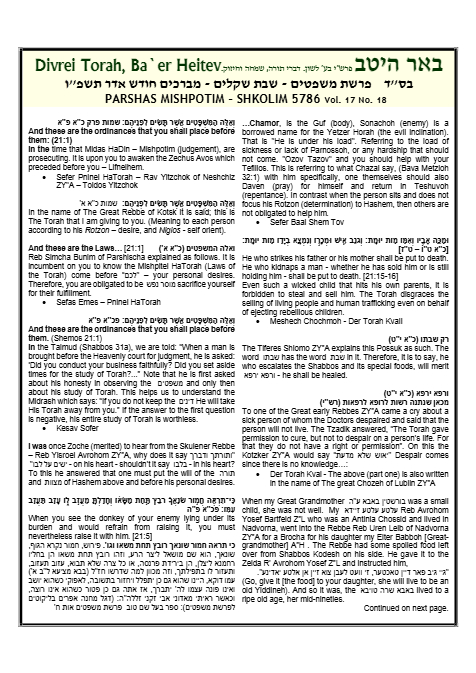

Charity and Lending

When you lend money to My people, to the person who is with you, do not act toward him as a creditor; do not lay interest upon him. (Shemos 22:24)

Alternative interpretation: “... את העני עמך - even when poverty is with you.” The commandments to give Tzedokah and to extend loans without charging interest apply even at times “when poverty is with you.” Even if you yourself are short of money, you must still set aside part of what you have for the poor. With regard to the verse “תֶא דֵבַּכּ-˃ְנוֹהֵמ 'ה” (Mishlei [Proverbs] 3:9) - “Honor Hashem with your wealth”, the Sages say: “Read not me-honecha - ‘with (or from) your wealth’ but mi-geronecha - ‘from your throat’.” This means that you must give charity, even if it means depriving your own stomach.

Rav Shmelkoh of Nikolsburg

One must always remember and not forget – The עני ohny. The Poor man riding on the Donkey, he is The Melech HaMoshiach:

Reb Menashe of Veretzky, Alfei Menashe

Reb Shlomah Chaim of Koidenov expounds in his Sefer Divrei Sholom on the words of The Possuk, the poor man – with you. Only the money that you give to the poor man – will be with you, remain with you, and escort you to Ollom Habboh

Pininei HaTorah

Holiness in Action

People of holiness shall you be to Me; etc. (22:30)

In the name of the Kotzker Rebbe ZY"A, on this Possuk, it shall be the safeguard of Kedushoh (holiness) in a person's actions and activities. As to say, there is no shortage of Heavenly Malochim, Serofim and Chayos HaKodesh (types of Angels), to Hashem. Rather Hashem wants human Kedushoh.

Sefer Sefas Emes

Following the Majority

The Possuk in Mishpotim tells us "Achrei Rabim Lihatos" (23:2) to follow the majority. The famous question asked is that since most of the world does not follow Hashem and abide by the laws of the Torah why aren't we obligated to follow the majority? The Chasam Sofer's explanation of this Posuk answers this question. "Lo Si'yeh Achrei Rabim Lira'os"; there are things that are absolutely, positively bad. Do not follow the majority in their wickedness and foolishness. When do you follow the majority? "Lihatos" when there is doubt in which way to turn. Then go with the Rabim. If you understand this, then "Vilo Saaneh Al Riv" says the Posuk. You will not be caught up in debate about avodah zoroh and other bad ways of the world because the guidelines are clear to you. Reb Elchonon Wasserman ZY”a HY”D answered that it says a few Psukim later (23:8) that bribery blinds the wise. The majority of the world is bribed by their desires and even if they are wise they have become blind and cannot be followed.

PDF Preview