Faith, Logic, and Beyond
Ben Chamesh L'Mikra | February 04, 2024
Print This Article
View Original PDF

Faith, Logic, and Beyond

Ben Chamesh L'Mikra | December 10, 2025

Parshas Mishpatim
Faith, Logic, and Beyond

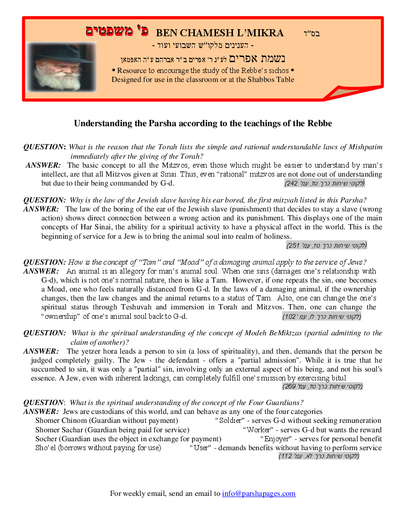
This week’s parsha focuses on the rational laws of the Torah. Included in this Torah portion however, are the preparations for the giving of the Torah and the prohibition of milk and meat—both of which do not seem to fit into the above theme. Through an analysis of the chronology of events, this Sicha illustrates the need for faith along with rationale in the service of G-d and the fulfillment of His mitzvos.

The name of each Torah portion expresses the theme of its entire content. The fact that the parsha as a whole is called by a certain name implies that all the details of the portion are expressive and connected to that title.

This week’s Torah portion is called “Mishpatim.” Accordingly, all the details of the parsha should be in line with the concept of mishpatim, rational laws.

It seems however, that this is not the case. For although much of the parsha does indeed deal with commandments which can be understood logically, other events and commandments related in Parshas Mishpatim seem to express an opposite theme.

Contrasting subjects

The end of the Torah portion of Mishpatim deals with the preparation for receiving the Torah—an event which far surpassed natural limitations and human rationale. This general account of the preparation for the Torah, recorded in the parsha does not seem connected to the theme of mishpatim at all.

Furthermore, mentioned in the Torah portion is also the specific preparatory steps that took place before the Torah was given at Mt. Sinai. Amongst these proceedings was the Israelites’ acceptance of the Torah, in which the Jewish people declared: “All that the Lord spoke, we will do and we will hear.”

By prefacing with the words “we will do,” the Jewish people expressed their commitment to fulfill the commandments of G-d, prior to understanding them rationally.

This statement, though, seems to be in stark contrast to the concept of mishpatim, which encompasses those G-dly directives belonging to the realm of reason. The Israelites’ declaration, by distinction, vocalized their pure faith and commitment to the Almighty and His mitzvos (commandments); a faith which surpassed reason.

Additionally, amongst the mitzvos found within Parshas Mishpatim is also a commandment that seems to be opposite the theme of the parsha as well. This mitzvah is the prohibition regarding mixing milk and meat—an instruction which ultimately cannot be understood logically, but which is rather an edict from the Almighty.

Why then, was the preparation for the giving of the Torah and the prohibition of milk and meat included in Parshas Mishpatim, which deals with the rational laws?

From Sinai

These questions can perhaps be explained through prefacing Rashi’s commentary of the first verse in the parsha.

In the opening sentence, “And these are the Mishpatim...,” Rashi explains the meaning of the initial word “And,” which the parsha begins with, based on the words of the Medrash.

The Medrash explains, that the laws of the parsha, which include many civil and logical guidelines such as the laws of injury, murder, etc., were also given along with the rest of the Torah at Mt. Sinai.

Text 1
Wherever it says, “these” [in the Torah,] it [(this word) is used to] separate from what has been stated previously. [Where it says,] “And these,” [it means that] it is adding to what has been previously stated. [Thus] just as what has been previously stated [namely the Ten Commandments,] were from Sinai, these too were from Sinai...
Rashi, Shemos 21:1

The deeper meaning to this statement is that not only were these rational laws, given at Sinai, but they should be fulfilled in the same spirit of Sinai—i.e. for the very fact that G-d said so, not only because they make sense for us to abide by them.

In light of this, the reason for the inclusion of the super-rational elements in the parsha can also be understood.

The expression “we will do and we will hear,” articulates a complete subservience to the Almighty, which transcends reason. The prohibition of milk and meat as well—a commandment which cannot be understood logically—expresses this same notion.

The inclusion of these mitzvos in Parshas Mishpatim therefore relates, that in truth, all of the mitzvos, including the rational ones, ultimately must be fulfilled because they are the will of G-d; not merely because of a moral imperative.

The super-rational elements that are present in the parsha are thus not in contrast with the theme of the Torah portion, but express that in addition to logic, one must realize that all the laws of the Torah—including the rational, moral ones—must be fulfilled because they are the will of G-d.

The problem

However, this supposition cannot be accurate for numerous reasons:

  1. While Rashi conveys the explanation of the Medrash, that the laws of Parshas Mishpatim were instructed after the giving of the Torah (and thus originally came from Sinai), the Medrash brings an alternative opinion which states that these laws were given to the Jewish people prior to the giving of the Torah. Accordingly, it cannot be stressed that one must fulfill these mitzvos with the same feeling that was felt at the giving of the Torah—as they were indeed told to the Israelites prior to their receiving of the Torah.
  2. The name of the parsha is Mihshpatim, meaning laws that are understood logically. Consequently, the emphasis of the parsha must be in expressing the rational, not the irrational.

Rather than the Torah portion emphasizing that one must fulfill the rational laws because he is subservient to G-d’s will, in actuality, it must stress that one is required to fulfil the super-rational mitzvos with understanding and logic as well.

Maimonides explains this idea as follows:

Text 2
Although all of the statutes of the Torah are decrees...it is fit to meditate upon them and wherever it is possible to provide a reason, one should provide a reason. The Sages of the early generations said that King Shlomo understood most of the rationales for all the statutes of the Torah.
Rambam, Temura 4:13

Hence, although these above-mentioned laws are indeed decrees that are illogical, there is an element of reason within them as well. That is to say, that although the prohibition of milk and meat is irrational and the statement, “we will do and we will hear,” transcends logic, they too have a quality within them that can, and therefore must be understood with reason.

The order of Parsha’s

In addition to the previous questions on the parsha, there is as well an issue of the chronology, of which Parshas Mishpatim immediately follows the giving of the Torah expressed in Parshas Yisro.

The main innovation that arose as a result of the giving of the Torah was the instruction of the mitzvos that were super-rational, not of those that were logically understood on their own.

Why then, were the mitzvos that immediately followed the giving of the Torah—i.e. those found in Parshas Mishpatim—laws that would be understood and lived by, even were the Torah not have been given to the Jewish people?!

The novelty of Mt. Sinai

The giving of the Torah primarily expressed the fulfillment of the mitzvos which transcend logic (those mitzvos that are classified as chukim, edicts), not the mitzvos which can be understood through human comprehension:

  1. Regarding the mitzvos that are rational, a person should fulfill these cue to their moral obligation as a human being, even were they not to have been given in the Torah. Therefore, the primary mitzvos that are expressed with the giving of the Torah are those that transcend logic.

This is expressed in the Talmud as follows:

Text 3
Our Rabbis taught: “My ordinances you shall do,” i.e., such commandments which, if they were not written [in Scripture], they should by right have been written and these are they: [the laws concerning] idolatry [star-worship], immorality and bloodshed, robbery and blasphemy. “And My statutes you shall keep,” i.e., such commandments to which Satan objects, they are [those relating to]: the putting on of sha'atnez (the mixture of wool and linen), the chalizah [performed] by a sister-in-law, the purification of the leper, and the he-goat-to-be-sent-away. And perhaps you might think these are vain things, therefore Scripture says: “I am

Parshas Mishpatim
Faith, Logic, and Beyond

This week’s parsha focuses on the rational laws of the Torah. Included in this Torah portion however, are the preparations for the giving of the Torah and the prohibition of milk and meat—both of which do not seem to fit into the above theme. Through an analysis of the chronology of events, this Sicha illustrates the need for faith along with rationale in the service of G-d and the fulfillment of His mitzvos.

The name of each Torah portion expresses the theme of its entire content. The fact that the parsha as a whole is called by a certain name implies that all the details of the portion are expressive and connected to that title.

This week’s Torah portion is called “Mishpatim.” Accordingly, all the details of the parsha should be in line with the concept of mishpatim, rational laws.

It seems however, that this is not the case. For although much of the parsha does indeed deal with commandments which can be understood logically, other events and commandments related in Parshas Mishpatim seem to express an opposite theme.

Contrasting subjects

The end of the Torah portion of Mishpatim deals with the preparation for receiving the Torah—an event which far surpassed natural limitations and human rationale. This general account of the preparation for the Torah, recorded in the parsha does not seem connected to the theme of mishpatim at all.

Furthermore, mentioned in the Torah portion is also the specific preparatory steps that took place before the Torah was given at Mt. Sinai. Amongst these proceedings was the Israelites’ acceptance of the Torah, in which the Jewish people declared: “All that the Lord spoke, we will do and we will hear.”

By prefacing with the words “we will do,” the Jewish people expressed their commitment to fulfill the commandments of G-d, prior to understanding them rationally.

This statement, though, seems to be in stark contrast to the concept of mishpatim, which encompasses those G-dly directives belonging to the realm of reason. The Israelites’ declaration, by distinction, vocalized their pure faith and commitment to the Almighty and His mitzvos (commandments); a faith which surpassed reason.

Additionally, amongst the mitzvos found within Parshas Mishpatim is also a commandment that seems to be opposite the theme of the parsha as well. This mitzvah is the prohibition regarding mixing milk and meat—an instruction which ultimately cannot be understood logically, but which is rather an edict from the Almighty.

Why then, was the preparation for the giving of the Torah and the prohibition of milk and meat included in Parshas Mishpatim, which deals with the rational laws?

From Sinai

These questions can perhaps be explained through prefacing Rashi’s commentary of the first verse in the parsha.

In the opening sentence, “And these are the Mishpatim...,” Rashi explains the meaning of the initial word “And,” which the parsha begins with, based on the words of the Medrash.

The Medrash explains, that the laws of the parsha, which include many civil and logical guidelines such as the laws of injury, murder, etc., were also given along with the rest of the Torah at Mt. Sinai.

Text 1
Wherever it says, “these” [in the Torah,] it [(this word) is used to] separate from what has been stated previously. [Where it says,] “And these,” [it means that] it is adding to what has been previously stated. [Thus] just as what has been previously stated [namely the Ten Commandments,] were from Sinai, these too were from Sinai...
Rashi, Shemos 21:1

The deeper meaning to this statement is that not only were these rational laws, given at Sinai, but they should be fulfilled in the same spirit of Sinai—i.e. for the very fact that G-d said so, not only because they make sense for us to abide by them.

In light of this, the reason for the inclusion of the super-rational elements in the parsha can also be understood.

The expression “we will do and we will hear,” articulates a complete subservience to the Almighty, which transcends reason. The prohibition of milk and meat as well—a commandment which cannot be understood logically—expresses this same notion.

The inclusion of these mitzvos in Parshas Mishpatim therefore relates, that in truth, all of the mitzvos, including the rational ones, ultimately must be fulfilled because they are the will of G-d; not merely because of a moral imperative.

The super-rational elements that are present in the parsha are thus not in contrast with the theme of the Torah portion, but express that in addition to logic, one must realize that all the laws of the Torah—including the rational, moral ones—must be fulfilled because they are the will of G-d.

The problem

However, this supposition cannot be accurate for numerous reasons:

  1. While Rashi conveys the explanation of the Medrash, that the laws of Parshas Mishpatim were instructed after the giving of the Torah (and thus originally came from Sinai), the Medrash brings an alternative opinion which states that these laws were given to the Jewish people prior to the giving of the Torah. Accordingly, it cannot be stressed that one must fulfill these mitzvos with the same feeling that was felt at the giving of the Torah—as they were indeed told to the Israelites prior to their receiving of the Torah.
  2. The name of the parsha is Mihshpatim, meaning laws that are understood logically. Consequently, the emphasis of the parsha must be in expressing the rational, not the irrational.

Rather than the Torah portion emphasizing that one must fulfill the rational laws because he is subservient to G-d’s will, in actuality, it must stress that one is required to fulfil the super-rational mitzvos with understanding and logic as well.

Maimonides explains this idea as follows:

Text 2
Although all of the statutes of the Torah are decrees...it is fit to meditate upon them and wherever it is possible to provide a reason, one should provide a reason. The Sages of the early generations said that King Shlomo understood most of the rationales for all the statutes of the Torah.
Rambam, Temura 4:13

Hence, although these above-mentioned laws are indeed decrees that are illogical, there is an element of reason within them as well. That is to say, that although the prohibition of milk and meat is irrational and the statement, “we will do and we will hear,” transcends logic, they too have a quality within them that can, and therefore must be understood with reason.

The order of Parsha’s

In addition to the previous questions on the parsha, there is as well an issue of the chronology, of which Parshas Mishpatim immediately follows the giving of the Torah expressed in Parshas Yisro.

The main innovation that arose as a result of the giving of the Torah was the instruction of the mitzvos that were super-rational, not of those that were logically understood on their own.

Why then, were the mitzvos that immediately followed the giving of the Torah—i.e. those found in Parshas Mishpatim—laws that would be understood and lived by, even were the Torah not have been given to the Jewish people?!

The novelty of Mt. Sinai

The giving of the Torah primarily expressed the fulfillment of the mitzvos which transcend logic (those mitzvos that are classified as chukim, edicts), not the mitzvos which can be understood through human comprehension:

  1. Regarding the mitzvos that are rational, a person should fulfill these cue to their moral obligation as a human being, even were they not to have been given in the Torah. Therefore, the primary mitzvos that are expressed with the giving of the Torah are those that transcend logic.

This is expressed in the Talmud as follows:

Text 3
Our Rabbis taught: “My ordinances you shall do,” i.e., such commandments which, if they were not written [in Scripture], they should by right have been written and these are they: [the laws concerning] idolatry [star-worship], immorality and bloodshed, robbery and blasphemy. “And My statutes you shall keep,” i.e., such commandments to which Satan objects, they are [those relating to]: the putting on of sha'atnez (the mixture of wool and linen), the chalizah [performed] by a sister-in-law, the purification of the leper, and the he-goat-to-be-sent-away. And perhaps you might think these are vain things, therefore Scripture says: “I am

PDF Preview