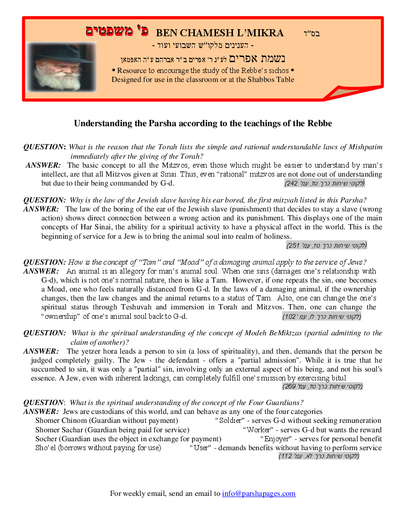
I Don’t Want: The Proper Attitude Toward Rational and Superrational Mitzvos
Ben Chamesh L'Mikra | February 04, 2024
Print This Article
View Original PDF

I Don’t Want: The Proper Attitude Toward Rational and Superrational Mitzvos

Ben Chamesh L'Mikra | December 10, 2025

I don’t want

Accordingly, we can understand the following Medrash:

Text 13
Rabbi Shimon ben Gamliel said: “A person should not say, ‘I do not want to eat meat and milk, I do not want to wear shatnez (a mixture of wool and linen) and I do not want to have illicit relations.’ Rather he should say, ‘I want to, but what shall I do when my Father in Heaven has decreed [forbidden] me from doing so.’”
Sifra, Kedoshim 20:26

Maimonides explains, that a person should only express the above and say that he would rather sin when it pertains to mitzvos that are beyond logic. These mitzvos he should indeed fulfill purely because the Almighty has mandated that he do so, though his own logic and feelings think otherwise. However, concerning mitzvos that are indeed logical, a person should feel that he does not wish to sin. He should not sin because G-d does not want him to, but because he understands that these transgressions are wrong.

Text 14
The evils which the philosophers term such, and of which they say that he who has no longing for them is more to be praised than he who desires them but conquers his passion, are things which all people commonly agree are evils, such as the shedding of blood, theft, robbery, fraud, injury to one who has done no harm, ingratitude, contempt for parents, and the like. The prescriptions which the Rabbis said, "If they had not already been written in the Law, it would be proper to add them."...There is no doubt that a soul which has the desire for, and lusts after, the above-mentioned misdeeds, is imperfect, that a noble soul has absolutely no desire for any such crimes, and experiences no struggle in refraining from them.
Rambam, Shemona Perakim 6
I don’t want

Accordingly, we can understand the following Medrash:

Text 13
Rabbi Shimon ben Gamliel said: “A person should not say, ‘I do not want to eat meat and milk, I do not want to wear shatnez (a mixture of wool and linen) and I do not want to have illicit relations.’ Rather he should say, ‘I want to, but what shall I do when my Father in Heaven has decreed [forbidden] me from doing so.’”
Sifra, Kedoshim 20:26

Maimonides explains, that a person should only express the above and say that he would rather sin when it pertains to mitzvos that are beyond logic. These mitzvos he should indeed fulfill purely because the Almighty has mandated that he do so, though his own logic and feelings think otherwise. However, concerning mitzvos that are indeed logical, a person should feel that he does not wish to sin. He should not sin because G-d does not want him to, but because he understands that these transgressions are wrong.

Text 14
The evils which the philosophers term such, and of which they say that he who has no longing for them is more to be praised than he who desires them but conquers his passion, are things which all people commonly agree are evils, such as the shedding of blood, theft, robbery, fraud, injury to one who has done no harm, ingratitude, contempt for parents, and the like. The prescriptions which the Rabbis said, "If they had not already been written in the Law, it would be proper to add them."...There is no doubt that a soul which has the desire for, and lusts after, the above-mentioned misdeeds, is imperfect, that a noble soul has absolutely no desire for any such crimes, and experiences no struggle in refraining from them.
Rambam, Shemona Perakim 6
PDF Preview