Mitzvah of Tzedaka is the key to having prayers answered
Pardes Yehuda | February 12, 2026
Print This Article
View Original PDF

Mitzvah of Tzedaka is the key to having prayers answered

Pardes Yehuda | February 13, 2026

When you lend money to My people, to the poor person who is with you.... To explain what is meant by "with you"? Rashi comments from the Midrash Tanchuma 15, that "with you" refers to the person who is giving the Tzedaka.

Look at yourself as if you were a poor person.

We can expand on this Rashi, as we know that according to the Arizal there is a statement and Kavanah that must be made before Davening: I hereby accept upon myself the commandment of The Creator to love my neighbor as myself! That is I am preparing to Daven and am performing the Mitzvah of loving my neighbor as myself.

To understand what does this Mitzvah have with Davening? This can be explained according to the Gemarra Shabbos 31a. There was another incident involving one gentile who came before Shammai and said to Shammai: Convert me on condition that you teach me the entire Torah while I am standing on one foot. Shammai pushed him away with the builder’s cubit in his hand. This was a common measuring stick and Shammai was a builder by trade. The same gentile came before Hillel. He converted him and said to him: That which is hateful to you do not do to another; that is the entire Torah, and the rest is its interpretation. Go study.

The explanation of Hillel that his idea constitutes the entire Torah can be the words of Rebbe Akiva: Rebbe Akiva said: This is a great principle of the Torah: "You shall love your neighbor as yourself" (Vayikra. 19:18). Thus, one should not say, “Since I am scorned, I should scorn my fellow as well; since I have been cursed, I will curse my fellow as well.” Rebbe Tanchuma said, if you act thus, realize who it is that you are willing to have humiliated - "the one who was made in the likeness of God." Rebbe Tanchuma says, “If you do so, you should know who are you scorning — ‘in the likeness of G-d He created him.’” Bereishis Rabbah 24:7

This is so powerful! Rebbe Akiva is saying this is a great principle of the Torah: "You shall love your neighbor as yourself". Hillel said that which is hateful to you do not do to another; that is the entire Torah. Evidently, they both have the same meaning of loving your neighbor as yourself—that is the entire Torah.

When we truly apply the principle of Hillel to our behavior to other people we become closer to Hashem as Rebbe Tanchuma says: by scorning your friend, you are scorning Hashem who created him. By acting negatively when things don’t go your way, you are scorning Hashem, who created you and that person who you want to scorn! The source of all bad Middos is arrogance according to the Ramchal in Mesilas Yesharim. If one acts with humility towards others, he would have good Middos, which is in reality Derech Eretz. Chazal in Midrash (Vayikra Rabba Chapter 9) say Derech Eretz Kadma LaTorah. Before someone can learn Torah he must have Derech Eretz which is "You shall love your neighbor as yourself". Hence are the words of Hillel and Rebbe Akiva that this principle is the basis of Torah, since without this one cannot learn Torah!

We can now apply the Arizal before davening: I hereby accept upon myself the commandment of The Creator to love my neighbor as myself! Since before we daven we have to learn as first is Torah then Tefilah. With the mitzvah of Ahavas Yisrael which is the Derech Eretz we can connect to the Torah. Afterwards we can Daven with the right Kavanah and connect to Hashem and our prayers would be answered. In many Siddurim it states clearly that by saying this it is a segulah to have the prayers answered!

This is "with you" and Rashi says: Look at yourself as if you were a poor person. Feel the pain of the poor person. This is what Hillel said “That which is hateful to you do not do to another”. Give Tzedaka to the poor person as you would if you were the receiver. This is the entire Torah, as this is Derech Eretz which would give you the key to understanding the Torah and connect to Hashem.

(Yehuda Z. Klitnick)
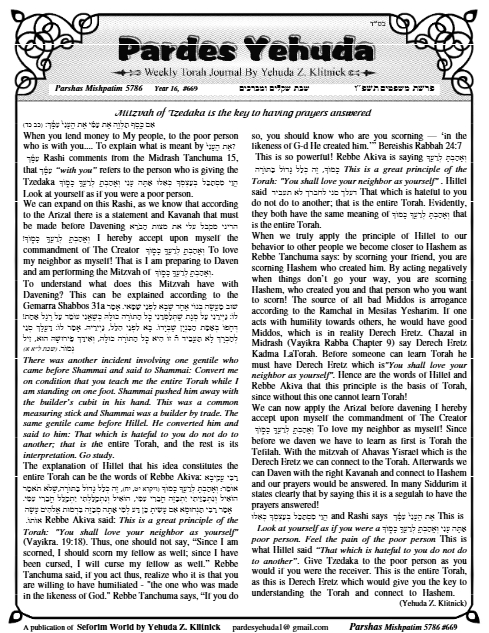
When you lend money to My people, to the poor person who is with you.... To explain what is meant by "with you"? Rashi comments from the Midrash Tanchuma 15, that "with you" refers to the person who is giving the Tzedaka.

Look at yourself as if you were a poor person.

We can expand on this Rashi, as we know that according to the Arizal there is a statement and Kavanah that must be made before Davening: I hereby accept upon myself the commandment of The Creator to love my neighbor as myself! That is I am preparing to Daven and am performing the Mitzvah of loving my neighbor as myself.

To understand what does this Mitzvah have with Davening? This can be explained according to the Gemarra Shabbos 31a. There was another incident involving one gentile who came before Shammai and said to Shammai: Convert me on condition that you teach me the entire Torah while I am standing on one foot. Shammai pushed him away with the builder’s cubit in his hand. This was a common measuring stick and Shammai was a builder by trade. The same gentile came before Hillel. He converted him and said to him: That which is hateful to you do not do to another; that is the entire Torah, and the rest is its interpretation. Go study.

The explanation of Hillel that his idea constitutes the entire Torah can be the words of Rebbe Akiva: Rebbe Akiva said: This is a great principle of the Torah: "You shall love your neighbor as yourself" (Vayikra. 19:18). Thus, one should not say, “Since I am scorned, I should scorn my fellow as well; since I have been cursed, I will curse my fellow as well.” Rebbe Tanchuma said, if you act thus, realize who it is that you are willing to have humiliated - "the one who was made in the likeness of God." Rebbe Tanchuma says, “If you do so, you should know who are you scorning — ‘in the likeness of G-d He created him.’” Bereishis Rabbah 24:7

This is so powerful! Rebbe Akiva is saying this is a great principle of the Torah: "You shall love your neighbor as yourself". Hillel said that which is hateful to you do not do to another; that is the entire Torah. Evidently, they both have the same meaning of loving your neighbor as yourself—that is the entire Torah.

When we truly apply the principle of Hillel to our behavior to other people we become closer to Hashem as Rebbe Tanchuma says: by scorning your friend, you are scorning Hashem who created him. By acting negatively when things don’t go your way, you are scorning Hashem, who created you and that person who you want to scorn! The source of all bad Middos is arrogance according to the Ramchal in Mesilas Yesharim. If one acts with humility towards others, he would have good Middos, which is in reality Derech Eretz. Chazal in Midrash (Vayikra Rabba Chapter 9) say Derech Eretz Kadma LaTorah. Before someone can learn Torah he must have Derech Eretz which is "You shall love your neighbor as yourself". Hence are the words of Hillel and Rebbe Akiva that this principle is the basis of Torah, since without this one cannot learn Torah!

We can now apply the Arizal before davening: I hereby accept upon myself the commandment of The Creator to love my neighbor as myself! Since before we daven we have to learn as first is Torah then Tefilah. With the mitzvah of Ahavas Yisrael which is the Derech Eretz we can connect to the Torah. Afterwards we can Daven with the right Kavanah and connect to Hashem and our prayers would be answered. In many Siddurim it states clearly that by saying this it is a segulah to have the prayers answered!

This is "with you" and Rashi says: Look at yourself as if you were a poor person. Feel the pain of the poor person. This is what Hillel said “That which is hateful to you do not do to another”. Give Tzedaka to the poor person as you would if you were the receiver. This is the entire Torah, as this is Derech Eretz which would give you the key to understanding the Torah and connect to Hashem.

(Yehuda Z. Klitnick)

PDF Preview