Purim Costumes in Halachah and Aggadah
למודי משה | February 12, 2026
Print This Article
View Original PDF

Purim Costumes in Halachah and Aggadah

למודי משה | February 13, 2026

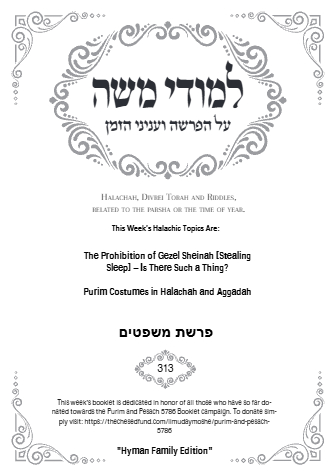
The month of Adar is just around the corner, and parents and children are filled with excitement about the upcoming Yom Tov of Purim. It is now that time of year when parents and children are deciding what Purim costumes to dress up with this year. Therefore, this week I would to discuss the topic of “Purim Costumes”, to help raise awareness of some pertinent halachos before it is too late. Why do we dress up on Purim? Is it fitting for Rabbonim to dress up? Does one need to be worried about shatnez when selecting a Purim costume? When choosing a Purim costume does one need to be concerned about “lo yilbash”? At what age does one need to start being careful? Is one allowed to daven in his Purim costume, or should he make sure to remove it before davening? May one dress up using a tallis or kittel? Is there an inyan to try and find a costume with a tail? Of this and more below.

The Minhag Yisrael of Dressing Up on Purim

The custom to dress up on Purim by wearing face masks, and by wearing a variety of different colorful clothing, is an ancient Jewish custom dating back to the times of Kadmonim, as is clear in the Teshuvos Mahari Mintz (siman 15), cited in the Rema (Orach Chaim 696:8). There are some Rabbonim who dress up, and even the Rema himself dressed up. R’ Akiva Yosef Schlesinger zt"l related (Lev HaIvri Yerushalayim 5750, Vol. 1, pg. 4, ois 2) that the Rema was niftar at the age of 33, on Lag B’Omer, in the year תשל''ג, and he wrote 33 seforim. And at his levayah they listed 32 praises about him, and they were struggling to find a 33rd. Then an elderly man came and said that on Purim the Rema would wear a mask and change his clothing, and he would go around to all the houses calling out “don’t forget to daven Ma’ariv”, in order that people didn’t forget to daven Ma’ariv due to the excitement of the Purim seudah. We see that the Rema himself dressed up.

Why Do People Dress Up on Purim?

Simcha: The simplest and most understandable reason for dressing up based on the words of the Mahari Mintz and Rema (cited above), and mentioned in the sefer Otzar HaMinhagim is to increase, joy, happiness, and simcha, like it says in the Megillah (Esther 8:16): ליהודים היתה אורה ושמחה וששן ויקר - “For the Jews there was light, simcha, great joy and splendor.”

Purim Play

R’ Chaim Kanievsky zt”l related in the name of his father the Steipler, that in the yeshivah he learnt in they would make a “Purim Shpiel” every year to highlight the Purim story. To bring it to life, the bochurim would dress up as the characters in the Purim story. Interestingly, every single year, the bochur that dressed up like Haman didn’t stay in learning, and would end up leaving yeshivah that year. Just something to think about before dressing up like Haman.

Clothing Are Mashpia

Mechanchim [educators] say that clothing is an expression of the inner soul, a type of 'role model', and influences the child's aspirations. Therefore, it is advisable for children to dress up as righteous men and women (Moshe Rabbeinu, Aharon HaKohen, Mordechai HaTzaddik) and not as negative things (Haman, priests, wicked people, secular people).

Dressing Up as A Clown

In Orchos Rabbeinu (Vol. 3, ois 104) they bring that someone once publicized that the clown costume was invented by the goyim to be used for their festivities and therefore it is forbidden to use it as a Purim costume. However, the Steipler disagreed with this statement and permitted dressing up as a clown, as has been the custom for centuries, and as is stated in the Ma’asei HaChida. He writes that on the contrary, the goyim took the idea from us, and in such cases, there is no prohibition of ובחקתיהם לא תלכו – “going in the way of the non-Jew’s.” Similar to what we find on Shavuos, that although non-Jew’s also use trees to decorate their places of worship, they copied us, therefore, there is no prohibition.
The month of Adar is just around the corner, and parents and children are filled with excitement about the upcoming Yom Tov of Purim. It is now that time of year when parents and children are deciding what Purim costumes to dress up with this year. Therefore, this week I would to discuss the topic of “Purim Costumes”, to help raise awareness of some pertinent halachos before it is too late. Why do we dress up on Purim? Is it fitting for Rabbonim to dress up? Does one need to be worried about shatnez when selecting a Purim costume? When choosing a Purim costume does one need to be concerned about “lo yilbash”? At what age does one need to start being careful? Is one allowed to daven in his Purim costume, or should he make sure to remove it before davening? May one dress up using a tallis or kittel? Is there an inyan to try and find a costume with a tail? Of this and more below.

The Minhag Yisrael of Dressing Up on Purim

The custom to dress up on Purim by wearing face masks, and by wearing a variety of different colorful clothing, is an ancient Jewish custom dating back to the times of Kadmonim, as is clear in the Teshuvos Mahari Mintz (siman 15), cited in the Rema (Orach Chaim 696:8). There are some Rabbonim who dress up, and even the Rema himself dressed up. R’ Akiva Yosef Schlesinger zt"l related (Lev HaIvri Yerushalayim 5750, Vol. 1, pg. 4, ois 2) that the Rema was niftar at the age of 33, on Lag B’Omer, in the year תשל''ג, and he wrote 33 seforim. And at his levayah they listed 32 praises about him, and they were struggling to find a 33rd. Then an elderly man came and said that on Purim the Rema would wear a mask and change his clothing, and he would go around to all the houses calling out “don’t forget to daven Ma’ariv”, in order that people didn’t forget to daven Ma’ariv due to the excitement of the Purim seudah. We see that the Rema himself dressed up.

Why Do People Dress Up on Purim?

Simcha: The simplest and most understandable reason for dressing up based on the words of the Mahari Mintz and Rema (cited above), and mentioned in the sefer Otzar HaMinhagim is to increase, joy, happiness, and simcha, like it says in the Megillah (Esther 8:16): ליהודים היתה אורה ושמחה וששן ויקר - “For the Jews there was light, simcha, great joy and splendor.”

Purim Play

R’ Chaim Kanievsky zt”l related in the name of his father the Steipler, that in the yeshivah he learnt in they would make a “Purim Shpiel” every year to highlight the Purim story. To bring it to life, the bochurim would dress up as the characters in the Purim story. Interestingly, every single year, the bochur that dressed up like Haman didn’t stay in learning, and would end up leaving yeshivah that year. Just something to think about before dressing up like Haman.

Clothing Are Mashpia

Mechanchim [educators] say that clothing is an expression of the inner soul, a type of 'role model', and influences the child's aspirations. Therefore, it is advisable for children to dress up as righteous men and women (Moshe Rabbeinu, Aharon HaKohen, Mordechai HaTzaddik) and not as negative things (Haman, priests, wicked people, secular people).

Dressing Up as A Clown

In Orchos Rabbeinu (Vol. 3, ois 104) they bring that someone once publicized that the clown costume was invented by the goyim to be used for their festivities and therefore it is forbidden to use it as a Purim costume. However, the Steipler disagreed with this statement and permitted dressing up as a clown, as has been the custom for centuries, and as is stated in the Ma’asei HaChida. He writes that on the contrary, the goyim took the idea from us, and in such cases, there is no prohibition of ובחקתיהם לא תלכו – “going in the way of the non-Jew’s.” Similar to what we find on Shavuos, that although non-Jew’s also use trees to decorate their places of worship, they copied us, therefore, there is no prohibition.

PDF Preview