Rabbi Meir Poppers The Young Redactor
Wonders | February 13, 2026
Print This Article
View Original PDF

Rabbi Meir Poppers The Young Redactor

Wonders | February 13, 2026

Rabbi Meir Poppers: The Young Redactor

Rabbi Meir Poppers, one of the most important Kabbalists in the generation following the Ari, was born in the year 5384 (1624) in Krakow, to his father Rabbi Yehuda Leib Ashkenazi Katz. At the age of thirteen, seeing that he was a genius in Kabbalah and he had no one to learn with at his level in Poland, his parents sent him to learn in Jerusalem, where he received the teachings of Kabbalah from many tzaddikim, among them Rabbi Yisrael Ashkenazi, author of Heichal HaShem, and Rabbi Ya’akov Tzemach the physician. Upon coming of age, he married the daughter of Rabbi Azariah Ze'evi and continued to study in the Kabbalists' yeshiva in Jerusalem. Despite his young age, he was adorned with great praise by the geniuses of his generation.

He toiled on organizing the writings of the Arizal that had been initially edited by Rabbi Chaim Vital and then reedited by his son, Rabbi Shmuel Vital. Ultimately, Rabbi Yaakov Tzemach, Rabbi Meir Poppers’ teacher, obtained alternate editions of Rabbi Chaim Vital’s writings and Rabbi Meir arranged all that was before him into a new edition, which he divided into three volumes titled Derech Etz Chaim, Nof Etz Chaim, and Pri Etz Chaim. His edition of the Arizal’s writings was accepted by all, so much so that his Derech Etz Chaim became known as simply Etz Chaim, sharing the same name that Rabbi Chaim Vital had given his edition. He departed this world in Jerusalem on the 2nd of Adar 5422 (1662) at the age of 38, the same age as the Arizal and was buried on the Mount of Olives.

In the introduction that Rabbi Meir Poppers wrote to his edition (titled Derech Etz Chaim) of Rabbi Chaim Vital’s book Etz Chaim, he says,

“My soul desired the Torah of Kabbalistic wisdom, and the fiery flames of passion for the coveted Kabbalistic wisdom. From the day I was thirteen years old, it burned within me like a fire burning in my bones. Until the King brought me to His chambers, and I merited to taste with the edge of a staff in the house of the distinguished teacher, the pious and humble one, the physician and consummate sage, our teacher Rabbi Ya’akov Tzemach, may his light shine. And I studied his books and found favor in his eyes.”

Indeed, Rabbi Meir’s wanderings from Krakow to Jerusalem at such a young age bore fruit. Following his teacher Rabbi Ya’akov Tzemach, he began to edit and arrange the teachings of the Arizal, which were originally recorded as they were spoken without order or classification between plain interpretation, homiletics, and mystical intentions.

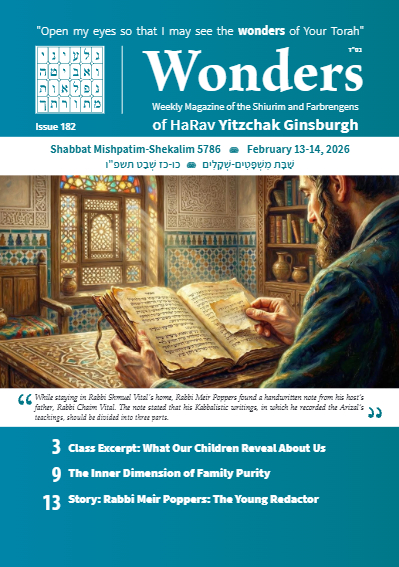
Though he began this work while still in Jerusalem, he only completed it thanks to a journey he undertook that at first prevented him from continuing to work on his edition. The journey was prompted by the Chmielnicki massacres of 1648-49, after which Rabbi Meir wished to inquire after the welfare of his family. Therefore, he left Jerusalem and set out for Poland. On his way, he passed through Damascus, where he stayed for eight days with Rabbi Shmuel Vital, the son of the Arizal’s premier disciple, Rabbi Chaim Vital. While staying in Rabbi Shmuel’s house, Rabbi Meir found a handwritten note from his host’s father, Rabbi Chaim Vital. The note stated that his Kabbalistic writings, in which he recorded the Arizal’s teachings, should be divided into three parts. As a result, Rabbi Meir divided his edition of the Arizal’s teachings into three parts: He called the first part Derech Etz Chaim (which quickly became known as simply Etz Chaim). The second part he called Pri Etz Chaim and the third, Nof Etz Chaim.

Afterwards, he stayed in Istanbul from Purim until Shavu’ot, where he continued his work, and upon arriving in Krakow, he completed writing his edition. In Krakow, he remained until 5414 (1654), received and taught students and wrote his own works of Kabbalah and then set out again for Jerusalem. His journey back to Jerusalem took an entire year, and when he arrived in the Land of Israel, he was ill and exhausted from the prolonged wanderings. Seven years later, on the 2nd of Adar 5426 (1666), Rabbi Meir passed away at the young age of thirty-eight.

(based on Zichronam Livrachah)

It is said that at the end of his life, the Arizal stated he would return to clarify his teachings. It is fitting, then, to see Rabbi Meir as this return: At a very young age, his heart already burned for Kabbalah. He authored many books and became a central authority on the Arizal’s teachings and finally departed this world at the age of thirty-eight, exactly like the holy Ari. Thanks to his writings, and even more so, due to his seminal edition of the Ari’s writings that ordered them in a clear way, Rabbi Meir holds a special place among the great Kabbalists. The Etz Chaim compilations he arranged became the primary source for Kabbalistic teachings, and many books he authored became cornerstones of Kabbalah. Rabbi Chaim Yosef David Azulai, the Chida, a giant in his own right and one of the all-time most important biographers and bibliographers of Torah personalities and writings relates that Rabbi Meir Poppers composed a total of thirty-nine books, corresponding to the numerical value of “dew” and alluding to the phrase, “the dew of lights is Your dew”, of which only about thirteen are known today.

The great Chasidic masters also greatly revered Rabbi Meir Poppers. His customs serve as a source for various practices in Chabad Chasidut, and his book Or Tzaddikim, containing customs and ethical teachings, earned enthusiastic praise from tzaddikim. The Maharil of Belz encouraged the printing of a prayer book that incorporated the customs from Or Tzaddikim, saying that through this book his holy father began to enter the service of God. The Divrei Chaim of Sanz (Rabbi Chaim of Sanz) said of this book that only one who follows it deserves to be called a chasid.

An interesting connection between Rabbi Meir Poppers and the Chasidic teachings of the Ba’al Shem Tov can be seen in the numerical value of his name, which is the same as 3 times the word “chashmal”. Chashmal, perhaps the most mysterious word in the entire Bible was a subject of study for both the Arizal and the Ba’al Shem Tov. The latter taught that this word chashmal, appearing only in the Book of Ezekiel alludes to the three-stage process required for every kind of psychological development: submission, separation, and sweetening. The first part of the word, chash corresponds to submission, since one of the meanings of chash in Hebrew is “silence”. The second part of the word, mal corresponds to separation, one of its meanings in Hebrew, as in “circumcision”. Mal also corresponds to sweetening. The Ba’al Shem Tov taught this process to his disciples, impressing upon them its application for speech. To be able to speak words of Torah and of God, they must first submit and separate themselves from their ego. Then their speech, the meaning of mal (as in melech), will be free of self-interest.

Interestingly, in the account of the Divine Chariot in Ezekiel, the word chashmal is mentioned exactly three times, the same numerical value as Rabbi Meir Poppers. These three instances of chashmal reveal that each stage of the three-stage process itself inter-includes all three stages, like a fractal where each branch duplicates the whole. Thus, there is the submission, separation, and sweetening of submission, of separation, and of sweetening.

Inter-inclusion makes the rigid model more flexible and makes it into a more mature and developed process of change. Instead of sharply jumping from submission to battle, and from there to reconciliation, a person can now discern more subtle shades of emotion and spiritual movements, and the movement toward good flows smoothly. Indeed, while sharp and uncompromising movements belong to the World of Chaos (tohu) that was shattered, inter-inclusion is a distinct characteristic of the world of Rectification (tikkun), where kindness and judgment can face each other and achieve mutual fertilization.

Even before considering inter-inclusion that divides the Ba’al Shem Tov’s process into 9 stages, dividing the process into three stages already indicates a characteristic of the World of Rectification. Whereas the World of Chaos is characterized by structures that have only two axes to them: a right and a left, loving-kindness and judgment, in the World of Rectification, there are three axes, a right, left, and a middle axis that provides balance between the right and the left. By both balancing and joining the right and the left, the middle axis becomes compassion. Rabbi Meir embodies this ability in the triple gematria of his name and in the three books of Etz Chaim he gave the world.
Rabbi Meir Poppers: The Young Redactor

Rabbi Meir Poppers, one of the most important Kabbalists in the generation following the Ari, was born in the year 5384 (1624) in Krakow, to his father Rabbi Yehuda Leib Ashkenazi Katz. At the age of thirteen, seeing that he was a genius in Kabbalah and he had no one to learn with at his level in Poland, his parents sent him to learn in Jerusalem, where he received the teachings of Kabbalah from many tzaddikim, among them Rabbi Yisrael Ashkenazi, author of Heichal HaShem, and Rabbi Ya’akov Tzemach the physician. Upon coming of age, he married the daughter of Rabbi Azariah Ze'evi and continued to study in the Kabbalists' yeshiva in Jerusalem. Despite his young age, he was adorned with great praise by the geniuses of his generation.

He toiled on organizing the writings of the Arizal that had been initially edited by Rabbi Chaim Vital and then reedited by his son, Rabbi Shmuel Vital. Ultimately, Rabbi Yaakov Tzemach, Rabbi Meir Poppers’ teacher, obtained alternate editions of Rabbi Chaim Vital’s writings and Rabbi Meir arranged all that was before him into a new edition, which he divided into three volumes titled Derech Etz Chaim, Nof Etz Chaim, and Pri Etz Chaim. His edition of the Arizal’s writings was accepted by all, so much so that his Derech Etz Chaim became known as simply Etz Chaim, sharing the same name that Rabbi Chaim Vital had given his edition. He departed this world in Jerusalem on the 2nd of Adar 5422 (1662) at the age of 38, the same age as the Arizal and was buried on the Mount of Olives.

In the introduction that Rabbi Meir Poppers wrote to his edition (titled Derech Etz Chaim) of Rabbi Chaim Vital’s book Etz Chaim, he says,

“My soul desired the Torah of Kabbalistic wisdom, and the fiery flames of passion for the coveted Kabbalistic wisdom. From the day I was thirteen years old, it burned within me like a fire burning in my bones. Until the King brought me to His chambers, and I merited to taste with the edge of a staff in the house of the distinguished teacher, the pious and humble one, the physician and consummate sage, our teacher Rabbi Ya’akov Tzemach, may his light shine. And I studied his books and found favor in his eyes.”

Indeed, Rabbi Meir’s wanderings from Krakow to Jerusalem at such a young age bore fruit. Following his teacher Rabbi Ya’akov Tzemach, he began to edit and arrange the teachings of the Arizal, which were originally recorded as they were spoken without order or classification between plain interpretation, homiletics, and mystical intentions.

Though he began this work while still in Jerusalem, he only completed it thanks to a journey he undertook that at first prevented him from continuing to work on his edition. The journey was prompted by the Chmielnicki massacres of 1648-49, after which Rabbi Meir wished to inquire after the welfare of his family. Therefore, he left Jerusalem and set out for Poland. On his way, he passed through Damascus, where he stayed for eight days with Rabbi Shmuel Vital, the son of the Arizal’s premier disciple, Rabbi Chaim Vital. While staying in Rabbi Shmuel’s house, Rabbi Meir found a handwritten note from his host’s father, Rabbi Chaim Vital. The note stated that his Kabbalistic writings, in which he recorded the Arizal’s teachings, should be divided into three parts. As a result, Rabbi Meir divided his edition of the Arizal’s teachings into three parts: He called the first part Derech Etz Chaim (which quickly became known as simply Etz Chaim). The second part he called Pri Etz Chaim and the third, Nof Etz Chaim.

Afterwards, he stayed in Istanbul from Purim until Shavu’ot, where he continued his work, and upon arriving in Krakow, he completed writing his edition. In Krakow, he remained until 5414 (1654), received and taught students and wrote his own works of Kabbalah and then set out again for Jerusalem. His journey back to Jerusalem took an entire year, and when he arrived in the Land of Israel, he was ill and exhausted from the prolonged wanderings. Seven years later, on the 2nd of Adar 5426 (1666), Rabbi Meir passed away at the young age of thirty-eight.

(based on Zichronam Livrachah)

It is said that at the end of his life, the Arizal stated he would return to clarify his teachings. It is fitting, then, to see Rabbi Meir as this return: At a very young age, his heart already burned for Kabbalah. He authored many books and became a central authority on the Arizal’s teachings and finally departed this world at the age of thirty-eight, exactly like the holy Ari. Thanks to his writings, and even more so, due to his seminal edition of the Ari’s writings that ordered them in a clear way, Rabbi Meir holds a special place among the great Kabbalists. The Etz Chaim compilations he arranged became the primary source for Kabbalistic teachings, and many books he authored became cornerstones of Kabbalah. Rabbi Chaim Yosef David Azulai, the Chida, a giant in his own right and one of the all-time most important biographers and bibliographers of Torah personalities and writings relates that Rabbi Meir Poppers composed a total of thirty-nine books, corresponding to the numerical value of “dew” and alluding to the phrase, “the dew of lights is Your dew”, of which only about thirteen are known today.

The great Chasidic masters also greatly revered Rabbi Meir Poppers. His customs serve as a source for various practices in Chabad Chasidut, and his book Or Tzaddikim, containing customs and ethical teachings, earned enthusiastic praise from tzaddikim. The Maharil of Belz encouraged the printing of a prayer book that incorporated the customs from Or Tzaddikim, saying that through this book his holy father began to enter the service of God. The Divrei Chaim of Sanz (Rabbi Chaim of Sanz) said of this book that only one who follows it deserves to be called a chasid.

An interesting connection between Rabbi Meir Poppers and the Chasidic teachings of the Ba’al Shem Tov can be seen in the numerical value of his name, which is the same as 3 times the word “chashmal”. Chashmal, perhaps the most mysterious word in the entire Bible was a subject of study for both the Arizal and the Ba’al Shem Tov. The latter taught that this word chashmal, appearing only in the Book of Ezekiel alludes to the three-stage process required for every kind of psychological development: submission, separation, and sweetening. The first part of the word, chash corresponds to submission, since one of the meanings of chash in Hebrew is “silence”. The second part of the word, mal corresponds to separation, one of its meanings in Hebrew, as in “circumcision”. Mal also corresponds to sweetening. The Ba’al Shem Tov taught this process to his disciples, impressing upon them its application for speech. To be able to speak words of Torah and of God, they must first submit and separate themselves from their ego. Then their speech, the meaning of mal (as in melech), will be free of self-interest.

Interestingly, in the account of the Divine Chariot in Ezekiel, the word chashmal is mentioned exactly three times, the same numerical value as Rabbi Meir Poppers. These three instances of chashmal reveal that each stage of the three-stage process itself inter-includes all three stages, like a fractal where each branch duplicates the whole. Thus, there is the submission, separation, and sweetening of submission, of separation, and of sweetening.

Inter-inclusion makes the rigid model more flexible and makes it into a more mature and developed process of change. Instead of sharply jumping from submission to battle, and from there to reconciliation, a person can now discern more subtle shades of emotion and spiritual movements, and the movement toward good flows smoothly. Indeed, while sharp and uncompromising movements belong to the World of Chaos (tohu) that was shattered, inter-inclusion is a distinct characteristic of the world of Rectification (tikkun), where kindness and judgment can face each other and achieve mutual fertilization.

Even before considering inter-inclusion that divides the Ba’al Shem Tov’s process into 9 stages, dividing the process into three stages already indicates a characteristic of the World of Rectification. Whereas the World of Chaos is characterized by structures that have only two axes to them: a right and a left, loving-kindness and judgment, in the World of Rectification, there are three axes, a right, left, and a middle axis that provides balance between the right and the left. By both balancing and joining the right and the left, the middle axis becomes compassion. Rabbi Meir embodies this ability in the triple gematria of his name and in the three books of Etz Chaim he gave the world.

PDF Preview