The Yehoash Tablet and the Power of Tzedaka
MAOR CENTRE publications | February 13, 2026
Print This Article
View Original PDF

The Yehoash Tablet and the Power of Tzedaka

MAOR CENTRE publications | February 13, 2026

Back in the 1990s, a stone tablet was found in a Muslim cemetery in Jerusalem. The inscription, carved in ancient Hebrew letters, was believed to have been written by king Yehoash ben Achazyahu, describing his efforts to raise funds for the Bedek Habayis, the restoration of the Beis Hamikdash.

It refers to the “donating money for sacred contributions” by the men of the “cities of Yehuda” that would be given with “generosity of heart of men”. It details how these funds were used to “purchase hewn stone and... copper”. It concludes “I renovated the Bedek Habayis—the breaches of the Temple and the surrounding walls.” It became known as the Yehoash inscription.

The tablet appeared to be archeological evidence of the account in Tanach which is read as the Haftorah for Shabbos Shekalim.

The Haftorah describes how the Beis Hamikdash had fallen into disrepair. details the efforts that king Yehoash took to raise money for the upkeep and renovation of the Beis Hamikdash. This is in keeping with the requirement that the content of the Haftorah should contain or refer to a central idea of the weekly Parsha. In this case, the Maftir and Haftarah both discuss financial donations for the Temple.

In his efforts to raise communal funds, Yehoyada the Kohen Gadol arranged the first Tzedaka box, a wooden box, with an opening bored into its side that was placed next to the Mizbeach. The Pasuk refers to ארון אחד, one box.

The commentators note that in Divrei Hayamim it records that the box was placed outside of the courtyard, rather than next to the Mizbeach. The Malbim reconciles the contradiction by explaining that the box next to the Mizbeach was actually the box for the collection of the half Shekel contributions for that year. The box outside was for the half Shekels of the previous year, if someone had not given it then.

He further writes that the word אחד, which has the gematria of 13, alludes to 13 different boxes for contributions that were present in the Beis Hamikdash. The Mishna in Mesechta Shekalim lists 13 donation boxes that were in the Beis hamikdash. Each box was designated for a specific collection, including; the annual half Shekel donations that were used to purchase the communal sacrifices, donations to purchase frankincense or wood for the Mizbeach, purchasing specific types of sacrifices, and a 6 boxes for general donations for the Temple upkeep.

The Mishna calls these boxes “Shofars”. This is because they were constructed like the shape of a Shofar. Just as a Shofar is narrow at the “mouthpiece” and becomes wider at the other end, these boxes were narrow at the top where the coins were inserted, and wider at the bottom.

The reason for this was to make it difficult for someone to be able to take money out of the box. But there is also a deeper message for us about the power of Tzedaka.

The mystics associate the shape of the Shofar with the verse “from the narrowness I call out to You Hashem, answer me with expansiveness Hashem”. This verse is read before the blowing of the Shofar on Rosh Hashana. Blowing the Shofar from the narrow end represents our humility. When blown with this humility, Hashem answers us in an expansive measure.

The same is true with Tzedaka. When we give Tzedaka, it might be with a small or "narrow" act or amount, like the half Shekel. But when given with sincerity and humility, this small act generates expansive blessings from Above. It also becomes magnified as the kindness is paid-forward.

The ארון אחד and the 13 boxes allude to how Tzedaka creates oneness and unity amongst the Jewish people and connects us with the oneness of Hashem.

Tzedaka creates unity amongst the Jewish people by fostering a sense of compassion, empathy and care and demanding that we act with kindness and charity to others. This unity of Tzedaka was especially emphasized in the half Shekel donation, where one needed to “join” together with a fellow Jew, to be able to have a complete Shekel. This teaches us that our own sense of wholeness and completion can only be attained through our Achdus with others.

Back to the Yehoash tablet. A decade after its discovery, accusations were raised that it was a forgery used for financial fraud. It was at the centre of a 7-year court-case in Israel and was examined by over 70 scholars. The court concluded that the State had not successfully proven that it was a forgery. Scholars debate its authenticity to this very day.

What no one can doubt is the Torah’s assurance that through Tzedaka we draw down Hashem’s blessing and atonement and through this we will merit the rebuilding of the Beis Hamikdash.
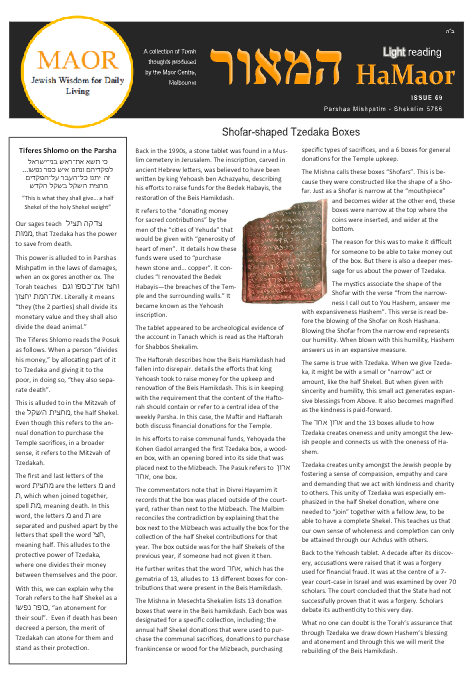

Back in the 1990s, a stone tablet was found in a Muslim cemetery in Jerusalem. The inscription, carved in ancient Hebrew letters, was believed to have been written by king Yehoash ben Achazyahu, describing his efforts to raise funds for the Bedek Habayis, the restoration of the Beis Hamikdash.

It refers to the “donating money for sacred contributions” by the men of the “cities of Yehuda” that would be given with “generosity of heart of men”. It details how these funds were used to “purchase hewn stone and... copper”. It concludes “I renovated the Bedek Habayis—the breaches of the Temple and the surrounding walls.” It became known as the Yehoash inscription.

The tablet appeared to be archeological evidence of the account in Tanach which is read as the Haftorah for Shabbos Shekalim.

The Haftorah describes how the Beis Hamikdash had fallen into disrepair. details the efforts that king Yehoash took to raise money for the upkeep and renovation of the Beis Hamikdash. This is in keeping with the requirement that the content of the Haftorah should contain or refer to a central idea of the weekly Parsha. In this case, the Maftir and Haftarah both discuss financial donations for the Temple.

In his efforts to raise communal funds, Yehoyada the Kohen Gadol arranged the first Tzedaka box, a wooden box, with an opening bored into its side that was placed next to the Mizbeach. The Pasuk refers to ארון אחד, one box.

The commentators note that in Divrei Hayamim it records that the box was placed outside of the courtyard, rather than next to the Mizbeach. The Malbim reconciles the contradiction by explaining that the box next to the Mizbeach was actually the box for the collection of the half Shekel contributions for that year. The box outside was for the half Shekels of the previous year, if someone had not given it then.

He further writes that the word אחד, which has the gematria of 13, alludes to 13 different boxes for contributions that were present in the Beis Hamikdash. The Mishna in Mesechta Shekalim lists 13 donation boxes that were in the Beis hamikdash. Each box was designated for a specific collection, including; the annual half Shekel donations that were used to purchase the communal sacrifices, donations to purchase frankincense or wood for the Mizbeach, purchasing specific types of sacrifices, and a 6 boxes for general donations for the Temple upkeep.

The Mishna calls these boxes “Shofars”. This is because they were constructed like the shape of a Shofar. Just as a Shofar is narrow at the “mouthpiece” and becomes wider at the other end, these boxes were narrow at the top where the coins were inserted, and wider at the bottom.

The reason for this was to make it difficult for someone to be able to take money out of the box. But there is also a deeper message for us about the power of Tzedaka.

The mystics associate the shape of the Shofar with the verse “from the narrowness I call out to You Hashem, answer me with expansiveness Hashem”. This verse is read before the blowing of the Shofar on Rosh Hashana. Blowing the Shofar from the narrow end represents our humility. When blown with this humility, Hashem answers us in an expansive measure.

The same is true with Tzedaka. When we give Tzedaka, it might be with a small or "narrow" act or amount, like the half Shekel. But when given with sincerity and humility, this small act generates expansive blessings from Above. It also becomes magnified as the kindness is paid-forward.

The ארון אחד and the 13 boxes allude to how Tzedaka creates oneness and unity amongst the Jewish people and connects us with the oneness of Hashem.

Tzedaka creates unity amongst the Jewish people by fostering a sense of compassion, empathy and care and demanding that we act with kindness and charity to others. This unity of Tzedaka was especially emphasized in the half Shekel donation, where one needed to “join” together with a fellow Jew, to be able to have a complete Shekel. This teaches us that our own sense of wholeness and completion can only be attained through our Achdus with others.

Back to the Yehoash tablet. A decade after its discovery, accusations were raised that it was a forgery used for financial fraud. It was at the centre of a 7-year court-case in Israel and was examined by over 70 scholars. The court concluded that the State had not successfully proven that it was a forgery. Scholars debate its authenticity to this very day.

What no one can doubt is the Torah’s assurance that through Tzedaka we draw down Hashem’s blessing and atonement and through this we will merit the rebuilding of the Beis Hamikdash.

PDF Preview