What Our Children Reveal About Us
Wonders | February 13, 2026
Print This Article
View Original PDF

What Our Children Reveal About Us

Wonders | February 13, 2026

The Ba’al Shem Tov had two children, a boy and a girl. His son was Rebbe Tzvi and his daughter was the famous Odel. Few know about Rebbe Tzvi and his descendants, while Odel’s descendants are famous. They include Rebbe Nachman of Breslov, his uncles the Degel Machaneh Ephraim and Rebbe Baruch of Mezhibuzh. What can we learn about the difference between a tzaddik’s sons and daughters from the history of the Ba’al Shem Tov’s family and how does this relate to each of us?

This class was given on the 7th of Tevet, 5786 and its transcript was first published in Hebrew in Nifla’ot for parashat Shemot of this year.

The Ba’al Shem Tov’s Grandchildren: Revealed and Concealed

The Ba’al Shem Tov’s son was Rebbe Tzvi whose yahrzeit is on the 7th of Tevet. His son, Rebbe Aharon of Titov’s yahrzeit is on the 5th of Tevet. Both lived their lives out of the limelight; in this, they resembled the concealed tzaddikim that the Ba’al Shem Tov was a part of until he was forced to reveal himself. Indeed, both were known in their lifetimes as tzaddikim, and they had followers, but they never sought publicity and lived in poverty. Rebbe Aharon once proclaimed that had he so wished, he would have money (and even proved so in a particular incident), but generally he had no interest in it.

It is interesting that in contrast to them, the descendants of the Baal Shem Tov from his daughter, Odel, were much more famous—her eldest son, the Degel Machaneh Ephraim, was famous, and even more so his younger brother, Rebbe Baruch of Mezhibuzh. Of course, there was more to them than just what was revealed, as is known from the parable comparing a tzaddik to an iceberg, where only ten percent is above water and visible while the other ninety percent is submerged and invisible; but their “visible ten percent” was famous. In the next generation as well, Odel’s grandson, the son of her daughter Feige—Rebbe Nachman of Breslov—was very famous.

We should contemplate why the offspring through the Ba’al Shem Tov’s son were more hidden, while those from his daughter were more famous.

Controversy and the Dissemination of Chassidus

Tzaddikim said that if, after the passing of the Ba’al Shem Tov, all the disciples had accepted his son, Rebbe Tzvi, as their Rebbe, there would have been no disputes between the tzaddikim throughout the continuation of the Chasidic movement. Similarly, they said that if after the passing of the Maggid of Mezritch, everyone had accepted the Me’or Einayim, Rebbe Menachem Nachum of Chernobyl as rebbe, there would have been no disputes regarding the way in which Chasidut should be practiced.

It is written that there was a connection between Rebbe Tzvi and the Me’or Einayim. The Ba’al Shem Tov came to the Me’or Einayim in a dream and asked him to look after his son, Rebbe Tzvi, and from then until the end of his life, he supported him. Rebbe Tzvi gave a great gift to the Me’or Einayim—the Torah scroll of the Ba’al Shem Tov. I do not know if it exists today, but presumably, it existed until the Holocaust. This was the most precious object in the House of Chernobyl.

What the Tzaddik Wants, What God Wants

Let us return to the distinction with which we began, between the Baal Shem Tov’s descendants through his son, who were relatively hidden, and his descendants from his daughter Odel who were famous:

It must be posited that within a tzaddik, there is what he wants, and there is what God wants from him. The tzaddik desires to be hidden, like all tzaddikim who did not wish to be revealed. However, God has other thoughts. King Solomon says, “many thoughts are in a man’s heart.” The tzaddik’s pure heart is laden with thoughts on how to conceal himself, but they will not be successful, for “God’s counsel is what will stand.”

It is known that the Ba’al Shem Tov found it very difficult to reveal himself; he resisted and it had to be decreed upon him to reveal himself. Like Moses, who refused God’s mission with all his might, the Ba’al Shem Tov wanted to remain hidden, but God wanted him to be revealed. From this we learn that what a person thinks is suitable for them is not always their true destiny, which is what God wants from them. These are two sides of the soul.

Both aspects are expressed in our children: the sons reveal the parent’s conscious will while the daughters (and their sons after them) reveal what God wants from the person. A simple example can demonstrate this: a father wants to remain in the Beit Midrash and learn Torah all the days of his life, and he teaches his son to do the same—to learn like him and even surpass him in learning. The daughter, however, tells her father she needs to get married and he had better prepare a fine dowry for her. To that end he must go into the world and conduct himself realistically so that he can provide for her needs.

In doing so, the daughter aims for God’s will regarding the father, which is described in the Talmud with the well-known idiom that one should perform his mitzvah obligations in a worldly way (דרך ארץ), meaning that one should set aside time not only for Torah but also for work. This is known as living a life of “Torah with Derech Eretz.” Indeed, the sages continue to tell us that “Many individuals strove to follow Rabbi Shimon bar Yochai [who dedicated himself exclusively to Torah but they did not succeed [and ultimately abandoned their Torah learning.” This is because most people are governed by the verse, “He [God] did not create it [the earth] to remain uninhabited [or uncivilized]”—God did not intend that this individual strive to isolate and conceal himself—rather, “He formed it [the earth] to be inhabited”—God intends that this individual take an active part in settling the world, starting with the commandment to “be fruitful and multiply,” which necessarily requires one to limit their Torah study.

Potential Versus Actualization, Past Versus Future

As a rule, a person’s true destiny is hidden in their unconscious, and it is revealed specifically by the prudent daughter, who understands [the secret of the sefirah of understanding [binah]) one thing from within another thanks to the extra measure of understanding that was granted to women. One might ask if sons do not also have a special affinity for understanding one thing from another? We find that regarding the candidates for becoming judges noted in parashat Yitro, the Torah tells us that Moses could not find any that were nevonim, i.e., men of understanding. And yet, though we have few descriptions of women in the Torah, one of the few is of the five daughters of Zelophehad who were both discerning in their understanding and exhibited a special love for the Land of Israel, a clear allusion to the notion of Derech Eretz mentioned above—indeed, they were able to see what Moses could not see.

In other words, a son can reveal his father’s past (as well as the present that derives from the past), his primal desire; whereas a daughter is sensitive to her father’s future, his true destiny from God. Past and present are described in Sefer Yetzirah as the depth of the beginning and the depth of the end, corresponding thus to the son and the daughter, respectively.

Therefore, we often see that the grandson—the daughter’s son—surpasses the grandfather; he reveals things that existed within the grandfather only in potential (b'koach). A tzaddik has dreams he wishes to fulfill. For example, he may dream of writing a commentary on the entire Talmud, but he does not succeed in fulfilling his dream during his lifetime in this world. Even among the great tzaddikim, there are many such dreams. However, the grandchildren, especially from the daughters, sometimes fulfill many of the grandfather’s dreams. The dreams of tzaddikim are connected to their destiny-future (in contrast to the tzaddik’s desire to remain hidden, which is not a dream but his consciously desired reality for the time being, according to his own mind; this is his past, which he wishes to perpetuate in the present and onward, as mentioned). Every dream is a vision for the future, something that does not yet exist in the present, like the dreams of Joseph and Pharaoh—the dream is a kind of prophecy the tzaddik receives, meant to reveal God’s will to him.

In the Ba’al Shem Tov’s case, it was Rebbe Nachman, the son of a daughter of a daughter, who publicized himself even more than the sons of the daughter (Rebbe Baruch and the Degel Machneh Ephraim). He also said that he surpassed the Ba’al Shem Tov, which according to our explanation means he succeeded in revealing and fulfilling the dreams of the Ba’al Shem Tov, which included reaching the Land of Israel, a dream the Ba’al Shem Tov tried to fulfill with his daughter Odel. Rebbe Nachman’s journey greatly angered his uncle, Rebbe Baruch.

The Feminine Future

An example of sons expressing the past while daughters express the future can already be found with Moses. Moses only had two sons and did not strive to have a daughter, apparently following the ruling of Beit Shammai that one fulfills the commandment of procreation by having two sons. This would present a valid reason for why the accepted ruling is that one should have a son and a daughter, the opinion of Beit Hillel, because one must have a way to extend both one’s past (and the present derived from it) and one’s future into the next generation.

Moses possesses the potential of being both the first redeemer and the final redeemer—he brought us out of Egypt and thus played the role of our first redeemer, but he is also meant to bring us out of our current exile making him our final redeemer. But in his lifetime, because he had only sons, he could not fulfill his role of being our final redeemer, nor did his sons and grandsons fulfill his potential. This would also explain why he was not permitted to enter the Land of Israel. Note that Joshua, who did enter the Land of Israel, had only daughters, to which we may add that a student, relative to his teacher, is likened to a daughter.

In Chabad, too, there is an example of this principle. The Mittler Rebbe, Rebbe Dov Ber Schenuri was the son of Rebbe Schneur Zalman of Liadi, the founder of Chabad. As famous as he was as a Rebbe who published Chasidut in abundance, his character was that of a hidden tzaddik. This reached its pinnacle when, as he neared his final days, he travelled to the burial place of his father, the Alter Rebbe to ask him for permission to depart from this world. After him came the Tzemach Tzedek who made great efforts to publicize the teachings of Chasidut in the world, also by virtue of being known as a great genius in the revealed Torah. Under his leadership, Chabad reached its peak size.

The Tzemach Tzedek was the son of the Alter Rebbe’s daughter, Devorah Leah. The Alter Rebbe said to his grandson, the Tzemach Tzedek, “I am the Written Torah of Chasidut and you are its Oral Torah. Just like daughters in relation to their fathers, the Oral Torah reveals the potential hidden within the Written Torah.

In the Merit of Righteous Women

To conclude, we have said three similar, but not identical, things:

  • The son inherits from his father what he wants, and the daughter inherits what God wants from him.
  • The son is the revelation of his father's conscious mind, and the daughter reveals his unconscious, i.e., his hidden potential.
  • And very similarly, almost identically: The son is the past-leading-to-the-present of the father, and the daughter is his future.

This offers us a new appreciation of the sages’ statement, “A daughter [born] first is a good sign for [the birth of ] sons” (בת סימן יפה לבנים). Every daughter is in her essence “a daughter [born] first” because she is the beginning of a new revelation that until now existed only in potential. The plain meaning of this statement is that she is a good sign for [the birth of ] sons for her parents, but following our approach, we may say that she is a good sign for [the birth of her] sons, thereby revealing her parents’ concealed potential. Kabbalistically, this is known as the mother principle [the intellect] that gives birth to sons, referring to the revealed emotive faculties of the heart: loving-kindness (chesed) and might (gevurah).

The idea that girls preserve the future can be seen at the inception of the Jewish nation. The Torah relates that Pharaoh thought the essence of the People of Israel is in their sons and therefore commanded the Hebrew midwives, “Every son that is born you shall cast into the river, and every daughter you shall save.” But the midwives, the heroines of parashat Shemot (and the entire Book) exhibited tremendous self-sacrifice and disobeyed Pharaoh, “and they saved the male children” out of concern for the nation’s future. Pharaoh erred in thinking that the daughters of Israel presented no danger because they could more easily be subdued and assimilated into Egypt. Therefore, it was “in the merit of righteous women that we were redeemed from Egypt,” and in their merit, we are destined to be redeemed in the final redemption as well, speedily in our days.

With all that we have seen, we can address a question that is raised regarding the Mashiach: Must the Mashiach son of David descend patrilineally (son after son) from David, or is it possible he will be of mixed lineage or matrilineally descended from David? According to what we have explained, he will be specifically a son after daughter. Indeed, by God’s will, the destruction of the First Temple and subsequently the Hasmonean Kingdom interrupted the patrilineal lineage of the House of David. Patrilineal lineage preserves the past, while God preferred an emergence of a new potential future through David’s daughters. Consequently (as can be shown scientifically), pretty much every single Jew is fit to be the Mashiach and, importantly, there is no need to check the Mashiach’s lineage.
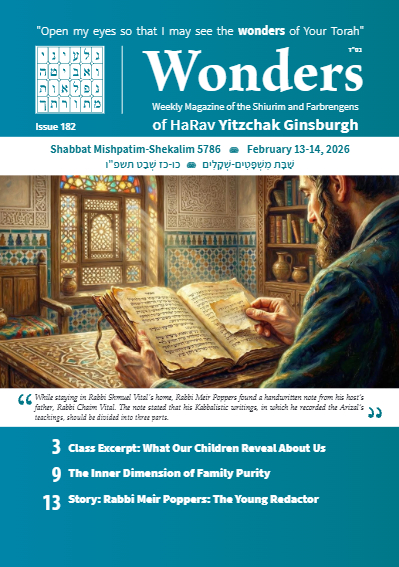
The Ba’al Shem Tov had two children, a boy and a girl. His son was Rebbe Tzvi and his daughter was the famous Odel. Few know about Rebbe Tzvi and his descendants, while Odel’s descendants are famous. They include Rebbe Nachman of Breslov, his uncles the Degel Machaneh Ephraim and Rebbe Baruch of Mezhibuzh. What can we learn about the difference between a tzaddik’s sons and daughters from the history of the Ba’al Shem Tov’s family and how does this relate to each of us?

This class was given on the 7th of Tevet, 5786 and its transcript was first published in Hebrew in Nifla’ot for parashat Shemot of this year.

The Ba’al Shem Tov’s Grandchildren: Revealed and Concealed

The Ba’al Shem Tov’s son was Rebbe Tzvi whose yahrzeit is on the 7th of Tevet. His son, Rebbe Aharon of Titov’s yahrzeit is on the 5th of Tevet. Both lived their lives out of the limelight; in this, they resembled the concealed tzaddikim that the Ba’al Shem Tov was a part of until he was forced to reveal himself. Indeed, both were known in their lifetimes as tzaddikim, and they had followers, but they never sought publicity and lived in poverty. Rebbe Aharon once proclaimed that had he so wished, he would have money (and even proved so in a particular incident), but generally he had no interest in it.

It is interesting that in contrast to them, the descendants of the Baal Shem Tov from his daughter, Odel, were much more famous—her eldest son, the Degel Machaneh Ephraim, was famous, and even more so his younger brother, Rebbe Baruch of Mezhibuzh. Of course, there was more to them than just what was revealed, as is known from the parable comparing a tzaddik to an iceberg, where only ten percent is above water and visible while the other ninety percent is submerged and invisible; but their “visible ten percent” was famous. In the next generation as well, Odel’s grandson, the son of her daughter Feige—Rebbe Nachman of Breslov—was very famous.

We should contemplate why the offspring through the Ba’al Shem Tov’s son were more hidden, while those from his daughter were more famous.

Controversy and the Dissemination of Chassidus

Tzaddikim said that if, after the passing of the Ba’al Shem Tov, all the disciples had accepted his son, Rebbe Tzvi, as their Rebbe, there would have been no disputes between the tzaddikim throughout the continuation of the Chasidic movement. Similarly, they said that if after the passing of the Maggid of Mezritch, everyone had accepted the Me’or Einayim, Rebbe Menachem Nachum of Chernobyl as rebbe, there would have been no disputes regarding the way in which Chasidut should be practiced.

It is written that there was a connection between Rebbe Tzvi and the Me’or Einayim. The Ba’al Shem Tov came to the Me’or Einayim in a dream and asked him to look after his son, Rebbe Tzvi, and from then until the end of his life, he supported him. Rebbe Tzvi gave a great gift to the Me’or Einayim—the Torah scroll of the Ba’al Shem Tov. I do not know if it exists today, but presumably, it existed until the Holocaust. This was the most precious object in the House of Chernobyl.

What the Tzaddik Wants, What God Wants

Let us return to the distinction with which we began, between the Baal Shem Tov’s descendants through his son, who were relatively hidden, and his descendants from his daughter Odel who were famous:

It must be posited that within a tzaddik, there is what he wants, and there is what God wants from him. The tzaddik desires to be hidden, like all tzaddikim who did not wish to be revealed. However, God has other thoughts. King Solomon says, “many thoughts are in a man’s heart.” The tzaddik’s pure heart is laden with thoughts on how to conceal himself, but they will not be successful, for “God’s counsel is what will stand.”

It is known that the Ba’al Shem Tov found it very difficult to reveal himself; he resisted and it had to be decreed upon him to reveal himself. Like Moses, who refused God’s mission with all his might, the Ba’al Shem Tov wanted to remain hidden, but God wanted him to be revealed. From this we learn that what a person thinks is suitable for them is not always their true destiny, which is what God wants from them. These are two sides of the soul.

Both aspects are expressed in our children: the sons reveal the parent’s conscious will while the daughters (and their sons after them) reveal what God wants from the person. A simple example can demonstrate this: a father wants to remain in the Beit Midrash and learn Torah all the days of his life, and he teaches his son to do the same—to learn like him and even surpass him in learning. The daughter, however, tells her father she needs to get married and he had better prepare a fine dowry for her. To that end he must go into the world and conduct himself realistically so that he can provide for her needs.

In doing so, the daughter aims for God’s will regarding the father, which is described in the Talmud with the well-known idiom that one should perform his mitzvah obligations in a worldly way (דרך ארץ), meaning that one should set aside time not only for Torah but also for work. This is known as living a life of “Torah with Derech Eretz.” Indeed, the sages continue to tell us that “Many individuals strove to follow Rabbi Shimon bar Yochai [who dedicated himself exclusively to Torah but they did not succeed [and ultimately abandoned their Torah learning.” This is because most people are governed by the verse, “He [God] did not create it [the earth] to remain uninhabited [or uncivilized]”—God did not intend that this individual strive to isolate and conceal himself—rather, “He formed it [the earth] to be inhabited”—God intends that this individual take an active part in settling the world, starting with the commandment to “be fruitful and multiply,” which necessarily requires one to limit their Torah study.

Potential Versus Actualization, Past Versus Future

As a rule, a person’s true destiny is hidden in their unconscious, and it is revealed specifically by the prudent daughter, who understands [the secret of the sefirah of understanding [binah]) one thing from within another thanks to the extra measure of understanding that was granted to women. One might ask if sons do not also have a special affinity for understanding one thing from another? We find that regarding the candidates for becoming judges noted in parashat Yitro, the Torah tells us that Moses could not find any that were nevonim, i.e., men of understanding. And yet, though we have few descriptions of women in the Torah, one of the few is of the five daughters of Zelophehad who were both discerning in their understanding and exhibited a special love for the Land of Israel, a clear allusion to the notion of Derech Eretz mentioned above—indeed, they were able to see what Moses could not see.

In other words, a son can reveal his father’s past (as well as the present that derives from the past), his primal desire; whereas a daughter is sensitive to her father’s future, his true destiny from God. Past and present are described in Sefer Yetzirah as the depth of the beginning and the depth of the end, corresponding thus to the son and the daughter, respectively.

Therefore, we often see that the grandson—the daughter’s son—surpasses the grandfather; he reveals things that existed within the grandfather only in potential (b'koach). A tzaddik has dreams he wishes to fulfill. For example, he may dream of writing a commentary on the entire Talmud, but he does not succeed in fulfilling his dream during his lifetime in this world. Even among the great tzaddikim, there are many such dreams. However, the grandchildren, especially from the daughters, sometimes fulfill many of the grandfather’s dreams. The dreams of tzaddikim are connected to their destiny-future (in contrast to the tzaddik’s desire to remain hidden, which is not a dream but his consciously desired reality for the time being, according to his own mind; this is his past, which he wishes to perpetuate in the present and onward, as mentioned). Every dream is a vision for the future, something that does not yet exist in the present, like the dreams of Joseph and Pharaoh—the dream is a kind of prophecy the tzaddik receives, meant to reveal God’s will to him.

In the Ba’al Shem Tov’s case, it was Rebbe Nachman, the son of a daughter of a daughter, who publicized himself even more than the sons of the daughter (Rebbe Baruch and the Degel Machneh Ephraim). He also said that he surpassed the Ba’al Shem Tov, which according to our explanation means he succeeded in revealing and fulfilling the dreams of the Ba’al Shem Tov, which included reaching the Land of Israel, a dream the Ba’al Shem Tov tried to fulfill with his daughter Odel. Rebbe Nachman’s journey greatly angered his uncle, Rebbe Baruch.

The Feminine Future

An example of sons expressing the past while daughters express the future can already be found with Moses. Moses only had two sons and did not strive to have a daughter, apparently following the ruling of Beit Shammai that one fulfills the commandment of procreation by having two sons. This would present a valid reason for why the accepted ruling is that one should have a son and a daughter, the opinion of Beit Hillel, because one must have a way to extend both one’s past (and the present derived from it) and one’s future into the next generation.

Moses possesses the potential of being both the first redeemer and the final redeemer—he brought us out of Egypt and thus played the role of our first redeemer, but he is also meant to bring us out of our current exile making him our final redeemer. But in his lifetime, because he had only sons, he could not fulfill his role of being our final redeemer, nor did his sons and grandsons fulfill his potential. This would also explain why he was not permitted to enter the Land of Israel. Note that Joshua, who did enter the Land of Israel, had only daughters, to which we may add that a student, relative to his teacher, is likened to a daughter.

In Chabad, too, there is an example of this principle. The Mittler Rebbe, Rebbe Dov Ber Schenuri was the son of Rebbe Schneur Zalman of Liadi, the founder of Chabad. As famous as he was as a Rebbe who published Chasidut in abundance, his character was that of a hidden tzaddik. This reached its pinnacle when, as he neared his final days, he travelled to the burial place of his father, the Alter Rebbe to ask him for permission to depart from this world. After him came the Tzemach Tzedek who made great efforts to publicize the teachings of Chasidut in the world, also by virtue of being known as a great genius in the revealed Torah. Under his leadership, Chabad reached its peak size.

The Tzemach Tzedek was the son of the Alter Rebbe’s daughter, Devorah Leah. The Alter Rebbe said to his grandson, the Tzemach Tzedek, “I am the Written Torah of Chasidut and you are its Oral Torah. Just like daughters in relation to their fathers, the Oral Torah reveals the potential hidden within the Written Torah.

In the Merit of Righteous Women

To conclude, we have said three similar, but not identical, things:

  • The son inherits from his father what he wants, and the daughter inherits what God wants from him.
  • The son is the revelation of his father's conscious mind, and the daughter reveals his unconscious, i.e., his hidden potential.
  • And very similarly, almost identically: The son is the past-leading-to-the-present of the father, and the daughter is his future.

This offers us a new appreciation of the sages’ statement, “A daughter [born] first is a good sign for [the birth of ] sons” (בת סימן יפה לבנים). Every daughter is in her essence “a daughter [born] first” because she is the beginning of a new revelation that until now existed only in potential. The plain meaning of this statement is that she is a good sign for [the birth of ] sons for her parents, but following our approach, we may say that she is a good sign for [the birth of her] sons, thereby revealing her parents’ concealed potential. Kabbalistically, this is known as the mother principle [the intellect] that gives birth to sons, referring to the revealed emotive faculties of the heart: loving-kindness (chesed) and might (gevurah).

The idea that girls preserve the future can be seen at the inception of the Jewish nation. The Torah relates that Pharaoh thought the essence of the People of Israel is in their sons and therefore commanded the Hebrew midwives, “Every son that is born you shall cast into the river, and every daughter you shall save.” But the midwives, the heroines of parashat Shemot (and the entire Book) exhibited tremendous self-sacrifice and disobeyed Pharaoh, “and they saved the male children” out of concern for the nation’s future. Pharaoh erred in thinking that the daughters of Israel presented no danger because they could more easily be subdued and assimilated into Egypt. Therefore, it was “in the merit of righteous women that we were redeemed from Egypt,” and in their merit, we are destined to be redeemed in the final redemption as well, speedily in our days.

With all that we have seen, we can address a question that is raised regarding the Mashiach: Must the Mashiach son of David descend patrilineally (son after son) from David, or is it possible he will be of mixed lineage or matrilineally descended from David? According to what we have explained, he will be specifically a son after daughter. Indeed, by God’s will, the destruction of the First Temple and subsequently the Hasmonean Kingdom interrupted the patrilineal lineage of the House of David. Patrilineal lineage preserves the past, while God preferred an emergence of a new potential future through David’s daughters. Consequently (as can be shown scientifically), pretty much every single Jew is fit to be the Mashiach and, importantly, there is no need to check the Mashiach’s lineage.

PDF Preview