Sidra of the Week Naso
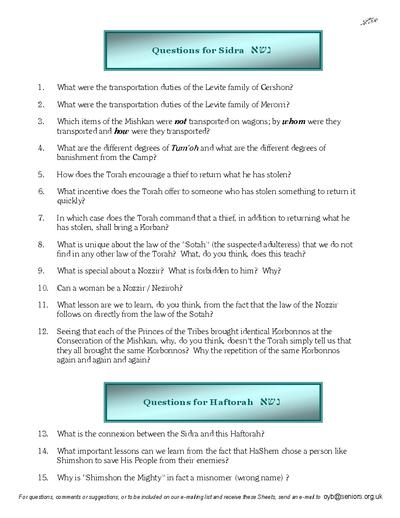
1. In last week’s Sidra, HaShem commanded Mosheh to take up the count of the males of the Tribe of Levi, aged one month and older. These Levi’im were singled out to take the place of all the male firstborns of the Israelites of one month and more. After that, Mosheh was commanded to count the Levi’im who were actually in service, that is, those aged between thirty years and fifty years. This week’s Sidra continues with the command to count the adult males of the Levite families of Gershon and the families of Merorri and the allocation of their respective duties. The command to count the adult males of the Levite families of Kehoss and the allocation of their duties was given in last week’s Sidra: their duties comprised the carrying of the sacred furniture and the utensils and contents of the Mishkan. (When HaShem so commanded, Mosheh gave the order for the Israelites to break camp and travel. The Kohannim would then cover up the holy contents of the Mishkan, and the Kehossites carried the holy furniture and other contents to the next stop, as indicated by HaShem.) The duties of the Gershonites comprised the transportation of the coverings and the hangings and the curtains of the Mishkan, with their various cords, and the Merorrites’ duties comprised the transportation of the great boards and pillars of the Mishkan, the columns of the Court of the Mishkan, with their bolts, pegs, sockets and ropes.
2. With this is completed the description of the various duties of the different families of the Tribe of Levi, together with the arrangements for the taking-down and the putting-up of the Mishkan; where these Levite families were to encamp round the Mishkan; the positions of the Tribes of Israel around the Camp of the Levi’im — all as commanded by HaShem. With the holy Mishkan in its midst and as the centre of attention, physically and figuratively, the entire Nation is thus encouraged to aspire to holiness. To this end, HaShem commands that there shall be sent out of the Camp all those who are “Tommay” through being stricken with Tzoraas. Likewise to be sent out from the Camp are those stricken with other forms of Tum’oh which also are signs of the displeasure of HaShem, and those who have come into contact with the dead, too, must be sent out from the Camp. The Torah teaches that different degrees of Tum’oh are governed by different degrees of banishment and the people are commanded to keep their camp free from all such Tommay persons, for the Divine Presence resides in their midst.
3. As mentioned at the beginning of last week’s Sidra Sheet, the Chumash BeMidbor starts with the command of HaShem to Mosheh our Teacher to take up the count of His People. For in the same way that a king newly enthroned wishes to get to know his subjects, so does HaShem show how precious is His People which is encamped around the newly-completed Mikdash, the Sanctuary, which is the appointed Abode of the Divine Presence in the midst of the Jewish People. As well as the count of the Tribes, each Tribe is assigned its position around the Mishkan, and the first part of this week’s Sidra completes this counting and the description of the duties of the families of the Tribe of Levi. As a matter of interest, the word that the Torah uses for counting the Jewish People, "דקוֹפְת," has also the meaning of “appointing”. For even when the need to count the Jewish People arises, such counting of the Nation as a whole must never ignore the intrinsic worth of each individual. On the contrary, each person is unique and has his appointed task in life, his "ידקִפְת". The Torah views each and every one of us as a person appointed to his or her special, unique, task: each one is a "ידקִפ".
4. The Sidra later describes the special Korbonnos brought by the representative Princes of the Tribes of Israel at the Consecration of the Mishkan. (The special Tribe of Levi, however, was not included in this.) But before this, the account is interrupted to teach some laws which, at first glance, seem to be out of place here.
5. Firstly, the Torah reiterates the law against stealing and the unlawful withholding of another’s property. (Noteworthy is that these offences are called “treachery against HaShem.”) The Torah teaches here further details about such malpractices, as follows: In a case where a person has taken another person’s property unlawfully and his stealing is discovered by others, he has to return the stolen article (or its value) plus the same again. In other words, he pays double. If he should own up by himself, however, he makes restitution to his victim (or his victim’s heirs) without any extra penalty. (The Torah recognizes that a human can be weak and can fall for temptation. HaShem says: Let him return that which he has stolen and let him repent of his sin, and he will be forgiven. And as an incentive to do so quickly, he is told that if he owns up by himself, before he is discovered, he will not be punished at all. Thus does the Torah of HaShem give a chance to the thief to correct himself and hasten the return of stolen property to its rightful owner.) If the offence also involved a false oath (that is, he swore falsely that he had not stolen the article) then, when he repents of his crime he must pay to his victim (for this “treachery to HaShem”) an additional fifth (the same amount extra that a person has to pay who has unlawfully used anything belonging to the Mikdash) and for the false oath he must additionally bring a Korbon Oshom. The Torah here adds that in a case where the victim is no longer alive and neither is there any heir (the only such case that can arise is where the victim is a proselyte) then the perpetrator can achieve atonement only where the confession is freely made and then the thief must make restitution to HaShem Himself, as it were, for HaShem is the Father and Protector of all humanity, and He takes the place of the lonely victim. (The Torah stipulates that in such a case the property thus returned, with the extra fifth, shall be given to the Kohannim who are HaShem’s representatives.)
6. By teaching these laws here the Torah intimates that the holy Nation of HaShem can hope for His Presence to dwell amongst them only if their dealings with one another are correct and just. Even with the holy Sanctuary in our midst, indeed, because His Sanctuary is in our midst, we must at all times take care to be honest in our dealings with one another, and this is especially so in the case of the stranger who chooses to join himself to the Jewish People. Indeed, to behave any differently would make a mockery of the Sanctuary of HaShem and would be nothing short of hypocrisy.
7. The second law that the Torah teaches here — in the middle of the account of the Mikdash and its establishment in the midst of the Jewish People — is that of the “Sotah,” the suspected adulteress. For it is not enough that the people shall encamp round the Mikdash. It is not even enough that their dealings with one another shall be just and correct, too. But, teaches the Torah, each Jewish home, in its intimacy and privacy, must be pure and holy: if the Divine Presence is to dwell in the midst of the Nation, each family unit of that Nation must be harmonious and complete. Thus, a wife who disregards the Torah’s rules of propriety and chaste behaviour threatens the purity and holiness of the Jewish family and causes the Divine Presence to depart from the midst of the Jewish People. (It is the wife and mother, rather than the husband and father, whom the Torah considers the king-pin and pivot of the Jewish family and therefore so important to the stability of the Jewish home.)
8. In this law of the Sotah, the Torah describes the case of a wife being warned by her husband not to defile herself by being with another man. But she ignores this serious warning and does indeed consort with him in a manner that gives rise to grave suspicions of adultery having been committed. That being so, the marriage, which should be founded on trust and faithfulness but which is now riddled with suspicion and discord, is not allowed to continue until the wife has been cleared of these suspicions. She is brought into the holy Mikdash where, in the Presence of HaShem, she is made to confess to her crime or, conversely, her claims of innocence of adultery will be shown to be true.
9. The whole process to prove the woman’s infidelity or, conversely, to vindicate her innocence of the charge of adultery, is described by the Torah. Careful study of the details of the process will reveal deep symbolisms in each. Taken all together, this chapter which describes the punishment and disgrace of the extremely rare, exceptional, adulterous couple, proclaims the superior moral standard of the men and women of the People of HaShem who all live their lives according to the Torah. Unfortunately, these lessons will be lost on those who choose not to understand the high principles of family purity and nobility that the Torah teaches. Such people look only superficially and they see in the Law of the Sotah nothing but a “trial by ordeal.” But in fact this law of the Sotah is unique in that it is the only case in the whole of the Torah where the Torah says that we are to ask for the direct intervention of HaShem by a miracle. For HaShem wishes to be seen as the Author and Founder of the holy institution of Marriage, Whose All-Seeing Eye watches each individual Jewish marriage. This Law, therefore, shows how the Presence of HaShem is in every Torah-true marriage and how the faithfulness to each other of husband and wife is the quite special concern of HaShem’s attention. (In stark contrast, one is struck by the fact that the vast majority of literature and drama in what is called “entertainment” in the non-Torah world consists of little else than real or imaginary tales of adultery and infidelity, often with murder thrown in, too.)
10. The Sidra continues with the Law of the Nozzir, the man (or woman) who takes it upon himself to be singularly dedicated to HaShem. To this end, he vows to abstain from wine or any intoxicating drink and so keep himself away from all kinds of Tum’oh. Our Chachommim, of blessed memory, tell us that one of the reasons for this Law of the Nozzir being placed in the Torah immediately after the Law of the Sotah is to teach that “one who sees the degradation of the Sotah should take upon himself a vow of abstention from wine.” For it is only when a spirit of folly or light- headedness (typically induced by drinking wine) enters a person that he or she comes to sin. By contrast, the Nozzir represents the human being in a state of complete self-control, dedicated to HaShem and His Torah. His abstention from wine is only one aspect of his Nozzir-state: but during his time of being a Nozzir, his mind is only on higher things. His head is symbolically “crowned” — he may not cut his hair. This Law of the Nozzir and the very fact that the Torah legislates for such a person who is especially holy to HaShem within the Jewish Nation, is a further sign of the Divine Presence in the midst of that People.
11. It is a People that is thus mindful of HaShem’s Presence that can be dedicated to fulfilling His law. Whether it be in their dealings with one another, that they be honest and true and do not offend against HaShem’s warnings against dishonesty, or whether it be in their moral behaviour in their family life: in their commercial undertakings and in their family relationships they are the People of HaShem. Such a people can be confident of HaShem’s blessing, and the next section of the Sidra describes how the Kohannim, the special representatives of HaShem to His People, are to pronounce the Birkas Kohannim (the Priestly Blessing) that He bestows upon them all.
12. These laws having been taught and the foundation for their noble calling as HaShem’s People having thus been laid, the Sidra then resumes the account of the Consecration of the Mishkan. At this inauguration, the Princes of the Tribes of Israel brought various Korbonnos (the first was brought by Nachshon ben Aminoddov, the Prince of the Tribe of Yehuda) and on each of the following eleven days a Prince of one of the other Tribes brought his Korbonnos. Although the actual Korbonnos were identical, each is described fully. This is to emphasise that each Prince was unique and special in his intentions to pay homage to the Divine Presence in the Mishkan, and did not intend to merely copy those before him.
13. Thus was the Mishkan consecrated. Through the earnest devotion of the Princes of Israel to HaShem and through their personal demonstration of their sacred responsibilities, they showed also the eagerness of the entire Jewish Nation to be the loyal subjects of HaShem. In this way the Mishkan became the true symbol of the Divine Presence dwelling in the midst of the People of HaShem. And it was from the Holy of Holies of this Mishkan, in the midst of this Nation, that the Voice of HaShem was heard by Mosheh our Teacher, who then communicated to us the wishes of HaShem.
For the explanation of the Haftorah of Sidra נשא please go to HAFTORAHS.