Davening with Fervor
The Weekly Farbrengen | September 17, 2025
Print This Article
View Original PDF

Davening with Fervor

The Weekly Farbrengen | December 10, 2025

On Rosh Hashana the Rebbeim would daven with much fervor and tears, particularly the first maariv which would extend for many hours. The Rebbe spoke of how every individual should take a lesson to some extent from the exceptional davening of the Rebbeim.

(סה"ש תשנ"ב ע' 13, הע' 19)

In the year תרמ”ו (1885), the Rebbe Rashab was in Yalta, Crimea, and davened in a little shul of Poilishe chassidim. On the night of Rosh Hashanah, he remained there to daven after everyone had left. The shamash, before going home, ordered the goy who cleaned the shul not to extinguish the light or lock the door. When the shamash finished his seuda, he felt guilty that he had left a Yid, a talmid chochom, alone in shul, so he returned to see what was happening. Upon arriving, he saw the goy standing in the foyer and crying bitterly.

The goy explained, “I’m used to hearing people praying with joyful songs – but here stood a man who was pouring out his soul. So how could I hold back from crying? I remembered all my problems: my uncle died, my cow died, my aged mother is sick, and I wanted to cry.”

And when the shamash entered the shul itself and his eyes beheld the Rebbe Rashab davening, they too became fountains of tears.

(ספר המאמרים תשי"א ע' 90)
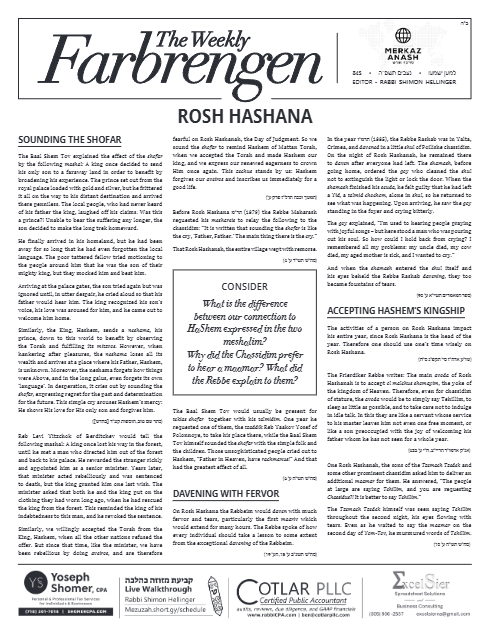
On Rosh Hashana the Rebbeim would daven with much fervor and tears, particularly the first maariv which would extend for many hours. The Rebbe spoke of how every individual should take a lesson to some extent from the exceptional davening of the Rebbeim.

(סה"ש תשנ"ב ע' 13, הע' 19)

In the year תרמ”ו (1885), the Rebbe Rashab was in Yalta, Crimea, and davened in a little shul of Poilishe chassidim. On the night of Rosh Hashanah, he remained there to daven after everyone had left. The shamash, before going home, ordered the goy who cleaned the shul not to extinguish the light or lock the door. When the shamash finished his seuda, he felt guilty that he had left a Yid, a talmid chochom, alone in shul, so he returned to see what was happening. Upon arriving, he saw the goy standing in the foyer and crying bitterly.

The goy explained, “I’m used to hearing people praying with joyful songs – but here stood a man who was pouring out his soul. So how could I hold back from crying? I remembered all my problems: my uncle died, my cow died, my aged mother is sick, and I wanted to cry.”

And when the shamash entered the shul itself and his eyes beheld the Rebbe Rashab davening, they too became fountains of tears.

(ספר המאמרים תשי"א ע' 90)

PDF Preview