Encouragement before the sin and after it
טיב הקהילה English | September 17, 2025
Print This Article
View Original PDF

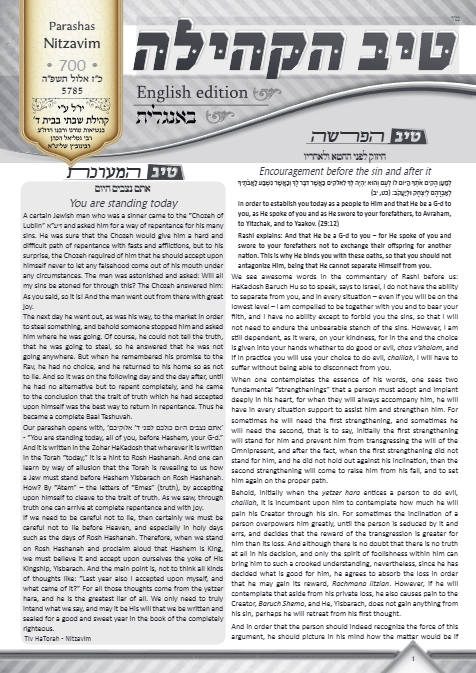
Encouragement before the sin and after it

טיב הקהילה English | December 10, 2025

ְך לֵאלקִ ים כַאֲשֶ ר ד펼ִ ב톼ֶר לָך쀀 וְכַאֲשֶ ר נִשְ ב톼ַע לַאֲבֹתֶ יך לְמַ עַן הָ קִ ים אֹתְ ך הַ יו햹ם לו햹 לְעָם וְהו햼א יִהְ יֶה ל לְאַ בְ רָ הָ ם לְיִצְ חָ ק ו햼לְיַעֲקֹב: (כט, יב)

In order to establish you today as a people to Him and that He be a G-d to you, as He spoke of you and as He swore to your forefathers, to Avraham, to Yitzchak, and to Yaakov. (29:12)

Rashi explains: And that He be a G-d to you – for He spoke of you and swore to your forefathers not to exchange their offspring for another nation. This is why He binds you with these oaths, so that you should not antagonize Him, being that He cannot separate Himself from you.

We see awesome words in the commentary of Rashi before us: HaKadosh Baruch Hu so to speak, says to Israel, I do not have the ability to separate from you, and in every situation – even if you will be on the lowest level – I am compelled to be together with you and to bear your filth, and I have no ability except to forbid you the sins, so that I will not need to endure the unbearable stench of the sins. However, I am still dependent, as it were, on your kindness, for in the end the choice is given into your hands whether to do good or evil, chas v’shalom, and if in practice you will use your choice to do evil, chalilah, I will have to suffer without being able to disconnect from you.

When one contemplates the essence of his words, one sees two fundamental “strengthenings” that a person must adopt and implant deeply in his heart, for when they will always accompany him, he will have in every situation support to assist him and strengthen him. For sometimes he will need the first strengthening, and sometimes he will need the second, that is to say, initially the first strengthening will stand for him and prevent him from transgressing the will of the Omnipresent, and after the fact, when the first strengthening did not stand for him, and he did not hold out against his inclination, then the second strengthening will come to raise him from his fall, and to set him again on the proper path.

Behold, initially when the yetzer hara entices a person to do evil, chalilah, it is incumbent upon him to contemplate how much he will pain his Creator through his sin. For sometimes the inclination of a person overpowers him greatly, until the person is seduced by it and errs, and decides that the reward of the transgression is greater for him than its loss. And although there is no doubt that there is no truth at all in his decision, and only the spirit of foolishness within him can bring him to such a crooked understanding, nevertheless, since he has decided what is good for him, he agrees to absorb the loss in order that he may gain its reward, Rachmana litzlan. However, if he will contemplate that aside from his private loss, he also causes pain to the Creator, Baruch Shemo, and He, Yisbarach, does not gain anything from his sin, perhaps he will retreat from his first thought.

And in order that the person should indeed recognize the force of this argument, he should picture in his mind how the matter would be if this argument were to come from the mouth of a human being. And thus he should say to himself: If I wished to perform a certain act which would cause me a loss on one side, and a benefit many times over on the other, would I not do it?! However, if someone would inform me in advance that through this act I would also cause him a loss, and unlike me he would not also gain from it any benefit, would I not take his loss into consideration?! Behold, it is obvious that I would be compelled to retreat from my desire, and this would be so even if, chas v’shalom, I were not a man of good traits, and it were fine with me to bring harm upon another if the matter would cause me benefit. For it is a great shame for a person to pain his fellow just to bring benefit to himself, and if I would ignore his arguments, I would not be able to bear to lift my face before him because of the evil of my deeds. And if so great would be my shame before flesh and blood, all the more so must it be when the one with the argument is HaKadosh Baruch Hu, in His Glory and Essence. Therefore, even if it is my desire to sin in order to bring myself benefit, it is necessary to retreat, for in any case how will I lift my face before the King of the universe when I am prepared to cause Him pain only for my own good and pleasure...!?

This is the first point that we see in the words of Rashi, for Rashi reveals to us that HaKadosh Baruch Hu is in the company of every Jew, and He cannot separate from him, despite his being a sinner, and before HaKadosh Baruch Hu he is like a “leper covered with boils” who cannot be borne. That is to say, at the time that the person sins, he, so to speak, forces HaKadosh Baruch Hu to dwell together with a leper covered with boils, from whom an unbearable stench emanates. Another detail is brought in Rashi, that HaKadosh Baruch Hu, Who knows in advance how much He will suffer from the sins of this one, requests of him beforehand ‘that he not anger Him,’ and behold it is as though He says to him: Even if you imagine in your soul that a certain benefit will come to you from this sin, and you are willing to bear the loss on account of the gain, nevertheless you must also take into consideration My pain, for I will not share with you in the gain... And indeed this argument must serve as a shield against sin, and whenever a person’s yetzer provokes him, he should say to himself: Just as I am not permitted to seat my fellow in one dwelling with a leper covered with boils only for the sake of some private benefit of mine, so too and all the more so I am not permitted to seat the King of the universe together with a leper covered with boils and to cause Him pain thereby. And often, after a person reflects well on this matter, he will be saved from the sin.

However, sometimes the yetzer provokes a person so strongly that he has no ability to give himself space to reflect on his deed, and if he is a Heaven-fearing man, certainly his heart will ache after the act for not having withstood the test. And in order that he should not come as a result to despair and to the thought that he has no hope, we require the second point that we see from the words of Rashi, and that is the tremendous love that HaKadosh Baruch Hu has for Israel. For this is necessarily the reason for that which is stated at the end of his words, that even if they sin before Him, He does not separate from them, although they anger Him with their sins and it is difficult for Him to bear them. And if you will answer me that this is no proof, since from the very wording of Rashi we see that this is only because of the oath that He swore to their forefathers, I too will answer you that this very oath itself proves the love that “distorts the line,” for He, Yisbarach, ‘calls the generations from the beginning,’ and at the time that He swore to their forefathers He already knew that their children would sin before Him, and this oath would compel Him to endure evildoers. Nevertheless, He did not refrain from uttering it. This is nothing else but a sign and proof that Israel is beloved before Him even when He suffers because of them.

This knowledge serves as a great strengthening for repentance, for when a person knows that although he sinned and rebelled against his Creator, still He has not ceased to love him, he understands well the intention of our Sages who said (Sifrei Devarim 3:29) that ‘[HaKadosh Baruch Hu’s] right hand is stretched out to receive those who return.’ He understands that repentance has the power to erase completely all the bad impression of the ‘sin.’ For he knows that Israel is beloved to their Creator like a beloved son to his father, and even if some quarrel occurs between them, it will not be a reason to divide between them except for a moment. But when they will come to appease Him, His old love will be aroused again, and that resentment that separated them will be nullified without leaving behind any impression.
ְך לֵאלקִ ים כַאֲשֶ ר ד펼ִ ב톼ֶר לָך쀀 וְכַאֲשֶ ר נִשְ ב톼ַע לַאֲבֹתֶ יך לְמַ עַן הָ קִ ים אֹתְ ך הַ יו햹ם לו햹 לְעָם וְהו햼א יִהְ יֶה ל לְאַ בְ רָ הָ ם לְיִצְ חָ ק ו햼לְיַעֲקֹב: (כט, יב)

In order to establish you today as a people to Him and that He be a G-d to you, as He spoke of you and as He swore to your forefathers, to Avraham, to Yitzchak, and to Yaakov. (29:12)

Rashi explains: And that He be a G-d to you – for He spoke of you and swore to your forefathers not to exchange their offspring for another nation. This is why He binds you with these oaths, so that you should not antagonize Him, being that He cannot separate Himself from you.

We see awesome words in the commentary of Rashi before us: HaKadosh Baruch Hu so to speak, says to Israel, I do not have the ability to separate from you, and in every situation – even if you will be on the lowest level – I am compelled to be together with you and to bear your filth, and I have no ability except to forbid you the sins, so that I will not need to endure the unbearable stench of the sins. However, I am still dependent, as it were, on your kindness, for in the end the choice is given into your hands whether to do good or evil, chas v’shalom, and if in practice you will use your choice to do evil, chalilah, I will have to suffer without being able to disconnect from you.

When one contemplates the essence of his words, one sees two fundamental “strengthenings” that a person must adopt and implant deeply in his heart, for when they will always accompany him, he will have in every situation support to assist him and strengthen him. For sometimes he will need the first strengthening, and sometimes he will need the second, that is to say, initially the first strengthening will stand for him and prevent him from transgressing the will of the Omnipresent, and after the fact, when the first strengthening did not stand for him, and he did not hold out against his inclination, then the second strengthening will come to raise him from his fall, and to set him again on the proper path.

Behold, initially when the yetzer hara entices a person to do evil, chalilah, it is incumbent upon him to contemplate how much he will pain his Creator through his sin. For sometimes the inclination of a person overpowers him greatly, until the person is seduced by it and errs, and decides that the reward of the transgression is greater for him than its loss. And although there is no doubt that there is no truth at all in his decision, and only the spirit of foolishness within him can bring him to such a crooked understanding, nevertheless, since he has decided what is good for him, he agrees to absorb the loss in order that he may gain its reward, Rachmana litzlan. However, if he will contemplate that aside from his private loss, he also causes pain to the Creator, Baruch Shemo, and He, Yisbarach, does not gain anything from his sin, perhaps he will retreat from his first thought.

And in order that the person should indeed recognize the force of this argument, he should picture in his mind how the matter would be if this argument were to come from the mouth of a human being. And thus he should say to himself: If I wished to perform a certain act which would cause me a loss on one side, and a benefit many times over on the other, would I not do it?! However, if someone would inform me in advance that through this act I would also cause him a loss, and unlike me he would not also gain from it any benefit, would I not take his loss into consideration?! Behold, it is obvious that I would be compelled to retreat from my desire, and this would be so even if, chas v’shalom, I were not a man of good traits, and it were fine with me to bring harm upon another if the matter would cause me benefit. For it is a great shame for a person to pain his fellow just to bring benefit to himself, and if I would ignore his arguments, I would not be able to bear to lift my face before him because of the evil of my deeds. And if so great would be my shame before flesh and blood, all the more so must it be when the one with the argument is HaKadosh Baruch Hu, in His Glory and Essence. Therefore, even if it is my desire to sin in order to bring myself benefit, it is necessary to retreat, for in any case how will I lift my face before the King of the universe when I am prepared to cause Him pain only for my own good and pleasure...!?

This is the first point that we see in the words of Rashi, for Rashi reveals to us that HaKadosh Baruch Hu is in the company of every Jew, and He cannot separate from him, despite his being a sinner, and before HaKadosh Baruch Hu he is like a “leper covered with boils” who cannot be borne. That is to say, at the time that the person sins, he, so to speak, forces HaKadosh Baruch Hu to dwell together with a leper covered with boils, from whom an unbearable stench emanates. Another detail is brought in Rashi, that HaKadosh Baruch Hu, Who knows in advance how much He will suffer from the sins of this one, requests of him beforehand ‘that he not anger Him,’ and behold it is as though He says to him: Even if you imagine in your soul that a certain benefit will come to you from this sin, and you are willing to bear the loss on account of the gain, nevertheless you must also take into consideration My pain, for I will not share with you in the gain... And indeed this argument must serve as a shield against sin, and whenever a person’s yetzer provokes him, he should say to himself: Just as I am not permitted to seat my fellow in one dwelling with a leper covered with boils only for the sake of some private benefit of mine, so too and all the more so I am not permitted to seat the King of the universe together with a leper covered with boils and to cause Him pain thereby. And often, after a person reflects well on this matter, he will be saved from the sin.

However, sometimes the yetzer provokes a person so strongly that he has no ability to give himself space to reflect on his deed, and if he is a Heaven-fearing man, certainly his heart will ache after the act for not having withstood the test. And in order that he should not come as a result to despair and to the thought that he has no hope, we require the second point that we see from the words of Rashi, and that is the tremendous love that HaKadosh Baruch Hu has for Israel. For this is necessarily the reason for that which is stated at the end of his words, that even if they sin before Him, He does not separate from them, although they anger Him with their sins and it is difficult for Him to bear them. And if you will answer me that this is no proof, since from the very wording of Rashi we see that this is only because of the oath that He swore to their forefathers, I too will answer you that this very oath itself proves the love that “distorts the line,” for He, Yisbarach, ‘calls the generations from the beginning,’ and at the time that He swore to their forefathers He already knew that their children would sin before Him, and this oath would compel Him to endure evildoers. Nevertheless, He did not refrain from uttering it. This is nothing else but a sign and proof that Israel is beloved before Him even when He suffers because of them.

This knowledge serves as a great strengthening for repentance, for when a person knows that although he sinned and rebelled against his Creator, still He has not ceased to love him, he understands well the intention of our Sages who said (Sifrei Devarim 3:29) that ‘[HaKadosh Baruch Hu’s] right hand is stretched out to receive those who return.’ He understands that repentance has the power to erase completely all the bad impression of the ‘sin.’ For he knows that Israel is beloved to their Creator like a beloved son to his father, and even if some quarrel occurs between them, it will not be a reason to divide between them except for a moment. But when they will come to appease Him, His old love will be aroused again, and that resentment that separated them will be nullified without leaving behind any impression.

PDF Preview