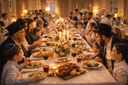
First Night of Rosh Hashanah
The Jewish Weekly | September 17, 2025
Print This Article
View Original PDF

First Night of Rosh Hashanah

The Jewish Weekly | December 10, 2025

One should use the time between Mincha and Maariv to recite Tehillim. Many times, the Lubavitcher Rebbe would begin the Niggun of Avinu Malkeinu, before Maariv.

L’David Mizmor: One’s intention at this time creates a vessel in which to draw down Gashmiyut for the whole year. Many communities recite it verse by verse and some say it all together and there are some who don’t say it at all. Many have the custom to open the Aron Hakodesh, however this is not the Chabad custom. L’David Mizmor is followed by Kaddish Titkabel.

After Davening on the first night, we greet each other L’Shana Tova Tikatev V’techatem. [The grammar is applicable for greeting a male. One may use gender-appropriate grammar when greeting a female; i.e. L’Shana Tova Tikatevee V’techatemee.] Some have the custom to add L’Alter, Lechaim Tovim Uleshalom. Some have the custom to bless their children Sheyizku L’Hikatev V’Lhichatem Lechaim Tovim Uleshalom. After the first night of Rosh Hashanah, we greet each other Gmar Chatima Tova.

From Rosh Hashanah until Hoshana Rabba (inclusive), some have the custom to use round Challot, and we dip it (three times) in honey. Apple and honey are eaten after the Challah, before the first course. The apple is sliced and dipped in honey. Borei Pri Ha’etz is recited while holding the apple in one’s right hand, followed by the Yehi Ratzon, before eating the apple. [Some say the Yehi Ratzon after the first bite of the apple]. If the pomegranate is on the table already one makes the Borei Pri Ha’etz on the pomegranate first before the apple and honey are eaten. Therefore one should try to keep the pomegranate away from the table till after the apple and honey are eaten.

When one recites Borei Pri Ha’etz, he should clearly have in mind that the Brachah includes any fruit served during the meal and at dessert. He does not make a new Brachah at the time of dessert. Pomegranate is also eaten on the first night. Most hold that it should not be present at the table when the Borei Pri Ha’etz is said on the apple, as it is one of the Seven Fruits of Israel. Some, including Chabad, hold that it should be present at the table when Borei Pri Ha’etz is said on the apple, and should be eaten after the apple. [On the second night, if the pomegranate is a new fruit, it should be present on the table during the Shehecheyanu of Kiddush, and one should have it in mind at that time.]

Some have the custom of eating Simanim (different foods which hint to good things). It is customary to eat fish, the head of a ram (or fish), as well as Tzimmes [carrots cooked in sweet sauce]. On Rosh Hashanah, it is appropriate to consume meat, sweet food and drink. It is customary not to eat any foods that are bitter, sour, overly sharp, or that contain nuts or vinegar.


One should use the time between Mincha and Maariv to recite Tehillim. Many times, the Lubavitcher Rebbe would begin the Niggun of Avinu Malkeinu, before Maariv.

L’David Mizmor: One’s intention at this time creates a vessel in which to draw down Gashmiyut for the whole year. Many communities recite it verse by verse and some say it all together and there are some who don’t say it at all. Many have the custom to open the Aron Hakodesh, however this is not the Chabad custom. L’David Mizmor is followed by Kaddish Titkabel.

After Davening on the first night, we greet each other L’Shana Tova Tikatev V’techatem. [The grammar is applicable for greeting a male. One may use gender-appropriate grammar when greeting a female; i.e. L’Shana Tova Tikatevee V’techatemee.] Some have the custom to add L’Alter, Lechaim Tovim Uleshalom. Some have the custom to bless their children Sheyizku L’Hikatev V’Lhichatem Lechaim Tovim Uleshalom. After the first night of Rosh Hashanah, we greet each other Gmar Chatima Tova.

From Rosh Hashanah until Hoshana Rabba (inclusive), some have the custom to use round Challot, and we dip it (three times) in honey. Apple and honey are eaten after the Challah, before the first course. The apple is sliced and dipped in honey. Borei Pri Ha’etz is recited while holding the apple in one’s right hand, followed by the Yehi Ratzon, before eating the apple. [Some say the Yehi Ratzon after the first bite of the apple]. If the pomegranate is on the table already one makes the Borei Pri Ha’etz on the pomegranate first before the apple and honey are eaten. Therefore one should try to keep the pomegranate away from the table till after the apple and honey are eaten.

When one recites Borei Pri Ha’etz, he should clearly have in mind that the Brachah includes any fruit served during the meal and at dessert. He does not make a new Brachah at the time of dessert. Pomegranate is also eaten on the first night. Most hold that it should not be present at the table when the Borei Pri Ha’etz is said on the apple, as it is one of the Seven Fruits of Israel. Some, including Chabad, hold that it should be present at the table when Borei Pri Ha’etz is said on the apple, and should be eaten after the apple. [On the second night, if the pomegranate is a new fruit, it should be present on the table during the Shehecheyanu of Kiddush, and one should have it in mind at that time.]

Some have the custom of eating Simanim (different foods which hint to good things). It is customary to eat fish, the head of a ram (or fish), as well as Tzimmes [carrots cooked in sweet sauce]. On Rosh Hashanah, it is appropriate to consume meat, sweet food and drink. It is customary not to eat any foods that are bitter, sour, overly sharp, or that contain nuts or vinegar.

PDF Preview