Riddles of the Week
למודי משה | September 18, 2025
Print This Article
View Original PDF

Riddles of the Week

למודי משה | December 10, 2025

(For answers see above)

  1. According to many Rishonim, in this week’s parsha we have the mitzvah of teshuvah (see above at length). The pasukim describe how the mitzvah of teshuvah is very easy to do, the pasuk says: כי קרוב אליך הדבר מאוד בפיך ובלבבך לעשותו – “Rather, the matter is very close to you, in your mouth and in your heart, so that you can fulfill it.” The question is, the Gemara in Yoma (86a) teaches that for chillul Hashem teshuvah doesn’t help, and the only thing that atones is death. The Chasam Sofer (Shu”t Likutei Teshuvah 59) says: There is no one who hasn’t sinned with chillul Hashem, if so, how can the Torah say teshuvah is easy, when seemingly no one is actually able to do it without needing to die?
  2. The Rambam (Hilchos Teshuva 2:2) describes the definition of teshuva as follows: ומה היא התשובה וכו 'וכן יתנחם על שעבר וכו 'ויעיד עליו יודע תעלומות שלא ישוב לעולם החטא לזה – “Teshuva is defined as one regretting what he did in the past, such that Hashem, who knows the depth of one’s heart, will testify that he will never do this sin again!” Where do we find a hint to the idea that Hashem’s must be able to testify about one’s teshuva in this week’s parsha?
  3. According to many Rishonim, in this week’s parsha we have the mitzvah of teshuvah. Being that teshuvah is one of the 613 mitzvos, is one allowed to sin in order to be able to fulfill this great mitzvah?
  4. The pasuk (30:14) says: כי קרוב אליך הדבר מאוד בפיך ובלבבך לעשותו - “Rather, the matter is very near to you – in your mouth and in your heart – to do it.” Shouldn’t the pasuk say, “in your heart and in your mouth – to do it”? Doesn’t the intention to do a mitzvah (“your heart”) precede the action (“your mouth”)?
  5. The structure of Selichos seems to parallel the structure of Mincha. Mincha begins with Ashrei, which is followed by half Kaddish, Shemoneh Esrei, Tachanun, and full Kaddish. Similarly, Selichos starts with Ashrei and half Kaddish, after which we recite Selichos and Tachanun and conclude with full Kaddish. Why is Selichos patterned after Mincha?
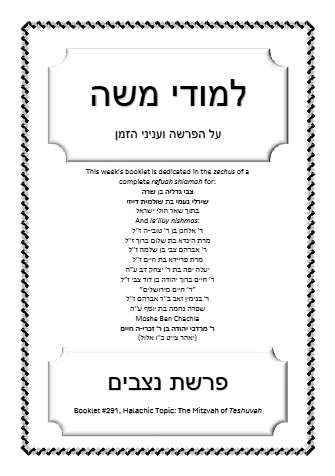
(For answers see above)

  1. According to many Rishonim, in this week’s parsha we have the mitzvah of teshuvah (see above at length). The pasukim describe how the mitzvah of teshuvah is very easy to do, the pasuk says: כי קרוב אליך הדבר מאוד בפיך ובלבבך לעשותו – “Rather, the matter is very close to you, in your mouth and in your heart, so that you can fulfill it.” The question is, the Gemara in Yoma (86a) teaches that for chillul Hashem teshuvah doesn’t help, and the only thing that atones is death. The Chasam Sofer (Shu”t Likutei Teshuvah 59) says: There is no one who hasn’t sinned with chillul Hashem, if so, how can the Torah say teshuvah is easy, when seemingly no one is actually able to do it without needing to die?
  2. The Rambam (Hilchos Teshuva 2:2) describes the definition of teshuva as follows: ומה היא התשובה וכו 'וכן יתנחם על שעבר וכו 'ויעיד עליו יודע תעלומות שלא ישוב לעולם החטא לזה – “Teshuva is defined as one regretting what he did in the past, such that Hashem, who knows the depth of one’s heart, will testify that he will never do this sin again!” Where do we find a hint to the idea that Hashem’s must be able to testify about one’s teshuva in this week’s parsha?
  3. According to many Rishonim, in this week’s parsha we have the mitzvah of teshuvah. Being that teshuvah is one of the 613 mitzvos, is one allowed to sin in order to be able to fulfill this great mitzvah?
  4. The pasuk (30:14) says: כי קרוב אליך הדבר מאוד בפיך ובלבבך לעשותו - “Rather, the matter is very near to you – in your mouth and in your heart – to do it.” Shouldn’t the pasuk say, “in your heart and in your mouth – to do it”? Doesn’t the intention to do a mitzvah (“your heart”) precede the action (“your mouth”)?
  5. The structure of Selichos seems to parallel the structure of Mincha. Mincha begins with Ashrei, which is followed by half Kaddish, Shemoneh Esrei, Tachanun, and full Kaddish. Similarly, Selichos starts with Ashrei and half Kaddish, after which we recite Selichos and Tachanun and conclude with full Kaddish. Why is Selichos patterned after Mincha?
PDF Preview