Rosh Hashanah Resolutions
Toras Avigdor | September 14, 2025
Print This Article
View Original PDF

Rosh Hashanah Resolutions

Toras Avigdor | December 10, 2025

When we come to Hashem on Rosh Hashana: we come knocking on Your door like beggars. That’s what we say in our tefillos. We’re not coming to give; we don't have anything to offer You, Hashem, and so we’re here now to ask, to beg.

And yet, there’s something misleading in those words because although that’s true—there’s nothing we can give to the King that He doesn’t have—but even more true is that we dare not come like a beggar.

If you come empty handed to Hashem, you're taking a very big risk because the principle is — bring an offering, a gift, and come before Him. Only then, can you bow down to Him, with the glory of sanctity (Divrei Hayomim I, 16:29). It means, “It's not enough to bow down to Me and to acknowledge that I'm the Melech. If I'm a King—if you really mean it—then you’d show it by bringing something. Where is the tribute? To a King you have to bring something when you come.”

You know, sometimes there’s a very wealthy king and he doesn’t need anything from his subjects. He has everything and your gifts don’t add anything. Even your taxes are unnecessary for running the country. But no matter—you have to pay something anyhow to show you are loyal to the king. The tribute is a sign that you recognize him, that you know he’s the boss and that your life, your future, is in his hands.

And so, you dare not come empty handed on Rosh Hashana. Yes, you knock on the door like a beggar because that’s what you are—you’re actually begging for your life during these days. But you must come with something in your hand anyhow.

Silencing the Accuser

After all, the satan is mekatreg; he accuses us on the basis of our past and he wishes therefore to deprive us of our future. ‘Don’t give them another chance.’ That’s his motto. And therefore one of our chief functions on Rosh Hashana is to convince Hakadosh Baruch Hu that we do have a future, that it pays to give us another chance.

And that’s why on Rosh Hashana among the most important functions is to make kabalos—it means to take upon ourselves certain promises, certain plans for the ensuing year somewhat beyond what we were up till now.

“Bli neder, I’m going to be different this year in certain things, certain definite things.” Whether it’s in shalom bayis, your behavior towards your fellow man, in the way you daven, your ambitions to learn Torah, undertaking maasim tovim and new mitzvos, or more hiddur mitzvahs; whatever it is, we intend to transform ourselves. And although it won’t be a perfect transformation, but even a little bit is an achievement and the satan is quieted down.

Kabbalah for the Layman

That’s why all the pious servants of Hashem always made kabalos during these days and they made plans, tachbulos, how to fulfill them. They used to write down their kabbalos before Rosh Hashana so they shouldn't forget them as soon as the day was over. And then all throughout the year, until next Rosh Hashana, they would constantly remind themselves, “Remember what you wrote down, what you came to the King with. You have to stick to it because on the strength of this kabbalah you bargained with Hashem for health and life and success.”

And as much as possible they would keep track of their progress throughout the year and then when Elul would come around again, they would take time to look over all the kabbalos of the last year and see, “How did I do? What could I have done more to fulfill my commitments to Hashem?”

Don’t Be Mean

Just one example so you’ll understand what I’m talking about. Let’s say for instance you’ll say, “This year I promise I'll never say a mean word to my wife.” ‘Bli neder’, say. But it should be clear cut: “This year, no matter how mean my wife is to me, and how much she’ll bother me and criticize me and nag me, I won’t say anything impolite to her. I’ll keep my mouth closed.” Very good; an excellent kabbalah. And make sure you have a little notebook, a place to keep track, to make sure you’re fulfilling your promise.

Of course, it’s nothing compared with what you're supposed to do for Hashem. You're not supposed to say mean words to anybody. But at least bring one kabbalah: “Ribono Shel Olam this year I'll make it a principle bli neder I won't say any mean word to my wife.”

Women have to do that too. Her husband comes home tired from work. He needs encouragement, and instead you attack him with words when he comes home: “Why did you come so late? I have to work all day long by myself with the children. You don't help me at all,” and so on and so forth. “There's not enough money in the house. I want a maid. My neighbors have maids. I don't have a maid.” Or, “She has two maids and I only have one maid.” So make a kabbalah, “This year, for the first thirty minutes after my husband comes home from work, I won’t say one bad word. Only ‘sugar and spice and everything nice’.”

Valuable Daisies

So you're coming now with a gift to Hashem—you're coming with some bargaining power. Of course, it's still like a poor beggar. Because it’s like coming to ask a king that he should spare you your life—let’s say you did a very big crime and you want him to spare your life—and you bring him a few daisies. You couldn't afford to buy flowers from a florist so you pick some dandelions by the road and you bring them to the palace.

Whatever you come with now is only dandelions, because even if you would come to Hashem with tremendous promises—“I’ll give ten million dollars to Your Torah institutions” and you have it to give—it’s a very big gift but it’s nothing. It's merely a sign that you want to show Hashem some loyalty. That's all it is. Because compared to what He gave you, it's nothing at all. He gave you life. You never can pay for the great gift of life. All the happiness that you have, even by just walking around on the street, looking at the blue sky, breathing the air, all the fun that life has, it’s impossible to pay for it. So whatever you promise, all your resolutions, are like dandelions. It's even less than dandelions you picked on the road.

And yet, it’s everything! You know that you’re only a beggar but at least you’re showing the King that you're bringing something to Him. And that’s already a tremendous step, to approach Hakadosh Baruch Hu with a kabbalah, with something which we promise to do.

Keep it Simple

Of course, you won't pick too many things. You have to make a minimum, something that you'll be able to do. But at least something real, something practical. Just to make pie-in-the-sky promises, vague promises, that’s nothing. No; it has to be something you can grab onto. If you try to grab too much at one time, you’re going to grab nothing at all. It’s all going to fall out of your hand. To say in general, “I’m going to be good this year,” is better than nothing, but not much better.

And therefore in order to make it easier—Rosh Hashanah is tomorrow night and so time is running out—we’ll make now three suggestions; three clear cut resolutions for the entire year which are not difficult to do but which will bring guaranteed results. If you are ambitious, you can do all three. Maybe you’ll say it’s too much and you’ll choose only two. But whatever you decide, stick to it. If you commit to practicing them up every day for the next year, that’s already at least you’re coming before Him on Rosh Hashana with something.

Sheva Yipol Tzaddik V’Kam

Will you forget about them sometimes? Probably. A year is a long time. You might fall down. Could be Chol Hamoed Sukkos you’ll be very busy; you’ll forget. And there’s winter and Chanukah and Purim and Pesach. And then the summer. It’s a long year and nobody is perfect. But if you keep a small notebook and mark it down every day—check it off; did I do this and this and this?—that will help. And when you do forget or you weaken in your resolve, so you start fresh the next day.

Rav Nachman Breslover in one of his seforim relates that when he began his career as an oved Hashem, he fell down many times. Sometimes, a hundred times a day he fell down; but he wasn’t discouraged. He got up and said, “This time I’m going to remain standing.” He fell again. Each time he rose again and fought back. And that’s the career of all good people. They fall and they fall, but in the end they are going to conquer.

Kabbalah in Secret

Now, before we start, one important introduction, a warning: Don't tell this to anybody; don’t tell anyone about your program. That’s the advice of Shlomo Hamelech. Do not speak in the ears of a fool; and most people are fools. Why shouldn't you tell him? He'll make your words into nothing (Mishlei 23:9).

Now it could be he'll even belittle it—“Oh, it’s nothing. It’s nothing. It’s devarim beteilim. You’re wasting time talking about these subjects.” Yes, you’ll find people like that. He'll say poo poo and the whole thing is exploded. But even if he won’t say one word, but you’ll look at his face—a dead pan face. He’s not interested. So you get cooled off. You hear that? You're cooled off by him lacking the reaction. You see he’s not really interested, that he’s not impressed, and you yourself lose your interest in what you have to say. That’s an important principle—keep your kabbolos hidden, even from good people.

You know, the great sage Rav Simcha Zissel who lived about eighty years ago had the practice that when it occurred to him some important Torah idea, some new thought of avodas Hashem entered his mind, so for a long time he didn't tell it to anyone. Even to his disciples in the yeshivah he didn’t say anything. He kept to himself; he thought about it, practiced it, developed it, and only later he told his talmidim. And he explained that by telling it to others it loses its effectiveness on you.

A Matter of Degrees

Now, when he spoke in the yeshiva he was speaking to very good talmidim. His disciples were great men, talmidei chachamim, lamdanim. But still when he spoke to them and he would tell them his new thought that he was inspired with, they didn’t understand it with the same enthusiasm that he understood it. So let’s say he was inspired 98 degrees Fahrenheit; he would tell it to them and they'd be inspired 55 degrees. And that would cool him off. Human beings are like that. We’re weak like that.

Even when I speak to you, the thing that I have in my mind is not reflected in your mind entirely—it’s only partly reflected—and your face shows that it's not reflected fully. So I'm cooled off. Only that you came here already so I won’t disappoint you. I lose out by telling it to you but sometimes you can't help yourself. After all you're a teacher, you're a parent; you must tell others. But even so, at the beginning try to hold it as long as you can and suck out all the inspiration you can get out of it before you tell it to them.

And therefore when it comes to our program for the coming year, we say It should be for you alone, and strangers should not share it with you (ibid. 5:17). You want to remain inspired? You want to keep this enthusiasm that you have now in the beginning of the year? You want to become better with three kabalos and keep it up till next year? So keep it to yourself. By yourself you’ll achieve greatness and perfection.
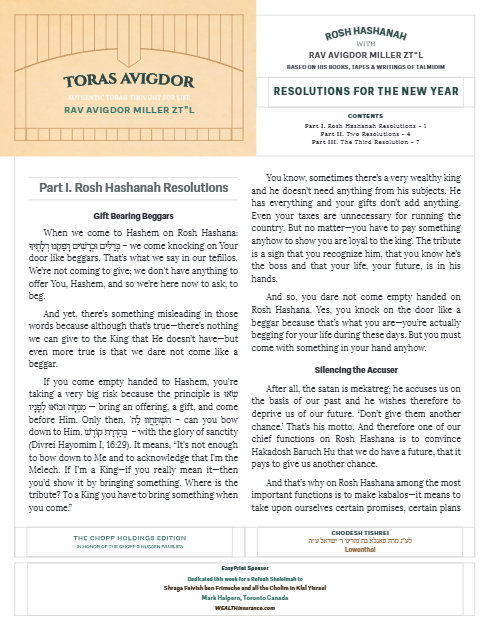

When we come to Hashem on Rosh Hashana: we come knocking on Your door like beggars. That’s what we say in our tefillos. We’re not coming to give; we don't have anything to offer You, Hashem, and so we’re here now to ask, to beg.

And yet, there’s something misleading in those words because although that’s true—there’s nothing we can give to the King that He doesn’t have—but even more true is that we dare not come like a beggar.

If you come empty handed to Hashem, you're taking a very big risk because the principle is — bring an offering, a gift, and come before Him. Only then, can you bow down to Him, with the glory of sanctity (Divrei Hayomim I, 16:29). It means, “It's not enough to bow down to Me and to acknowledge that I'm the Melech. If I'm a King—if you really mean it—then you’d show it by bringing something. Where is the tribute? To a King you have to bring something when you come.”

You know, sometimes there’s a very wealthy king and he doesn’t need anything from his subjects. He has everything and your gifts don’t add anything. Even your taxes are unnecessary for running the country. But no matter—you have to pay something anyhow to show you are loyal to the king. The tribute is a sign that you recognize him, that you know he’s the boss and that your life, your future, is in his hands.

And so, you dare not come empty handed on Rosh Hashana. Yes, you knock on the door like a beggar because that’s what you are—you’re actually begging for your life during these days. But you must come with something in your hand anyhow.

Silencing the Accuser

After all, the satan is mekatreg; he accuses us on the basis of our past and he wishes therefore to deprive us of our future. ‘Don’t give them another chance.’ That’s his motto. And therefore one of our chief functions on Rosh Hashana is to convince Hakadosh Baruch Hu that we do have a future, that it pays to give us another chance.

And that’s why on Rosh Hashana among the most important functions is to make kabalos—it means to take upon ourselves certain promises, certain plans for the ensuing year somewhat beyond what we were up till now.

“Bli neder, I’m going to be different this year in certain things, certain definite things.” Whether it’s in shalom bayis, your behavior towards your fellow man, in the way you daven, your ambitions to learn Torah, undertaking maasim tovim and new mitzvos, or more hiddur mitzvahs; whatever it is, we intend to transform ourselves. And although it won’t be a perfect transformation, but even a little bit is an achievement and the satan is quieted down.

Kabbalah for the Layman

That’s why all the pious servants of Hashem always made kabalos during these days and they made plans, tachbulos, how to fulfill them. They used to write down their kabbalos before Rosh Hashana so they shouldn't forget them as soon as the day was over. And then all throughout the year, until next Rosh Hashana, they would constantly remind themselves, “Remember what you wrote down, what you came to the King with. You have to stick to it because on the strength of this kabbalah you bargained with Hashem for health and life and success.”

And as much as possible they would keep track of their progress throughout the year and then when Elul would come around again, they would take time to look over all the kabbalos of the last year and see, “How did I do? What could I have done more to fulfill my commitments to Hashem?”

Don’t Be Mean

Just one example so you’ll understand what I’m talking about. Let’s say for instance you’ll say, “This year I promise I'll never say a mean word to my wife.” ‘Bli neder’, say. But it should be clear cut: “This year, no matter how mean my wife is to me, and how much she’ll bother me and criticize me and nag me, I won’t say anything impolite to her. I’ll keep my mouth closed.” Very good; an excellent kabbalah. And make sure you have a little notebook, a place to keep track, to make sure you’re fulfilling your promise.

Of course, it’s nothing compared with what you're supposed to do for Hashem. You're not supposed to say mean words to anybody. But at least bring one kabbalah: “Ribono Shel Olam this year I'll make it a principle bli neder I won't say any mean word to my wife.”

Women have to do that too. Her husband comes home tired from work. He needs encouragement, and instead you attack him with words when he comes home: “Why did you come so late? I have to work all day long by myself with the children. You don't help me at all,” and so on and so forth. “There's not enough money in the house. I want a maid. My neighbors have maids. I don't have a maid.” Or, “She has two maids and I only have one maid.” So make a kabbalah, “This year, for the first thirty minutes after my husband comes home from work, I won’t say one bad word. Only ‘sugar and spice and everything nice’.”

Valuable Daisies

So you're coming now with a gift to Hashem—you're coming with some bargaining power. Of course, it's still like a poor beggar. Because it’s like coming to ask a king that he should spare you your life—let’s say you did a very big crime and you want him to spare your life—and you bring him a few daisies. You couldn't afford to buy flowers from a florist so you pick some dandelions by the road and you bring them to the palace.

Whatever you come with now is only dandelions, because even if you would come to Hashem with tremendous promises—“I’ll give ten million dollars to Your Torah institutions” and you have it to give—it’s a very big gift but it’s nothing. It's merely a sign that you want to show Hashem some loyalty. That's all it is. Because compared to what He gave you, it's nothing at all. He gave you life. You never can pay for the great gift of life. All the happiness that you have, even by just walking around on the street, looking at the blue sky, breathing the air, all the fun that life has, it’s impossible to pay for it. So whatever you promise, all your resolutions, are like dandelions. It's even less than dandelions you picked on the road.

And yet, it’s everything! You know that you’re only a beggar but at least you’re showing the King that you're bringing something to Him. And that’s already a tremendous step, to approach Hakadosh Baruch Hu with a kabbalah, with something which we promise to do.

Keep it Simple

Of course, you won't pick too many things. You have to make a minimum, something that you'll be able to do. But at least something real, something practical. Just to make pie-in-the-sky promises, vague promises, that’s nothing. No; it has to be something you can grab onto. If you try to grab too much at one time, you’re going to grab nothing at all. It’s all going to fall out of your hand. To say in general, “I’m going to be good this year,” is better than nothing, but not much better.

And therefore in order to make it easier—Rosh Hashanah is tomorrow night and so time is running out—we’ll make now three suggestions; three clear cut resolutions for the entire year which are not difficult to do but which will bring guaranteed results. If you are ambitious, you can do all three. Maybe you’ll say it’s too much and you’ll choose only two. But whatever you decide, stick to it. If you commit to practicing them up every day for the next year, that’s already at least you’re coming before Him on Rosh Hashana with something.

Sheva Yipol Tzaddik V’Kam

Will you forget about them sometimes? Probably. A year is a long time. You might fall down. Could be Chol Hamoed Sukkos you’ll be very busy; you’ll forget. And there’s winter and Chanukah and Purim and Pesach. And then the summer. It’s a long year and nobody is perfect. But if you keep a small notebook and mark it down every day—check it off; did I do this and this and this?—that will help. And when you do forget or you weaken in your resolve, so you start fresh the next day.

Rav Nachman Breslover in one of his seforim relates that when he began his career as an oved Hashem, he fell down many times. Sometimes, a hundred times a day he fell down; but he wasn’t discouraged. He got up and said, “This time I’m going to remain standing.” He fell again. Each time he rose again and fought back. And that’s the career of all good people. They fall and they fall, but in the end they are going to conquer.

Kabbalah in Secret

Now, before we start, one important introduction, a warning: Don't tell this to anybody; don’t tell anyone about your program. That’s the advice of Shlomo Hamelech. Do not speak in the ears of a fool; and most people are fools. Why shouldn't you tell him? He'll make your words into nothing (Mishlei 23:9).

Now it could be he'll even belittle it—“Oh, it’s nothing. It’s nothing. It’s devarim beteilim. You’re wasting time talking about these subjects.” Yes, you’ll find people like that. He'll say poo poo and the whole thing is exploded. But even if he won’t say one word, but you’ll look at his face—a dead pan face. He’s not interested. So you get cooled off. You hear that? You're cooled off by him lacking the reaction. You see he’s not really interested, that he’s not impressed, and you yourself lose your interest in what you have to say. That’s an important principle—keep your kabbolos hidden, even from good people.

You know, the great sage Rav Simcha Zissel who lived about eighty years ago had the practice that when it occurred to him some important Torah idea, some new thought of avodas Hashem entered his mind, so for a long time he didn't tell it to anyone. Even to his disciples in the yeshivah he didn’t say anything. He kept to himself; he thought about it, practiced it, developed it, and only later he told his talmidim. And he explained that by telling it to others it loses its effectiveness on you.

A Matter of Degrees

Now, when he spoke in the yeshiva he was speaking to very good talmidim. His disciples were great men, talmidei chachamim, lamdanim. But still when he spoke to them and he would tell them his new thought that he was inspired with, they didn’t understand it with the same enthusiasm that he understood it. So let’s say he was inspired 98 degrees Fahrenheit; he would tell it to them and they'd be inspired 55 degrees. And that would cool him off. Human beings are like that. We’re weak like that.

Even when I speak to you, the thing that I have in my mind is not reflected in your mind entirely—it’s only partly reflected—and your face shows that it's not reflected fully. So I'm cooled off. Only that you came here already so I won’t disappoint you. I lose out by telling it to you but sometimes you can't help yourself. After all you're a teacher, you're a parent; you must tell others. But even so, at the beginning try to hold it as long as you can and suck out all the inspiration you can get out of it before you tell it to them.

And therefore when it comes to our program for the coming year, we say It should be for you alone, and strangers should not share it with you (ibid. 5:17). You want to remain inspired? You want to keep this enthusiasm that you have now in the beginning of the year? You want to become better with three kabalos and keep it up till next year? So keep it to yourself. By yourself you’ll achieve greatness and perfection.

PDF Preview