Erev Rosh Hashanah
Parsha Halacha | September 11, 2023
29 Elul, Friday, September 15
- No Tachnun (confessional prayer) is recited on Erev Rosh Hashanah, but it is said in the morning Selichot as well as in Mincha of the preceding day. Because the Selichot are traditionally recited before daybreak, it is not yet "Erev Rosh Hashanah" and therefore allowed.
- One should rise early and recite the Selichot of this day with emotion and tears in order to approach the King who is forgiving and to merit a positive judgment. One should recite the Selichot slowly, with humility and with a broken heart. The living should take to heart that it is a time to beseech G-d. We should remember that we are mere flesh, a wind that comes and does not return. One should remember the days they wasted in vanity. And realize that “If not now, when?”
- A mourner (G-d forbid) may go to Shul on Erev Rosh Hashanah for Selichot and davening.
- The Shofar is not blown on Erev Rosh Hashanah. This is in order to differentiate between the obligatory blowing of the Shofar on Rosh Hashanah and the customary blowing during the month of Elul. This is also to confuse the Satan so that he should think that the judgment of Rosh Hashanah has passed. (This means that the Satan will think that we are already deemed meritorious by G-d and no longer need judgment.)
- It is preferable that even a Ba'al Tokei’a who blows the Shofar for the community not practice on this day. If he needs to do so, he may do so in private (so that others should not think that one may blow the Shofar on this day).
- The Chazzan (leader of the prayers) and Ba'al Tokei’a should distance themselves from any (spiritual) impurity for three days before Rosh Hashanah. The Chazzan should review the meaning of the prayers and, if possible, their mystical meanings. These can be found in Sidurim with commentaries, for example Siddur Otzar HaTefilot. This is a good practice for people who are not Chazzanim as well. See below regarding the Ba'al Tokei’a.
- If a Shul does not have a regular Chazzan, they should appoint one for the High Holidays who is (preferably) G-d-fearing, married, with children, at least 25 or 30 years old, and involved in communal affairs.
- If a certain person is usually the chazzan for a certain service, this mitzvah should not be given to someone else. Correspondingly, one who is usually a chazzan for a certain prayer should not relinquish this mitzvah. That being said, one should nevertheless not fight about it.
- Although one who is in mourning should generally not be a chazzan on Shabbat and Yom Tov, if a shul’s regular chazzan is in mourning (may G-d have mercy), he may continue to serve as chazzan on Rosh Hashanah and Yom Kippur as well. The same applies to a Ba’al Tokei’a (one who blows the Shofar).
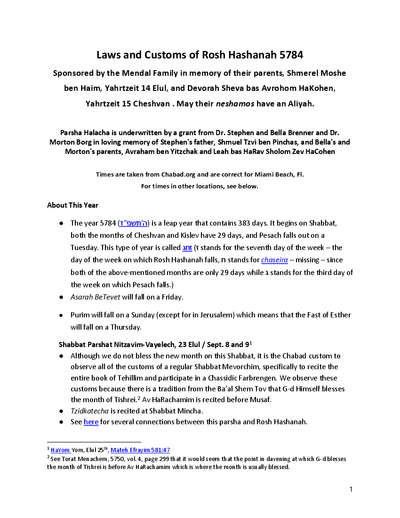
View The Full Article (PDF)
Related Articles

A Lesson from Chana in Making Our Personal Needs G-ds Needs
Brooklyn Torah Gazette • Nitzavim-Vayelech

Children in Shul
Parsha Halacha • Nitzavim-Vayelech

Mincha
Parsha Halacha • Nitzavim-Vayelech

Visiting the Graves of Tzadikim
Parsha Halacha • Nitzavim-Vayelech

To Confuse the Satan
Ben Chamesh L'Mikra • Nitzavim-Vayelech