The Cry of the Shofar Two Parables
L’Chaim | September 11, 2023
Print This Article
View Original PDF

The Cry of the Shofar Two Parables

L’Chaim | December 31, 2025

On the verse, “Seek Hashem when He could be found,” the Talmud says, “These are the ten days between Rosh Hashanah and Yom Kippur.” The words of the Talmud seem to contradict itself. On one hand it says, “between Rosh Hashanah and Yom Kippur,” which means that Rosh Hashanah and Yom Kippur are not included. On the other hand, it says, “These are the ten days,” which must include Rosh Hashanah and Yom Kippur, because there are only seven days between Rosh Hashanah and Yom Kippur.

We must conclude that there are two different aspects to Rosh Hashanah and Yom Kippur.

First is their own essential individual identity. And then there is the Teshuva - Repentance aspect, how they are included in the Ten Days of Teshuva. And because it says, “between Rosh Hashanah and Yom Kippur,” We understand that the holiday’s own significance comes first and is higher.

What is the individual aspect of Rosh Hashanah?

The Talmud tells us that about Rosh Hashanah, Hashem says, “Say before Me (verses of) kingship, in order that you should make Me King over you.” The whole concept of mitzvahs doesn’t exist before you accept Hashem as King. While Mitzvahs are Hashem’s will, Teshuva is even higher than mitzvahs, therefore, it can fix the damage that was caused by breaking them.

When we ask Hashem to be King over us, we are asking for Him Himself, His essence, which is higher than His will, and for that matter, beyond all of existence. This is a testament to how great the souls of the Jewish people are, they reach and connect to the essence of Hashem.

That is why we are able to generate the will in Him, to want to be King. And when do we connect with His essence? When we connect with our souls essence, on Rosh Hashanah, during the Amida, when we say the words, “Be King over the whole world with Your glory.”

To understand this better, we first have to understand the role of a human king in general in Judaism. A true king is not a dictator, nor is he seeking the office or yearning for power. He actually doesn’t want to be king. He is someone who everyone realizes, that he is higher and greater, not just greater, but head and shoulders over the rest.

We request of him to be our king, because we want to gain from and connect with his greatness.

Once he accepts, he is totally given over to the welfare of the people, physically and spiritually and because of his great closeness to Hashem, he has the ability to raise everyone up, closer to Him.

Therefore, the Torah gives him the title Nassi, because Nassi is from the word nasso, which means to raise.

The holiday is called Rosh Hashanah, the head of the year. The head has different aspects to it. First, is its own unique individuality as the head. Second, it is the life force of the limbs and organs. And third, it is what controls all the organs and limbs, even after the life force has been drawn into them.

The same is with Rosh Hashanah. First, there is the individual aspect of the day, making Hashem our King. Second, is the teshuva aspect of Rosh Hashanah, which is still higher than the mitzvahs, and third, is the direct effect of Rosh Hashanah on all the days of the year, because of the resolutions we make with regards to doing mitzvahs and serving Hashem all year round.

How amazing are we, that Hashem chose us as His own, and that we can connect with His essence. As the shofar is sounded, take a moment to lose yourself to the essence of your neshama, which will connect you to the essence of Hashem, and ask Him to be your King. He will surely accept and grant you and your loved ones a happy and sweet year.

Adapted by Rabbi Yitzi Hurwitz from the teachings of the Rebbe, yitzihurwitz.blogspot.com. Rabbi Hurwitz, who is battling ALS, and his wife Dina, are emissaries of the Rebbe in Temecula, Ca.

A parable from Rabbi Israel Baal Shem Tov:

A King had an only son, the apple of his eye. The King wanted his son to master different fields of knowledge and to experience various cultures, so he sent him to a far-off country, supplied with a generous quantity of silver and gold. Far away from home, the son squandered all the money until he was left completely destitute. In his distress he resolved to return to his father’s house and after much difficulty, he managed to arrive at the gate of the courtyard to his father’s palace.

In the passage of time, he had actually forgotten the language of his native country, and he was unable to identify himself to the guards. In utter despair he began to cry out in a loud voice, and the King, who recognized the voice of his son, went out to him and brought him into the house, kissing him and hugging him.

The meaning of the parable: The King is G-d. The prince is the Jewish people, who are called “Children of G-d” (Deuteronomy 14:1). The King sends a soul down to this world in order to fulfill the Torah and mitzvot. However, the soul becomes very distant and forgets everything to which it was accustomed to above, and in the long exile it forgets even its own “language.” So it utters a simple cry to its Father in Heaven. This is the blowing of the shofar, a cry from deep within, expressing regret for the past and determination for the future. This cry elicits G-d’s mercies, and He demonstrates His abiding affection for His child and forgives him.

A parable from Rabbi Levi Yitzchak of Berditchev:

A king was once traveling in the forest and lost his way, until he met a man who recognized that he was the king and escorted his master out of the forest and back to his palace. The king later rewarded him with many presents, and elevated him to a powerful minister’s post.

After a while, however, the man committed an act which was considered rebellious against the king, and he was sentenced to death. Before he was taken out to be executed, the king granted him one last request.

The man said: “I request to wear the clothes I wore when I escorted His Majesty when he was lost in the forest, and that His Majesty should also wear the clothes he wore then.”

The king complied, and when they were both dressed in the garments they wore at the time of their meeting, he said, “By your life, you have saved yourself,” and called off the execution.

The meaning of the parable is that when G-d gave the Torah to Israel, he offered it first to all the nations of the world. They all refused, except the people of Israel, who willingly accepted the yoke of Heaven and fulfilled the commandments of the Creator.

But now we have transgressed and rebelled, like the man in the parable, and with the arrival of the Day of Judgment we are fearful indeed. So we blow the shofar to recall the shofar blowing that accompanied our original acceptance of the Torah and coronation of G-d. This merit stands by us, and G-d forgives us all our sins and inscribes us immediately for a year of goodness and life.

Excerpted from Days Of Awe, Days Of Joy by Rabbi Eli Friedman, published by Kehot Publication Society
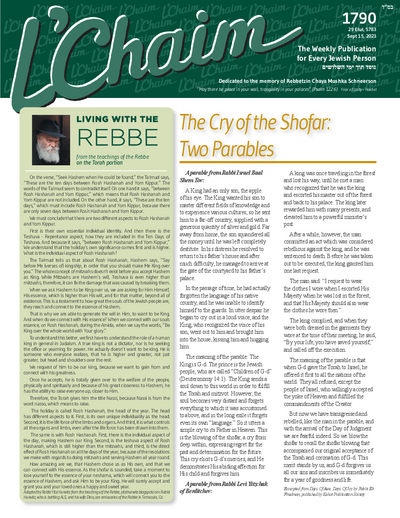
On the verse, “Seek Hashem when He could be found,” the Talmud says, “These are the ten days between Rosh Hashanah and Yom Kippur.” The words of the Talmud seem to contradict itself. On one hand it says, “between Rosh Hashanah and Yom Kippur,” which means that Rosh Hashanah and Yom Kippur are not included. On the other hand, it says, “These are the ten days,” which must include Rosh Hashanah and Yom Kippur, because there are only seven days between Rosh Hashanah and Yom Kippur.

We must conclude that there are two different aspects to Rosh Hashanah and Yom Kippur.

First is their own essential individual identity. And then there is the Teshuva - Repentance aspect, how they are included in the Ten Days of Teshuva. And because it says, “between Rosh Hashanah and Yom Kippur,” We understand that the holiday’s own significance comes first and is higher.

What is the individual aspect of Rosh Hashanah?

The Talmud tells us that about Rosh Hashanah, Hashem says, “Say before Me (verses of) kingship, in order that you should make Me King over you.” The whole concept of mitzvahs doesn’t exist before you accept Hashem as King. While Mitzvahs are Hashem’s will, Teshuva is even higher than mitzvahs, therefore, it can fix the damage that was caused by breaking them.

When we ask Hashem to be King over us, we are asking for Him Himself, His essence, which is higher than His will, and for that matter, beyond all of existence. This is a testament to how great the souls of the Jewish people are, they reach and connect to the essence of Hashem.

That is why we are able to generate the will in Him, to want to be King. And when do we connect with His essence? When we connect with our souls essence, on Rosh Hashanah, during the Amida, when we say the words, “Be King over the whole world with Your glory.”

To understand this better, we first have to understand the role of a human king in general in Judaism. A true king is not a dictator, nor is he seeking the office or yearning for power. He actually doesn’t want to be king. He is someone who everyone realizes, that he is higher and greater, not just greater, but head and shoulders over the rest.

We request of him to be our king, because we want to gain from and connect with his greatness.

Once he accepts, he is totally given over to the welfare of the people, physically and spiritually and because of his great closeness to Hashem, he has the ability to raise everyone up, closer to Him.

Therefore, the Torah gives him the title Nassi, because Nassi is from the word nasso, which means to raise.

The holiday is called Rosh Hashanah, the head of the year. The head has different aspects to it. First, is its own unique individuality as the head. Second, it is the life force of the limbs and organs. And third, it is what controls all the organs and limbs, even after the life force has been drawn into them.

The same is with Rosh Hashanah. First, there is the individual aspect of the day, making Hashem our King. Second, is the teshuva aspect of Rosh Hashanah, which is still higher than the mitzvahs, and third, is the direct effect of Rosh Hashanah on all the days of the year, because of the resolutions we make with regards to doing mitzvahs and serving Hashem all year round.

How amazing are we, that Hashem chose us as His own, and that we can connect with His essence. As the shofar is sounded, take a moment to lose yourself to the essence of your neshama, which will connect you to the essence of Hashem, and ask Him to be your King. He will surely accept and grant you and your loved ones a happy and sweet year.

Adapted by Rabbi Yitzi Hurwitz from the teachings of the Rebbe, yitzihurwitz.blogspot.com. Rabbi Hurwitz, who is battling ALS, and his wife Dina, are emissaries of the Rebbe in Temecula, Ca.

A parable from Rabbi Israel Baal Shem Tov:

A King had an only son, the apple of his eye. The King wanted his son to master different fields of knowledge and to experience various cultures, so he sent him to a far-off country, supplied with a generous quantity of silver and gold. Far away from home, the son squandered all the money until he was left completely destitute. In his distress he resolved to return to his father’s house and after much difficulty, he managed to arrive at the gate of the courtyard to his father’s palace.

In the passage of time, he had actually forgotten the language of his native country, and he was unable to identify himself to the guards. In utter despair he began to cry out in a loud voice, and the King, who recognized the voice of his son, went out to him and brought him into the house, kissing him and hugging him.

The meaning of the parable: The King is G-d. The prince is the Jewish people, who are called “Children of G-d” (Deuteronomy 14:1). The King sends a soul down to this world in order to fulfill the Torah and mitzvot. However, the soul becomes very distant and forgets everything to which it was accustomed to above, and in the long exile it forgets even its own “language.” So it utters a simple cry to its Father in Heaven. This is the blowing of the shofar, a cry from deep within, expressing regret for the past and determination for the future. This cry elicits G-d’s mercies, and He demonstrates His abiding affection for His child and forgives him.

A parable from Rabbi Levi Yitzchak of Berditchev:

A king was once traveling in the forest and lost his way, until he met a man who recognized that he was the king and escorted his master out of the forest and back to his palace. The king later rewarded him with many presents, and elevated him to a powerful minister’s post.

After a while, however, the man committed an act which was considered rebellious against the king, and he was sentenced to death. Before he was taken out to be executed, the king granted him one last request.

The man said: “I request to wear the clothes I wore when I escorted His Majesty when he was lost in the forest, and that His Majesty should also wear the clothes he wore then.”

The king complied, and when they were both dressed in the garments they wore at the time of their meeting, he said, “By your life, you have saved yourself,” and called off the execution.

The meaning of the parable is that when G-d gave the Torah to Israel, he offered it first to all the nations of the world. They all refused, except the people of Israel, who willingly accepted the yoke of Heaven and fulfilled the commandments of the Creator.

But now we have transgressed and rebelled, like the man in the parable, and with the arrival of the Day of Judgment we are fearful indeed. So we blow the shofar to recall the shofar blowing that accompanied our original acceptance of the Torah and coronation of G-d. This merit stands by us, and G-d forgives us all our sins and inscribes us immediately for a year of goodness and life.

Excerpted from Days Of Awe, Days Of Joy by Rabbi Eli Friedman, published by Kehot Publication Society

PDF Preview