The Second Day
Ben Chamesh L'Mikra | September 11, 2023
Print This Article
View Original PDF

The Second Day

Ben Chamesh L'Mikra | December 31, 2025

The Second Day

Translated by Rabbi Shmuel Kesselman
Edited by Rabbi Y. Eliezer Danzinger

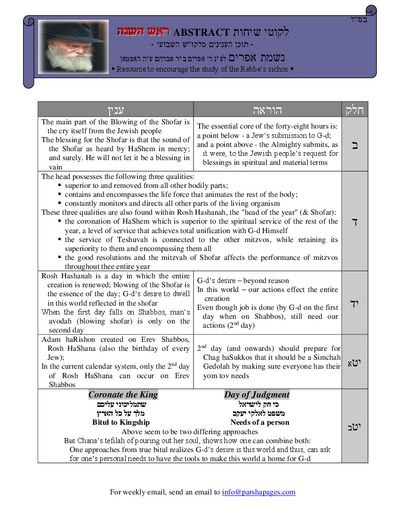
1. There is a difference between the second day of the festival of Rosh Hashanah and the second day of all the other festivals. This is true of (their respective relationships with the festival’s first day, and true of) their relationship with the core dynamic and theme of the festival. This is evident from a practical law (and in respect to this sphere of Torah, all Jews are equal): A substance that came into existence or milk that was expressed on the first day of Rosh Hashanah is forbidden also on the second day (unlike on other festivals when the substance would be permitted {using the logical reasoning of} “either way”). The rationale is that {unlike other two-day festivals} the two days of Rosh Hashanah are “like one prolonged day.”

This difference is particularly true considering the inner dimension of the festival, as it says in Likutei Torah on the verse, “He will revive us from the two days”: “The ‘two days’ refer to the two days of Rosh Hashanah because Rosh Hashanah was always celebrated for two days, even in bygone days, when the months were sanctified based on the actual sighting of the new moon.” As explained there, “On the two days of Rosh Hashanah, the worlds are elevated.” “On the first day, the inner aspects {of creation} are elevated; and on the second, the external aspects are elevated.” What emerges is that the two days of Rosh Hashanah share the same core dynamic—the elevation of the worlds. It is merely that this dynamic has two parts.

This relationship between the second day of Rosh Hashanah with (the first day, and with) the core theme of Rosh Hashanah is evident and expressed more prominently in this calendar year, when Rosh Hashanah falls out on Shabbos, as will be explained.

2. The Beginning of Creation

In the liturgy of Rosh Hashanah, it says, “This is the day of the beginning of Your work.” The word ma’asecha, your work, is in the plural form {as if to say “all your work”}. From this usage, it is understood that “this day” does not just mark “the beginning” of the creation of the specific species of man, rather this is “the beginning” of all the work of Hashem; even of what was created during the five days of creation prior to the creation of man. This idea is elucidated in the chassidic discourses on Rosh Hashanah.

Meaning, the Divine renewal of creation that occurs on Rosh Hashanah does not apply only to humanity, but to all the worlds and to the entire spectrum of creation (seder hishtalshelus). Nevertheless, the renewal of the worlds transpires on the same day as man’s creation.

The reason: The purpose of the entire hishtalshelus, of all the worlds, tzimtzumim, mesochim and parsa’ois, etc., is in order to facilitate the creation of this lowly world, as Hashem desired to have a “home” in the lower realms.

There are two aspects of this idea:

  1. What we do not understand or grasp is why Hashem desires a home in the lower worlds. For this desire, there is no reason; it is beyond any reasoning; and is merely because so He “desired.” This principle is explained in the series of maamarim beginning on Rosh Hashanah 5666 (1905), based on the adage of the Alter Rebbe, “Regarding a desire, there can be no question,” i.e., His intention is beyond any reason.
  2. We do know {however} what it is that He “desired”—meaning, the plan and the purpose of creating all the worlds—that is, for Hashem to have a home in the lower realms.

3. Renewal of All Worlds and the Mitzvah of Shofar

Since Rosh Hashanah is the day of the renewal of all the worlds, and their renewal occurs in a way that underscores their purpose, i.e., to make a home for Him in the lower realms, this must certainly be true of the mitzvos linked to Rosh Hashanah [which constitute the divine service of man on that day, and which are instrumental in renewing the existence of all the worlds]. These mitzvos must also express the concept that “Hashem desired to have a home in the lower realms.”

The explanation is as follows: The sages say “The mitzvah of the day is the shofar,” and Rambam writes: “Even though the sounding of the shofar on Rosh Hashanah is a divine decree {without any stated rationale}, it contains an allusion.” “It is as if the shofar's call is saying: ‘Wake up sleepy ones from your sleep’....”

Ostensibly, the novel concept that the Rambam introduces here, in Hilchos Teshuva, is that the sounding of the shofar alludes to repentance. Why then does he preface (in Hilchos Teshuva) by saying that the sounding of the shofar is a decree?

Put a different way: Even were we to say that the mitzvah of shofar does have a rationale (similar to what Rabbi Saadya Gaon writes, cited in Abudraham) it might also contain an allusion—as we find regarding many mitzvahs. {So the question is reinforced: Why does Rambam need to preface “Even though....”}

Thus, we are compelled to conclude that all this is the novelty introduced by Rambam’s remark. Namely, the mitzvah of shofar has two components: a) it is a Divine decree {without rhyme or reason}; and b) it alludes to the avodah of teshuva:

On the verse, “I said, ‘I will become wise,’ but it was far from me,” the Midrash writes: “King Shlomo, in his great wisdom, did not grasp the rationale behind the mitzvah of the red heifer.” “Only to Moshe did Hashem say, ‘To you {alone}, I will reveal the rationale for the heifer.’” The Midrash implies that although the mitzvah of the red heifer is a “statute of the Torah,” totally beyond reason, it is not intrinsically suprarational (for indeed its rationale was revealed to Moshe). King Shlomo, though, could not grasp it.

This then is Rambam’s intent by emphasising (as a preamble to explaining the allusion of shofar) that the mitzvah of shofar is a decree. Not that the mitzvah of the shofar really has a rationale, but Rambam does not state it explicitly because, for whatever reason, it is not to be disclosed. Rather, the mitzvah is intrinsically a Divine decree, i.e., beyond reason.

The reason is that the mitzvah of shofar relates to a very exalted level, beyond the parameters of intellect and reason.

On this basis, what emerges is that the mitzvah of shofar, being a decree and beyond comprehension, is {conceptually} similar to the idea that “Hashem desired to have a home in the lower worlds,” which, as discussed, is also beyond reason.

Nonetheless, Rambam continues: “It contains an allusion.” “{It is as if the shofar's call is saying:} ‘Wake up sleepy ones....’” The shofar reflects substantively the general avodah of man, which is subdivided into two facets: a) “Wake up sleepy ones,” avoiding sin; b) “improve your deeds,” doing good.

Therefore, Rambam conjoins these two details, stating that shofar is a decree and that it contains an allusion: Although the core idea of shofar is beyond reason and is rooted in a level beyond intellect (and {by extension, beyond any} revelation), still, this level can be reached {and revealed} specifically through the avodah of man. This idea dovetails with the idea that “Hashem desired...,” discussed earlier. The essence of Hashem’s “desire” is beyond mortal ken, but the “home” that He desires is actualized specifically through man’s avodah, as discussed earlier.

On this basis, it is now clear why on Rosh Hashanah, the mitzvah of the day is shofar. For its message and its significance correspond to the purpose and the goal of the creation of all the worlds (that Hashem desired), {a desire for} which is renewed on Rosh Hashanah.

4. Rosh Hashanah on Shabbos

When Rosh Hashanah coincides with Shabbos (as it does this year), Rosh Hashanah {itself} does not exhibit this {latent} shofar-related quality {since the shofar is not sounded}, since the renewal of the world is not then coming about {mainly} through the avodah of a person. True, Shabbos, on its own, accomplishes the renewal and elicits all the necessary energies that would ordinarily be elicited by the sounding of the shofar (and it is for this very reason {on a deeper level} that shofar is not sounded on Shabbos, as explained in many places in Chassidic teachings). But when Rosh Hashanah falls on Shabbos, Rosh Hashanah lacks this fundamental quality, i.e., that the renewal comes about through a person’s avodah. For then {i.e., on Shabbos, when the shofar is not sounded by man}, the renewal of the world is initiated On High—harnessing the power of Shabbos itself, which is “independently holy”—without recourse to the shofar’s sounding.

This dynamic, mentioned above, whereby through the medium of the shofar, man’s avodah brings about Hashem’s renewal of creation (which is also an underlying idea of Rosh Hashanah) is evident on the second day of Rosh Hashanah, in a calendar-setting like this year’s. For on the second day, the shofar is sounded even in a year like this one, and through man’s avodah, all the spiritual energies of Rosh Hashanah are elicited.

[Furthermore, although in a calendar year like this, Shabbos really substitutes for the shofar-sounding in all respects, still, the sound of the shofar is not heard by the physical ear, and thus it cannot affect the physical body, to waken it, etc. Not so on the second day, when we actually blow the shofar. A person hears the sounds with his physical ear [in addition to other people who hear it too, and even non-Jews who can hear it] and this experience awakens one’s physical body to recall the sovereignty of the King of all kings, Hashem, to which the mitzvah of shofar alludes, as explained by Rabbi Saadya Gaon, based on the verse, “With trumpets and the sound of a shofar, raise your voices before the King, Hashem.” Additionally, the shofar stirs a person to recollect the shofar sounded at Mount Sinai {at the giving of the Torah} (which is linked to the sounding of the shofar on Rosh Hashanah) even before one begins to recite the verses of shofaros, {which speaks about these topics}.]

5. The Benefit of This Calendar Setting

This is the benefit of a calendar setting (as on this year) in which Rosh Hashanah coincides with Shabbos. For then, the advantage of a person’s avodah is emphasized even more so than when Rosh Hashanah coincides with any other day of the week. This can be readily understood:

In a regular year {when Rosh Hashanah does not fall out on Shabbos} the renewal of creation is evoked by the mitzvah of the day, i.e., through the avodah of man (through the sounding of the shofar). In contrast, when Rosh Hashanah coincides with Shabbos, the renewal is achieved without the avodah of man. Nevertheless, we tell a person: “Even though the world was entirely and completely renewed on the first day of Rosh Hashanah (for it is achieved by the sanctity conferred from Above {on Shabbos} and {is therefore} enduring) still, notwithstanding all of this, your contribution to this process is needed. So when the second day arrives, you must sound the shofar.”

This then is the directive for every person [uniquely emphasized by how the calendar is fixed this year]:

The obligation of a person to serve Hashem does not apply only when a deficiency exists that needs attention, and through his efforts, a person can rectify and perfect the matter. Rather, even when something has already been rectified and perfected by tzaddikim—or by Hashem, the Tzaddik of the world—it still is necessary for a denizen of the “lower realm” to perform his duty. So much so, without this avodah, the matter is not truly complete. Even Gan Eden, regarding which it says, “Hashem planted a garden in the Eden of yore,” required man “to work within it and protect it.”

Also, the above explanation also accords with the mystical explanation of the concept (as explained in Section 1—that on the first day of Rosh Hashanah, the (inward dimension of the) worlds are elevated, and that on the second day—their external dimension is elevated:

When Rosh Hashanah coincides with Shabbos, the importance of a person’s divine service is emphasized. For on the first day, when the spiritual dynamics are accomplished by Shabbos’s inherent holiness, the import of the shofar is not recognizable or apparent in this physical world, as neither the blessing over the shofar nor the blessing of shehechiyanu is recited.

On the following day {on the day after Shabbos}, in contrast, when a person does sound the shofar, he recites the blessings, (and elicits) “...who has sanctified us with His commandments and who has commanded us, ונוויצ” (ונוויצ is related to the term אתווצ, meaning, connection). On this second day, he doesn’t need a new garment, or the like; rather, he simply recites the blessing, “...who has kept us alive, and who has sustained us, and who has brought us to this time.”

Based on a sicha delivered on the 2nd day of Rosh Hashanah, 5733 (1972)
The Second Day

Translated by Rabbi Shmuel Kesselman
Edited by Rabbi Y. Eliezer Danzinger

1. There is a difference between the second day of the festival of Rosh Hashanah and the second day of all the other festivals. This is true of (their respective relationships with the festival’s first day, and true of) their relationship with the core dynamic and theme of the festival. This is evident from a practical law (and in respect to this sphere of Torah, all Jews are equal): A substance that came into existence or milk that was expressed on the first day of Rosh Hashanah is forbidden also on the second day (unlike on other festivals when the substance would be permitted {using the logical reasoning of} “either way”). The rationale is that {unlike other two-day festivals} the two days of Rosh Hashanah are “like one prolonged day.”

This difference is particularly true considering the inner dimension of the festival, as it says in Likutei Torah on the verse, “He will revive us from the two days”: “The ‘two days’ refer to the two days of Rosh Hashanah because Rosh Hashanah was always celebrated for two days, even in bygone days, when the months were sanctified based on the actual sighting of the new moon.” As explained there, “On the two days of Rosh Hashanah, the worlds are elevated.” “On the first day, the inner aspects {of creation} are elevated; and on the second, the external aspects are elevated.” What emerges is that the two days of Rosh Hashanah share the same core dynamic—the elevation of the worlds. It is merely that this dynamic has two parts.

This relationship between the second day of Rosh Hashanah with (the first day, and with) the core theme of Rosh Hashanah is evident and expressed more prominently in this calendar year, when Rosh Hashanah falls out on Shabbos, as will be explained.

2. The Beginning of Creation

In the liturgy of Rosh Hashanah, it says, “This is the day of the beginning of Your work.” The word ma’asecha, your work, is in the plural form {as if to say “all your work”}. From this usage, it is understood that “this day” does not just mark “the beginning” of the creation of the specific species of man, rather this is “the beginning” of all the work of Hashem; even of what was created during the five days of creation prior to the creation of man. This idea is elucidated in the chassidic discourses on Rosh Hashanah.

Meaning, the Divine renewal of creation that occurs on Rosh Hashanah does not apply only to humanity, but to all the worlds and to the entire spectrum of creation (seder hishtalshelus). Nevertheless, the renewal of the worlds transpires on the same day as man’s creation.

The reason: The purpose of the entire hishtalshelus, of all the worlds, tzimtzumim, mesochim and parsa’ois, etc., is in order to facilitate the creation of this lowly world, as Hashem desired to have a “home” in the lower realms.

There are two aspects of this idea:

  1. What we do not understand or grasp is why Hashem desires a home in the lower worlds. For this desire, there is no reason; it is beyond any reasoning; and is merely because so He “desired.” This principle is explained in the series of maamarim beginning on Rosh Hashanah 5666 (1905), based on the adage of the Alter Rebbe, “Regarding a desire, there can be no question,” i.e., His intention is beyond any reason.
  2. We do know {however} what it is that He “desired”—meaning, the plan and the purpose of creating all the worlds—that is, for Hashem to have a home in the lower realms.

3. Renewal of All Worlds and the Mitzvah of Shofar

Since Rosh Hashanah is the day of the renewal of all the worlds, and their renewal occurs in a way that underscores their purpose, i.e., to make a home for Him in the lower realms, this must certainly be true of the mitzvos linked to Rosh Hashanah [which constitute the divine service of man on that day, and which are instrumental in renewing the existence of all the worlds]. These mitzvos must also express the concept that “Hashem desired to have a home in the lower realms.”

The explanation is as follows: The sages say “The mitzvah of the day is the shofar,” and Rambam writes: “Even though the sounding of the shofar on Rosh Hashanah is a divine decree {without any stated rationale}, it contains an allusion.” “It is as if the shofar's call is saying: ‘Wake up sleepy ones from your sleep’....”

Ostensibly, the novel concept that the Rambam introduces here, in Hilchos Teshuva, is that the sounding of the shofar alludes to repentance. Why then does he preface (in Hilchos Teshuva) by saying that the sounding of the shofar is a decree?

Put a different way: Even were we to say that the mitzvah of shofar does have a rationale (similar to what Rabbi Saadya Gaon writes, cited in Abudraham) it might also contain an allusion—as we find regarding many mitzvahs. {So the question is reinforced: Why does Rambam need to preface “Even though....”}

Thus, we are compelled to conclude that all this is the novelty introduced by Rambam’s remark. Namely, the mitzvah of shofar has two components: a) it is a Divine decree {without rhyme or reason}; and b) it alludes to the avodah of teshuva:

On the verse, “I said, ‘I will become wise,’ but it was far from me,” the Midrash writes: “King Shlomo, in his great wisdom, did not grasp the rationale behind the mitzvah of the red heifer.” “Only to Moshe did Hashem say, ‘To you {alone}, I will reveal the rationale for the heifer.’” The Midrash implies that although the mitzvah of the red heifer is a “statute of the Torah,” totally beyond reason, it is not intrinsically suprarational (for indeed its rationale was revealed to Moshe). King Shlomo, though, could not grasp it.

This then is Rambam’s intent by emphasising (as a preamble to explaining the allusion of shofar) that the mitzvah of shofar is a decree. Not that the mitzvah of the shofar really has a rationale, but Rambam does not state it explicitly because, for whatever reason, it is not to be disclosed. Rather, the mitzvah is intrinsically a Divine decree, i.e., beyond reason.

The reason is that the mitzvah of shofar relates to a very exalted level, beyond the parameters of intellect and reason.

On this basis, what emerges is that the mitzvah of shofar, being a decree and beyond comprehension, is {conceptually} similar to the idea that “Hashem desired to have a home in the lower worlds,” which, as discussed, is also beyond reason.

Nonetheless, Rambam continues: “It contains an allusion.” “{It is as if the shofar's call is saying:} ‘Wake up sleepy ones....’” The shofar reflects substantively the general avodah of man, which is subdivided into two facets: a) “Wake up sleepy ones,” avoiding sin; b) “improve your deeds,” doing good.

Therefore, Rambam conjoins these two details, stating that shofar is a decree and that it contains an allusion: Although the core idea of shofar is beyond reason and is rooted in a level beyond intellect (and {by extension, beyond any} revelation), still, this level can be reached {and revealed} specifically through the avodah of man. This idea dovetails with the idea that “Hashem desired...,” discussed earlier. The essence of Hashem’s “desire” is beyond mortal ken, but the “home” that He desires is actualized specifically through man’s avodah, as discussed earlier.

On this basis, it is now clear why on Rosh Hashanah, the mitzvah of the day is shofar. For its message and its significance correspond to the purpose and the goal of the creation of all the worlds (that Hashem desired), {a desire for} which is renewed on Rosh Hashanah.

4. Rosh Hashanah on Shabbos

When Rosh Hashanah coincides with Shabbos (as it does this year), Rosh Hashanah {itself} does not exhibit this {latent} shofar-related quality {since the shofar is not sounded}, since the renewal of the world is not then coming about {mainly} through the avodah of a person. True, Shabbos, on its own, accomplishes the renewal and elicits all the necessary energies that would ordinarily be elicited by the sounding of the shofar (and it is for this very reason {on a deeper level} that shofar is not sounded on Shabbos, as explained in many places in Chassidic teachings). But when Rosh Hashanah falls on Shabbos, Rosh Hashanah lacks this fundamental quality, i.e., that the renewal comes about through a person’s avodah. For then {i.e., on Shabbos, when the shofar is not sounded by man}, the renewal of the world is initiated On High—harnessing the power of Shabbos itself, which is “independently holy”—without recourse to the shofar’s sounding.

This dynamic, mentioned above, whereby through the medium of the shofar, man’s avodah brings about Hashem’s renewal of creation (which is also an underlying idea of Rosh Hashanah) is evident on the second day of Rosh Hashanah, in a calendar-setting like this year’s. For on the second day, the shofar is sounded even in a year like this one, and through man’s avodah, all the spiritual energies of Rosh Hashanah are elicited.

[Furthermore, although in a calendar year like this, Shabbos really substitutes for the shofar-sounding in all respects, still, the sound of the shofar is not heard by the physical ear, and thus it cannot affect the physical body, to waken it, etc. Not so on the second day, when we actually blow the shofar. A person hears the sounds with his physical ear [in addition to other people who hear it too, and even non-Jews who can hear it] and this experience awakens one’s physical body to recall the sovereignty of the King of all kings, Hashem, to which the mitzvah of shofar alludes, as explained by Rabbi Saadya Gaon, based on the verse, “With trumpets and the sound of a shofar, raise your voices before the King, Hashem.” Additionally, the shofar stirs a person to recollect the shofar sounded at Mount Sinai {at the giving of the Torah} (which is linked to the sounding of the shofar on Rosh Hashanah) even before one begins to recite the verses of shofaros, {which speaks about these topics}.]

5. The Benefit of This Calendar Setting

This is the benefit of a calendar setting (as on this year) in which Rosh Hashanah coincides with Shabbos. For then, the advantage of a person’s avodah is emphasized even more so than when Rosh Hashanah coincides with any other day of the week. This can be readily understood:

In a regular year {when Rosh Hashanah does not fall out on Shabbos} the renewal of creation is evoked by the mitzvah of the day, i.e., through the avodah of man (through the sounding of the shofar). In contrast, when Rosh Hashanah coincides with Shabbos, the renewal is achieved without the avodah of man. Nevertheless, we tell a person: “Even though the world was entirely and completely renewed on the first day of Rosh Hashanah (for it is achieved by the sanctity conferred from Above {on Shabbos} and {is therefore} enduring) still, notwithstanding all of this, your contribution to this process is needed. So when the second day arrives, you must sound the shofar.”

This then is the directive for every person [uniquely emphasized by how the calendar is fixed this year]:

The obligation of a person to serve Hashem does not apply only when a deficiency exists that needs attention, and through his efforts, a person can rectify and perfect the matter. Rather, even when something has already been rectified and perfected by tzaddikim—or by Hashem, the Tzaddik of the world—it still is necessary for a denizen of the “lower realm” to perform his duty. So much so, without this avodah, the matter is not truly complete. Even Gan Eden, regarding which it says, “Hashem planted a garden in the Eden of yore,” required man “to work within it and protect it.”

Also, the above explanation also accords with the mystical explanation of the concept (as explained in Section 1—that on the first day of Rosh Hashanah, the (inward dimension of the) worlds are elevated, and that on the second day—their external dimension is elevated:

When Rosh Hashanah coincides with Shabbos, the importance of a person’s divine service is emphasized. For on the first day, when the spiritual dynamics are accomplished by Shabbos’s inherent holiness, the import of the shofar is not recognizable or apparent in this physical world, as neither the blessing over the shofar nor the blessing of shehechiyanu is recited.

On the following day {on the day after Shabbos}, in contrast, when a person does sound the shofar, he recites the blessings, (and elicits) “...who has sanctified us with His commandments and who has commanded us, ונוויצ” (ונוויצ is related to the term אתווצ, meaning, connection). On this second day, he doesn’t need a new garment, or the like; rather, he simply recites the blessing, “...who has kept us alive, and who has sustained us, and who has brought us to this time.”

Based on a sicha delivered on the 2nd day of Rosh Hashanah, 5733 (1972)

PDF Preview