The Unknown
זכרון יעקב | September 26, 2024
Print This Article
View Original PDF

The Unknown

זכרון יעקב | June 27, 2025

Avrohom Yaakov

“You are all standing today before Hashem ... all men of Israel.” (29:9)

Rashi (29:13) notes, “Why is the section beginning with the words, ‘You are standing this day’ put in juxtaposition to the curses in the previous chapter? Because when Israel heard these one hundred less two curses besides the forty-nine that are contained in Torath-Cohanim (Vayikra 26:14 ff.), their faces turned pale (they were horrified), and they exclaimed, “Who can possibly stand against these?!” Therefore Moshe began to calm them: ‘See, you are standing today before the Lord!’ — many a time have you provoked the Omnipresent to anger and yet He has not made an end to you, but you still continue in His presence (Midrash Tanchuma, Nitzavim 1).”

Why use the expression ‘one hundred less two’? And it appears that the two missing curses were those generating the fear and angst?

WHAT generates greater fear – that which is known or that which is unknown? Clearly the latter.

As children (and maybe sometimes as adults) it is the darkness in the bedroom at night that brings out the fear of that which cannot seen and is not defined. The unknown allows the imagination run wild with terror.

Shed light on a problem, and we feel more confident in being able to resolve it. If we know the parameters of a difficult scenario, we are less afraid.

The Kli Yakar explains that the 98 curses were bad, but there were two curses that were not mentioned by Moshe on purpose – hence ‘100 curses less 2’. Since they were unknown, they created more fear than the other curses, simply because they weren’t defined.

The greatest curse is often not knowing.
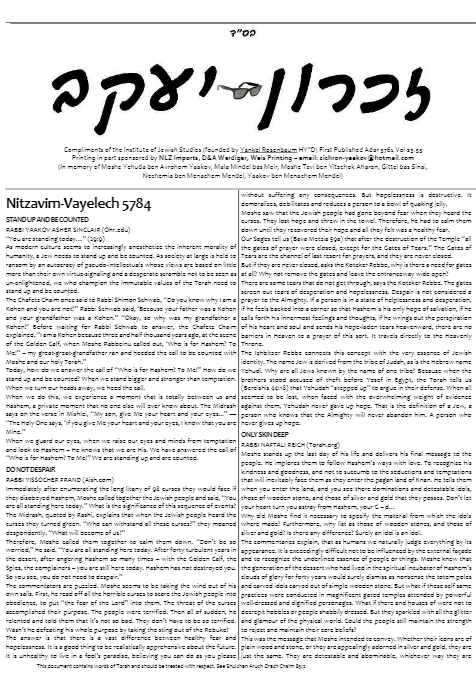
Avrohom Yaakov

“You are all standing today before Hashem ... all men of Israel.” (29:9)

Rashi (29:13) notes, “Why is the section beginning with the words, ‘You are standing this day’ put in juxtaposition to the curses in the previous chapter? Because when Israel heard these one hundred less two curses besides the forty-nine that are contained in Torath-Cohanim (Vayikra 26:14 ff.), their faces turned pale (they were horrified), and they exclaimed, “Who can possibly stand against these?!” Therefore Moshe began to calm them: ‘See, you are standing today before the Lord!’ — many a time have you provoked the Omnipresent to anger and yet He has not made an end to you, but you still continue in His presence (Midrash Tanchuma, Nitzavim 1).”

Why use the expression ‘one hundred less two’? And it appears that the two missing curses were those generating the fear and angst?

WHAT generates greater fear – that which is known or that which is unknown? Clearly the latter.

As children (and maybe sometimes as adults) it is the darkness in the bedroom at night that brings out the fear of that which cannot seen and is not defined. The unknown allows the imagination run wild with terror.

Shed light on a problem, and we feel more confident in being able to resolve it. If we know the parameters of a difficult scenario, we are less afraid.

The Kli Yakar explains that the 98 curses were bad, but there were two curses that were not mentioned by Moshe on purpose – hence ‘100 curses less 2’. Since they were unknown, they created more fear than the other curses, simply because they weren’t defined.

The greatest curse is often not knowing.

PDF Preview