Who Will Live and Who Will Be Uplifted
Hashgacha Pratis | September 12, 2023
Print This Article
View Original PDF

Who Will Live and Who Will Be Uplifted

Hashgacha Pratis | December 31, 2025

The integration of bitachon and hishtadlus means that we take action in order to gain parnassah, healing, shidduchim, and all the needs of people here in this world, and also to avoid things that cause loss of parnassah, health, and so on.

There are those who foolishly assume that they need not avoid danger, since everything was decreed on Rosh Hashanah. We say emotionally the stirring words of Unesaneh Tokef, where we announce, in 24 different ways, Hashem’s strengths. It is He Who decides who will live, who will become rich, who by water...; everything is determined ahead of time. If so, these people ask, how does it help us to take safety measures? If I feel like riding on a motorcycle and making dangerous twists and turns, why shouldn’t I do that? What was decreed will happen anyway, won’t it?

No! It is completely forbidden to act this way.

In the beginning of Chapter 4, Rabbenu Bachyai brings extreme examples of irresponsible behavior, such as a person who says, “I’m drinking poison, and what will be will be”; or one who engages in battle with lions and wild animals willingly, and not because he was forced to do so. Such behavior is forbidden, he says, because it is Hashem’s will that we consider the laws of nature and act accordingly. A person should staunchly avoid putting himself in a situation that is liable to cause him harm.

In this way we obey the mitzvah in Parshas Va’eschanan of “Do not test Hashem...as you did in the midbar.” What was that test? It was after Bnei Yisrael crossed the Yam Suf, and Hashem brought them mann from the heavens to eat, but, “And the nation thirsted for water, and they tested [Him] and said , ‘Is Hashem among us or not?’”

We are not allowed to test Hashem yisbarach’s strength in making miracles. Ramban, at the end of Parshas Bo, explains that Hakadosh Baruch Hu already showed us His strength His and ability to control and override the system of nature, through the ten makkos and the splitting of the Yam Suf, and this and all the miracles and wonders done for Am Yisrael throughout the generations are sufficient for us to believe in Him with complete faith. Therefore, a person should not do mitzvos on condition that he will see yeshuos and all sorts of sweet things that we want and wait for.

Even when his life is shrouded in darkness and there is no light, and he does mitzvos and good deeds and does not see his physical situation getting better, he should continue to trust in the Creator of all worlds.

There is only one mitzvah that enables one to anticipate seeing physical benefit, and that is the mitzvah of tzedakah. As the navi Malachi said regarding ma’aser, “Test me with this.” (When it comes to tzedakah it is permitted to say, “[I am giving tzedakah] so that my son will live.”) But we still have to remember always that the reward for the mitzvos is not in this world; rather, today is the time to fulfill them, and tomorrow – in the World to Come – is the time to receive their reward.

In Shaar Ahavas Hashem (86) Rabbenu Bachyai brings the story of a chassid who slept in the desert, and his friend came over to him and asked him, “Are you not afraid of the lion?” The chassid answered him, “I would be embarrassed for Hashem to see that I’m afraid of something other than Him.” How is it possible that Rabbenu is praising a chassid who slept in a dangerous place, and then he writes that it is forbidden to do so?

The Pas Lechem explains that in that incident there was no choice; he came upon a dangerous place against his will, so in that case he had to trust in Hashem that Hashem would save him, but to go in willingly, without any reason involving pikuach nefesh – that is forbidden. During wartime there were Yidden who ran off to the deserts and forests to avoid being caught by people who were worse than the animals of the field. There were those who jumped from the window of a moving train because they preferred endangering themselves rather than going to certain death. Under such circumstances they did the right thing, because they were trying to avoid the greater danger.

One who enters a situation of danger without a justified reason is called “a fool, a wicked person, and a crude spirit.” A fool – because he is acting illogically; a wicked person – because he is transgressing the words of the chachamim and the mitzvah to safeguard one’s life; and a crude spirit – because he trusts in his own merits, believing that he will be saved because of them. From where does he have the audacity to believe that he is so righteous as to be deserving of revealed miracles?! Even Moshe Rabbenu ran away from Pharaoh when Pharaoh wanted to kill him. Yaakov Avinu ran away from his brother Eisav, and Dovid Hamelech ran away from Shaul. These spiritual giants, with all their great merits, still did natural hishtadlus in order to save themselves. How much more are people like us obligated to do hishtadlus in safeguarding life!

May it be the will of our Father in Heaven that we be inscribed in the book of good life, brachah, shalom, parnassah tovah, good decrees and yeshuos, with good health and much happiness; amen.
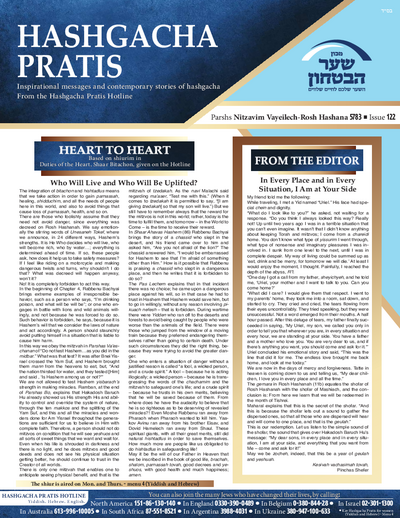
The integration of bitachon and hishtadlus means that we take action in order to gain parnassah, healing, shidduchim, and all the needs of people here in this world, and also to avoid things that cause loss of parnassah, health, and so on.

There are those who foolishly assume that they need not avoid danger, since everything was decreed on Rosh Hashanah. We say emotionally the stirring words of Unesaneh Tokef, where we announce, in 24 different ways, Hashem’s strengths. It is He Who decides who will live, who will become rich, who by water...; everything is determined ahead of time. If so, these people ask, how does it help us to take safety measures? If I feel like riding on a motorcycle and making dangerous twists and turns, why shouldn’t I do that? What was decreed will happen anyway, won’t it?

No! It is completely forbidden to act this way.

In the beginning of Chapter 4, Rabbenu Bachyai brings extreme examples of irresponsible behavior, such as a person who says, “I’m drinking poison, and what will be will be”; or one who engages in battle with lions and wild animals willingly, and not because he was forced to do so. Such behavior is forbidden, he says, because it is Hashem’s will that we consider the laws of nature and act accordingly. A person should staunchly avoid putting himself in a situation that is liable to cause him harm.

In this way we obey the mitzvah in Parshas Va’eschanan of “Do not test Hashem...as you did in the midbar.” What was that test? It was after Bnei Yisrael crossed the Yam Suf, and Hashem brought them mann from the heavens to eat, but, “And the nation thirsted for water, and they tested [Him] and said , ‘Is Hashem among us or not?’”

We are not allowed to test Hashem yisbarach’s strength in making miracles. Ramban, at the end of Parshas Bo, explains that Hakadosh Baruch Hu already showed us His strength His and ability to control and override the system of nature, through the ten makkos and the splitting of the Yam Suf, and this and all the miracles and wonders done for Am Yisrael throughout the generations are sufficient for us to believe in Him with complete faith. Therefore, a person should not do mitzvos on condition that he will see yeshuos and all sorts of sweet things that we want and wait for.

Even when his life is shrouded in darkness and there is no light, and he does mitzvos and good deeds and does not see his physical situation getting better, he should continue to trust in the Creator of all worlds.

There is only one mitzvah that enables one to anticipate seeing physical benefit, and that is the mitzvah of tzedakah. As the navi Malachi said regarding ma’aser, “Test me with this.” (When it comes to tzedakah it is permitted to say, “[I am giving tzedakah] so that my son will live.”) But we still have to remember always that the reward for the mitzvos is not in this world; rather, today is the time to fulfill them, and tomorrow – in the World to Come – is the time to receive their reward.

In Shaar Ahavas Hashem (86) Rabbenu Bachyai brings the story of a chassid who slept in the desert, and his friend came over to him and asked him, “Are you not afraid of the lion?” The chassid answered him, “I would be embarrassed for Hashem to see that I’m afraid of something other than Him.” How is it possible that Rabbenu is praising a chassid who slept in a dangerous place, and then he writes that it is forbidden to do so?

The Pas Lechem explains that in that incident there was no choice; he came upon a dangerous place against his will, so in that case he had to trust in Hashem that Hashem would save him, but to go in willingly, without any reason involving pikuach nefesh – that is forbidden. During wartime there were Yidden who ran off to the deserts and forests to avoid being caught by people who were worse than the animals of the field. There were those who jumped from the window of a moving train because they preferred endangering themselves rather than going to certain death. Under such circumstances they did the right thing, because they were trying to avoid the greater danger.

One who enters a situation of danger without a justified reason is called “a fool, a wicked person, and a crude spirit.” A fool – because he is acting illogically; a wicked person – because he is transgressing the words of the chachamim and the mitzvah to safeguard one’s life; and a crude spirit – because he trusts in his own merits, believing that he will be saved because of them. From where does he have the audacity to believe that he is so righteous as to be deserving of revealed miracles?! Even Moshe Rabbenu ran away from Pharaoh when Pharaoh wanted to kill him. Yaakov Avinu ran away from his brother Eisav, and Dovid Hamelech ran away from Shaul. These spiritual giants, with all their great merits, still did natural hishtadlus in order to save themselves. How much more are people like us obligated to do hishtadlus in safeguarding life!

May it be the will of our Father in Heaven that we be inscribed in the book of good life, brachah, shalom, parnassah tovah, good decrees and yeshuos, with good health and much happiness; amen.

PDF Preview