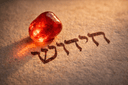
When He Hears the Words of This Curse
(XY:UK OYRBD) „...VLA YBL TWRRwB YK YL HYHY OWLw RMAL WBBLB VRBTHW...„
“When he hears the words of this curse he shall bless himself in his heart and say, “All will be well with me when I follow the guidance of my heart...” (Devarim 29:18)
Last week, the Torah unleashed a litany of curses and warnings upon those who would scorn Hashem’s mitzvos and ignore them. Now, the Torah tells us that if someone pats himself on the back and says, “I will follow the dictates of my heart and all will be well with me,” he should be warned that his sin will be unforgiveable.
The commentaries offer a number of explanations here. Some say that the fellow declares, “I will simply not accept these curses, and then I cannot be held accountable for them. I will act as I see fit, and will not agree to perform the mitzvos.” This is a mistake for he is bound by the mitzvos of Hashem which we all accepted at Sinai.
Others discuss that the curses in Ki Savo are given in the singular form, referring to Klal Yisrael as a single entity. This man, by announcing that he will follow the dictates of his heart, tries to separate himself from the Jewish People, and thereby escape punishment. This is not possible, and will lead to more punishment because he is brazenly flouting Hashem’s commands.
With Rosh Hashana upon us, and Hashem’s judgment, this is a poignant reminder that there are consequences to our actions. We are responsible to act like good Jews and if we don’t, we will be liable for even the inadvertent sins, because even were we to know about them, we would commit them anyway because we don’t care. This is a truly grave crime.
But there is one positive and inspiring message here as well. When a person sins and says, “I will be fine because I follow my heart,” he is wrong and will pay the price. But, if he tells himself he will be fine, “because Hashem will have compassion on me,” though this is the wrong approach, it may very well work. If we approach Hashem on Rosh HaShana and throw ourselves on the mercy of the court, we have a chance of getting off the hook, as long as we commit to be better.
When we recognize how kind and gracious Hashem is, understanding it is because He loves us, it is a merit for us and can help sweeten our judgment. However, if we simply feel Hashem is a pushover, who will look away from our misdeeds, He will not stand for that, and full judgment will come upon us.
Apples and Honey
In Shir HaShirim, the Jews are compared to the apple tree. The Midrash states that an apple tree puts forth the nub of its fruit even before its protective leaves grow. This symbolizes our agreeing to the mitzvos before commanded, when we said Na’aseh V’nishma. This is one reason to specifically have apples and honey on Rosh HaShana, and recall this merit before judgment.
The Meaning of HNwH wAR
The word for year in Lashon Kodesh is HNw. Those letters can be punctuated in two ways. It can be pronounced show-neh, which means repeat, to do over again and again. It can also be pronounced shee-neh, which means to change or differ from the past. At Rosh HaShana, we stand at the crossroads. Only we can decide whether this year will be different, and better, than previous years, or whether we will simply repeat the same mistakes.
The Akeida and Unity
On Rosh HaShana, we recall the Akeida, when Avraham bound Yitzchak. The Torah says they went there, “together,” meaning of unified feeling. But one was there to give his life, and one to give the life of his child. It’s hard to determine which is more challenging, but how were they of one mind? The answer is that each wanted to do what Hashem wanted of him. And so should we.
©2025 – J. Gewirtz