ABSTRACT Likkutei Sichos Part 3
Ben Chamesh L'Mikra | October 31, 2024
Print This Article
View Original PDF

ABSTRACT Likkutei Sichos Part 3

Ben Chamesh L'Mikra | June 27, 2025

The ages of people in the Torah are not on their birthday; rather it is rounded to the nearest year; therefore, Noach was not quite 600 at time of Flood and a year later was not yet. The Torah let us know the ages of the generations, allowing calculation of the age of the word, that our faith should be clear even in its details

ונח בן שש מאות שנה

The remembering of Noach is the beginning of the covenant, which negated the possibility of future floods; thus, needed the transformation of the attribute of Din itself into Rachamim. All the concealment in this world does not prevent the avodah of a Jew; it can even be transformed to assist the Jew in his avodah

ויזכור אלקים

Dispute between Rabbi Yehuda & Rabbi Yitzchak whether Noach prayed properly for his generation; even though beyond possibility, one should make an attempt. A person may well have done as much as was capable of doing; one should still continue to seek the welfare of others

בדורותיו

Rain waters could fall in two categories: Torrential flood waters מבול(6, 17) – a punishment. Mild rain גשם (7, 12) - a blessing. Same unit of water for either, to last 40 days. For the generation of the Flood, the waters were a punishment. For the world itself, the waters were a blessing, purifying; which leads to transforming Galus into Geulah

ויהי הגשם על הארץ

Noach in the Ark had a taste of the World to Come, and was reluctant to leave it; G-d told him to leave since his mission was to go out and repopulate the world. A person might be tempted to remain in the “ark” of personal spirituality; however, a Jew must go out and transform and populate the world (especially in this time prior to Moshiach)

צא מן התבה

The Mabul in the Torah Above, is to "purify the world," similar to the purifying waters of a mikveh; thus, the Flood served a positive purpose as well. Yet He wants the “dry land”, a world that feels independent but strives to know Him. After the task of Tishrei of bringing holiness into the world, now in Mar Cheshvan, one needs to draw the bitul of the flood waters onto the dry land

לשחת כל בשר

Command to Noach occurred even after he already had children; this command applies regarding more physical children and also regarding more spiritual children (students). The toil of “building the world” applies to all ages through having more physical and more spiritual children

פרו ורבו

G-d made a first covenant with the people not to exact total punishment (9, 13), evidenced by the rainbow. A 2nd covenant (in this verse) is between the Midas haDin and living creatures to refrain from additional prosecution (transforms the Midas haDin into Midas haRachamim). During a dangerous situation the Satan seeks punishment even for these things which are not ordinarily punished (except for the current situation of danger)

בין אלקים ובין כל נפש חיה
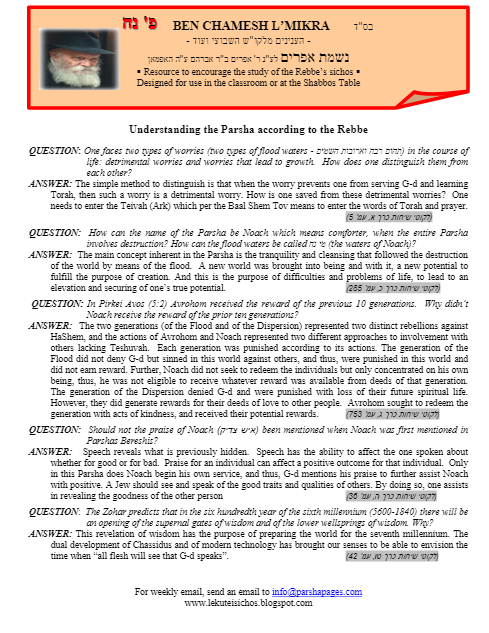
The ages of people in the Torah are not on their birthday; rather it is rounded to the nearest year; therefore, Noach was not quite 600 at time of Flood and a year later was not yet. The Torah let us know the ages of the generations, allowing calculation of the age of the word, that our faith should be clear even in its details

ונח בן שש מאות שנה

The remembering of Noach is the beginning of the covenant, which negated the possibility of future floods; thus, needed the transformation of the attribute of Din itself into Rachamim. All the concealment in this world does not prevent the avodah of a Jew; it can even be transformed to assist the Jew in his avodah

ויזכור אלקים

Dispute between Rabbi Yehuda & Rabbi Yitzchak whether Noach prayed properly for his generation; even though beyond possibility, one should make an attempt. A person may well have done as much as was capable of doing; one should still continue to seek the welfare of others

בדורותיו

Rain waters could fall in two categories: Torrential flood waters מבול(6, 17) – a punishment. Mild rain גשם (7, 12) - a blessing. Same unit of water for either, to last 40 days. For the generation of the Flood, the waters were a punishment. For the world itself, the waters were a blessing, purifying; which leads to transforming Galus into Geulah

ויהי הגשם על הארץ

Noach in the Ark had a taste of the World to Come, and was reluctant to leave it; G-d told him to leave since his mission was to go out and repopulate the world. A person might be tempted to remain in the “ark” of personal spirituality; however, a Jew must go out and transform and populate the world (especially in this time prior to Moshiach)

צא מן התבה

The Mabul in the Torah Above, is to "purify the world," similar to the purifying waters of a mikveh; thus, the Flood served a positive purpose as well. Yet He wants the “dry land”, a world that feels independent but strives to know Him. After the task of Tishrei of bringing holiness into the world, now in Mar Cheshvan, one needs to draw the bitul of the flood waters onto the dry land

לשחת כל בשר

Command to Noach occurred even after he already had children; this command applies regarding more physical children and also regarding more spiritual children (students). The toil of “building the world” applies to all ages through having more physical and more spiritual children

פרו ורבו

G-d made a first covenant with the people not to exact total punishment (9, 13), evidenced by the rainbow. A 2nd covenant (in this verse) is between the Midas haDin and living creatures to refrain from additional prosecution (transforms the Midas haDin into Midas haRachamim). During a dangerous situation the Satan seeks punishment even for these things which are not ordinarily punished (except for the current situation of danger)

בין אלקים ובין כל נפש חיה

PDF Preview