Delaying Marriage for Torah Study and Community Practice
למודי משה | October 23, 2025
Print This Article
View Original PDF

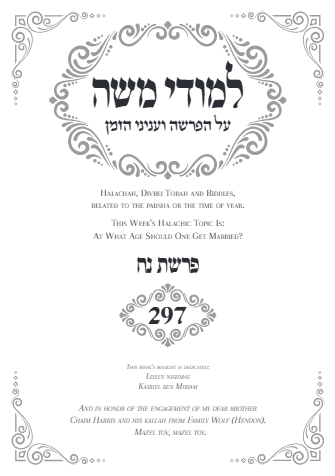
Delaying Marriage for Torah Study and Community Practice

למודי משה | December 08, 2025

The Shulchan Aruch HaRav (Hilchos Talmud Torah, Perek 3, sif 1 and Kuntros Achron, Perek 3, he’orah 1) answers: The truth is, the mitzvah of peru u’revu is like all mitzvos, that if it can’t be carried out by others, it overrides the mitzvah of learning Torah, however, this is only if one can interrupt for a short time and then return to his learning. However, the yoke of earning a parnosah is a constant bitul Torah, and it is possible that it may cause one to forget lots of his Torah as he won’t have time to review it, and the mitzvah of yedias haTorah [knowing Torah] isn’t pushed aside for the mitzvah of peru u’revu, even though it can’t be carried out through someone else. Therefore, he concludes: If one has a good memory and is able to learn and remember the Torah, he shouldn’t get married until he finishes the entire Torah She’ba’al Peh [Oral Torah], if, however, one isn’t able to do this, then he may get married before doing so.

He adds: In the times of Chazal, they learnt with young children, 5 years Mishnah (from 10 – 15), five years Talmud (from age 15 – 20) and they got married at age 20. Sometimes they got married already from age 18 as even after getting married one is normally able to learn 2 – 3 years without any great distractions, before one has lots of children. He then quotes Rashi and the Bartenura (Avos, end of Perek 5) who both explain: בן עשרים לרדוף - age 20 is the age for running, to mean at age 20 one must run after finding a parnosah.

Minhag Yisrael Torah ...

Before 20 – In recent times, many communities in Yerushalayim and amongst the chassidim, and a number of Sephardim as well, had the minhag to get married before turning 20. It is well known that R’ Yosef Chaim Sonnenfeld zt”l in a tzava’oh [will] wrote to his children (and is printed on his matzavah) that they should marry off their sons before they turn 20.

The Chazon Ish (Even HaEzer 148, he’oras on Kiddushin 29b, and see also Kovetz Igros Chazon Ish, siman 135) also writes that there is no heter [allowance] to wait past the age of 20. Although in Bavel they would learn Torah before getting married, it is clear in the Gemara that if one can’t manage without a wife, he should first marry and then learn, and once someone reaches the age of 20, he is considered someone who can’t manage without a wife as if he doesn’t get married ‘he is going to have constant bad thoughts’. He concludes, that it needs looking into, why the poskim don’t mention this.

In a letter the Chazon Ish adds: ויש מאחרין מפני עסק התורה אבל אין דרך זו רק ליחידים – some delay because they are busy learning Torah, however, this is only suitable for select individuals.

The Shu”t Pe’as Sodcha (1, 149, 10) brings from the Chazon Ish, that nowadays there is no one who can say his yetzer horah isn’t winning over him.

In Ma’aseh Ish (Vol. 2, pg. 206) they bring that someone tried to tell the Chazon Ish that when Chazal said that one should get married at 18, that was in those days, however, today a bochur isn’t ready to get married until later. The Chazon Ish protested: “Are you going to say the same thing about the rest of the Mishnah, and that the age of 13 for mitzvos was also only in their times, however, today we should start keeping mitzvos later? The times Chazal fixed are accurate and are not subject to change.

The Klausenberger Rebbe (Shu”t Divrei Yatziv, Even HaEzer 3) also writes that from age 20 and on, it is considered “not possible to remain without a wife”, and the heter to delay is only from 17 until age 20.

The sefer Mitzhalois Chasanim brings that the Steipler held that one should get married before turning 20, and ideally as close to 18 as possible. One time, a 17-year-old bochur came to the Steipler with a sefer he had made, and the Steipler said “now you need to get married”, if you are already able to learn so well, then you should get married and continue learning after the chasunah. R’ Chaim Kanievsky zt”l followed in his father’s footsteps, and some of his grandchildren got married at age 17, as is clear from the Rambam and Shulchan Aruch that one should get married at the beginning of his 18th year, which is when one turns 17.

There is a wonderful sefer called Higiah Zeman (הגיע זמן) written by R’ Avud Eliyahu, he discusses at great length the various ages at which one should get married in today’s generation.

After 20

The widespread minhag in the oilam hayeshivos today is that if a bochur is sitting and learning, there is no need for him to get married before turning 20. This helps ensure that he can learn and know the basic Masechtos and go to yeshivah gedolah and at least learn the basic cycle of yeshivisha masechtos once, and acquire a basic knowledge of the yesodos [foundations] and grow to be a gadol b’Torah. We find that there were Gedolei Yisrael, who told bochurim who were heavily involved in their learning that they could wait a bit longer, provided that they didn’t have a strong yetzer horah, as is clear from the Shulchan Aruch.

Some gedolei mashgichim say that an avreich who has the yoke of parnosah on his head, isn’t able to learn the same as he was before the chasunah. The Shu”t Maharam Mintz (siman 42) quoted by R’ Akiva Eiger (hago’as on Shulchan Aruch 1, s.k. 3) already discusses if one wants to learn Torah by his rebbe, if he is able to delay getting married, and he ends off tzorich iyun. Based on this, a bochur who is shteiging [learning away] in yeshivah and he won’t be able to keep this up in a kollel after he gets married, would be allowed to delay getting married.

Others argue, that today there are kollelim which pay respectfully, and if one wants to continue learning and shteiging after the chasunah it is possible, and on the contrary, many avreichim testify about themselves that they can learn better after the chasunah than before. According to this argument, there is no heter to delay getting married.
The Shulchan Aruch HaRav (Hilchos Talmud Torah, Perek 3, sif 1 and Kuntros Achron, Perek 3, he’orah 1) answers: The truth is, the mitzvah of peru u’revu is like all mitzvos, that if it can’t be carried out by others, it overrides the mitzvah of learning Torah, however, this is only if one can interrupt for a short time and then return to his learning. However, the yoke of earning a parnosah is a constant bitul Torah, and it is possible that it may cause one to forget lots of his Torah as he won’t have time to review it, and the mitzvah of yedias haTorah [knowing Torah] isn’t pushed aside for the mitzvah of peru u’revu, even though it can’t be carried out through someone else. Therefore, he concludes: If one has a good memory and is able to learn and remember the Torah, he shouldn’t get married until he finishes the entire Torah She’ba’al Peh [Oral Torah], if, however, one isn’t able to do this, then he may get married before doing so.

He adds: In the times of Chazal, they learnt with young children, 5 years Mishnah (from 10 – 15), five years Talmud (from age 15 – 20) and they got married at age 20. Sometimes they got married already from age 18 as even after getting married one is normally able to learn 2 – 3 years without any great distractions, before one has lots of children. He then quotes Rashi and the Bartenura (Avos, end of Perek 5) who both explain: בן עשרים לרדוף - age 20 is the age for running, to mean at age 20 one must run after finding a parnosah.

Minhag Yisrael Torah ...

Before 20 – In recent times, many communities in Yerushalayim and amongst the chassidim, and a number of Sephardim as well, had the minhag to get married before turning 20. It is well known that R’ Yosef Chaim Sonnenfeld zt”l in a tzava’oh [will] wrote to his children (and is printed on his matzavah) that they should marry off their sons before they turn 20.

The Chazon Ish (Even HaEzer 148, he’oras on Kiddushin 29b, and see also Kovetz Igros Chazon Ish, siman 135) also writes that there is no heter [allowance] to wait past the age of 20. Although in Bavel they would learn Torah before getting married, it is clear in the Gemara that if one can’t manage without a wife, he should first marry and then learn, and once someone reaches the age of 20, he is considered someone who can’t manage without a wife as if he doesn’t get married ‘he is going to have constant bad thoughts’. He concludes, that it needs looking into, why the poskim don’t mention this.

In a letter the Chazon Ish adds: ויש מאחרין מפני עסק התורה אבל אין דרך זו רק ליחידים – some delay because they are busy learning Torah, however, this is only suitable for select individuals.

The Shu”t Pe’as Sodcha (1, 149, 10) brings from the Chazon Ish, that nowadays there is no one who can say his yetzer horah isn’t winning over him.

In Ma’aseh Ish (Vol. 2, pg. 206) they bring that someone tried to tell the Chazon Ish that when Chazal said that one should get married at 18, that was in those days, however, today a bochur isn’t ready to get married until later. The Chazon Ish protested: “Are you going to say the same thing about the rest of the Mishnah, and that the age of 13 for mitzvos was also only in their times, however, today we should start keeping mitzvos later? The times Chazal fixed are accurate and are not subject to change.

The Klausenberger Rebbe (Shu”t Divrei Yatziv, Even HaEzer 3) also writes that from age 20 and on, it is considered “not possible to remain without a wife”, and the heter to delay is only from 17 until age 20.

The sefer Mitzhalois Chasanim brings that the Steipler held that one should get married before turning 20, and ideally as close to 18 as possible. One time, a 17-year-old bochur came to the Steipler with a sefer he had made, and the Steipler said “now you need to get married”, if you are already able to learn so well, then you should get married and continue learning after the chasunah. R’ Chaim Kanievsky zt”l followed in his father’s footsteps, and some of his grandchildren got married at age 17, as is clear from the Rambam and Shulchan Aruch that one should get married at the beginning of his 18th year, which is when one turns 17.

There is a wonderful sefer called Higiah Zeman (הגיע זמן) written by R’ Avud Eliyahu, he discusses at great length the various ages at which one should get married in today’s generation.

After 20

The widespread minhag in the oilam hayeshivos today is that if a bochur is sitting and learning, there is no need for him to get married before turning 20. This helps ensure that he can learn and know the basic Masechtos and go to yeshivah gedolah and at least learn the basic cycle of yeshivisha masechtos once, and acquire a basic knowledge of the yesodos [foundations] and grow to be a gadol b’Torah. We find that there were Gedolei Yisrael, who told bochurim who were heavily involved in their learning that they could wait a bit longer, provided that they didn’t have a strong yetzer horah, as is clear from the Shulchan Aruch.

Some gedolei mashgichim say that an avreich who has the yoke of parnosah on his head, isn’t able to learn the same as he was before the chasunah. The Shu”t Maharam Mintz (siman 42) quoted by R’ Akiva Eiger (hago’as on Shulchan Aruch 1, s.k. 3) already discusses if one wants to learn Torah by his rebbe, if he is able to delay getting married, and he ends off tzorich iyun. Based on this, a bochur who is shteiging [learning away] in yeshivah and he won’t be able to keep this up in a kollel after he gets married, would be allowed to delay getting married.

Others argue, that today there are kollelim which pay respectfully, and if one wants to continue learning and shteiging after the chasunah it is possible, and on the contrary, many avreichim testify about themselves that they can learn better after the chasunah than before. According to this argument, there is no heter to delay getting married.

PDF Preview