Finding Favor
The Torah Anytimes | October 24, 2025
Print This Article
View Original PDF

Finding Favor

The Torah Anytimes | December 08, 2025

Parshat Noach truly begins with last week’s Parshat Bereishit. The final verse of Bereishit reads, “And Noach found favor in the eyes of Hashem.” Already there, the Torah hints to something exceptional. Noach’s very name carries a sense of destiny. His father, Lemech, called him Noach, saying, “This one will comfort us from the toil and pain of working the cursed earth.” From the moment of his birth, Noach was marked as a man with a mission.

But here is where it becomes remarkable. The Torah doesn’t simply say Noach found favor with people. It says he found favor in the eyes of Hashem Himself. That is not a small compliment. You can fool a human being, you can impress others for a moment, but Hashem sees the inner truth. If Hashem therefore declares that Noach found favor, that means something profound. But considering this, it is all the more puzzling when we reach the opening of our Parsha and encounter one of the most famous disputes in Chazal.

The verse says: “These are the generations of Noach; Noach was a righteous man, perfect in his generations.” Rashi, citing the Gemara, brings two interpretations:

“In his generations” means even in a corrupt generation, Noach remained righteous. If he had lived in a better time, among greater people, he would have risen even higher. Alternatively, “In his generations” means relative to his generation he was righteous, but had he lived in the days of Avraham Avinu, he would have been insignificant.

Now we face a real question. If the Torah tells us that Noach found favor in the eyes of Hashem, how could he have been spiritually mediocre? You can’t say that Hashem was simply grading on a curve. This isn’t a classroom; this is divine assessment. If the Torah calls him tzaddik, there must be real righteousness there.

The answer, I believe, lies in a deep principle about how Hashem judges human beings.

When someone lives in a generation like that of Noach—when the world around them is steeped in corruption and moral collapse—and yet that person remains faithful to what is right, Hashem counts them as a tzaddik. Maybe, in another generation, surrounded by giants like Avraham, Sarah, and Moshe, their light would seem small. But Hashem doesn’t judge hypotheticals. He judges you in your world, under your conditions, in your battles.

So yes, perhaps Noach was only “righteous in his generation.” But in the eyes of Heaven, he was righteous. Period.

This is our story. We read of earlier generations, of people whose entire communities lived like angels. I have a book written about the Jews of Halab (Aleppo). It describes how, after Shacharit on Shabbat, the entire community would go home for a brief meal and then return to the synagogue to learn Torah until Minchah. Not the rabbis; the entire community. Men, merchants, laborers all immersed in Torah. It’s humbling to read that. Today, even full-time kollel students don’t maintain that schedule. So what are we to think? That we don’t measure up? No. The lesson of Noach is that Hashem loves you for far less, when that “less” is achieved through struggle. He sees your world, your generation, your pressures, and He cherishes your effort.

Of course, aim higher. But when someone tells me, “Rabbi, I’m not such a religious person,” I sometimes smile, because often, in their circle, they are the rabbi. Their family asks them the halachic questions, their friends turn to them for guidance, they keep Shabbat when few around them do, and they resist certain temptations when others don’t even recognize them as wrong. That person is Noach, a tzaddik in his generation.

A person raised in a home of Torah, surrounded by rabbis, yeshiva students, and observant peers, doesn’t face the same daily tests. He doesn’t need to choose between Shabbat and social belonging. He never hears, “Come on, just once; what’s the big deal?” His righteousness may be pure, but it’s not forged in fire. But when someone lives surrounded by influences that pull them away—friends who don’t keep kosher, colleagues who work on Shabbat—and they still hold their ground, even imperfectly, that is greatness. Even when they walk into the non-kosher restaurant and only drink a Diet Coke, Hashem says, “That’s My Noach. That’s My tzaddik.” For someone raised in a beit midrash, that same act might be a step backward. But for someone fighting upstream, it is holiness itself.

There are times in life when everything seems to be against us, whether it be business pressures, family strain or emotional exhaustion. In those moments, we may not perform at our best. We might miss a class, skip a tefillah, or feel spiritually numb. But Hashem judges us in the moment we are in. He doesn’t compare you to your best day. He looks at your struggle today and asks: “Are you still walking toward Me?”

There’s a stunning Pasuk in Shir HaShirim (7:2): “How beautiful are your footsteps in shoes, noble daughter.” The Sages (Chagigah 3a) explain this refers to Am Yisrael ascending to the Beit Hamikdash for the festivals. But why praise their shoes? What’s beautiful about shoes?

Because before they arrived at the Temple, before they removed their shoes on holy ground, they had to walk there. They had to leave their homes unguarded, trusting Hashem’s promise that “no one will covet your land” while you come to serve Him. Those footsteps, still filled with worry, still human, still imperfect—that’s what Hashem calls beautiful. “How beautiful are your footsteps in shoes.” He loves us not only when we’ve arrived at holiness, but when we are walking toward it.

So perhaps Noach, in the eyes of some, was only righteous in his generation. But that was the generation he was given. And his courage to stand alone against an entire world—that is what Hashem loved.

This is why, every Motzei Shabbat in Havdalah, many have the custom to say three times, “And Noach found favor in the eyes of Hashem.” We say it three times because “three” represents permanence and commitment. It’s as if we declare: “Hashem, this week may bring challenges. I don’t know what will come my way. But I promise to try, to put one foot forward, to do my best, however imperfectly. And I trust that You will love me for it.”

And to that, Hashem answers, as He did to Noach: “You have found favor in My eyes.”
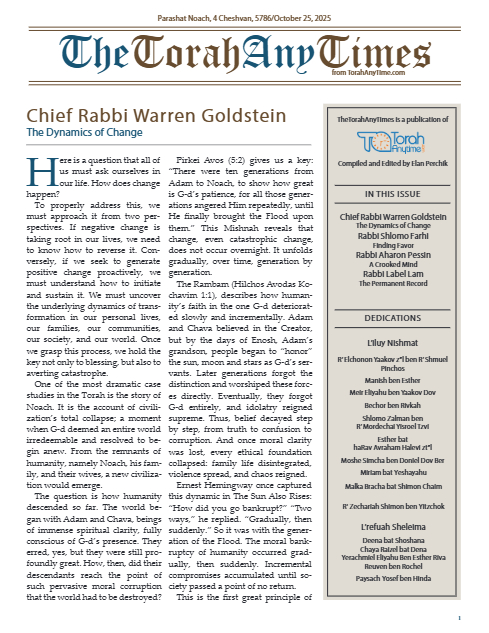
Parshat Noach truly begins with last week’s Parshat Bereishit. The final verse of Bereishit reads, “And Noach found favor in the eyes of Hashem.” Already there, the Torah hints to something exceptional. Noach’s very name carries a sense of destiny. His father, Lemech, called him Noach, saying, “This one will comfort us from the toil and pain of working the cursed earth.” From the moment of his birth, Noach was marked as a man with a mission.

But here is where it becomes remarkable. The Torah doesn’t simply say Noach found favor with people. It says he found favor in the eyes of Hashem Himself. That is not a small compliment. You can fool a human being, you can impress others for a moment, but Hashem sees the inner truth. If Hashem therefore declares that Noach found favor, that means something profound. But considering this, it is all the more puzzling when we reach the opening of our Parsha and encounter one of the most famous disputes in Chazal.

The verse says: “These are the generations of Noach; Noach was a righteous man, perfect in his generations.” Rashi, citing the Gemara, brings two interpretations:

“In his generations” means even in a corrupt generation, Noach remained righteous. If he had lived in a better time, among greater people, he would have risen even higher. Alternatively, “In his generations” means relative to his generation he was righteous, but had he lived in the days of Avraham Avinu, he would have been insignificant.

Now we face a real question. If the Torah tells us that Noach found favor in the eyes of Hashem, how could he have been spiritually mediocre? You can’t say that Hashem was simply grading on a curve. This isn’t a classroom; this is divine assessment. If the Torah calls him tzaddik, there must be real righteousness there.

The answer, I believe, lies in a deep principle about how Hashem judges human beings.

When someone lives in a generation like that of Noach—when the world around them is steeped in corruption and moral collapse—and yet that person remains faithful to what is right, Hashem counts them as a tzaddik. Maybe, in another generation, surrounded by giants like Avraham, Sarah, and Moshe, their light would seem small. But Hashem doesn’t judge hypotheticals. He judges you in your world, under your conditions, in your battles.

So yes, perhaps Noach was only “righteous in his generation.” But in the eyes of Heaven, he was righteous. Period.

This is our story. We read of earlier generations, of people whose entire communities lived like angels. I have a book written about the Jews of Halab (Aleppo). It describes how, after Shacharit on Shabbat, the entire community would go home for a brief meal and then return to the synagogue to learn Torah until Minchah. Not the rabbis; the entire community. Men, merchants, laborers all immersed in Torah. It’s humbling to read that. Today, even full-time kollel students don’t maintain that schedule. So what are we to think? That we don’t measure up? No. The lesson of Noach is that Hashem loves you for far less, when that “less” is achieved through struggle. He sees your world, your generation, your pressures, and He cherishes your effort.

Of course, aim higher. But when someone tells me, “Rabbi, I’m not such a religious person,” I sometimes smile, because often, in their circle, they are the rabbi. Their family asks them the halachic questions, their friends turn to them for guidance, they keep Shabbat when few around them do, and they resist certain temptations when others don’t even recognize them as wrong. That person is Noach, a tzaddik in his generation.

A person raised in a home of Torah, surrounded by rabbis, yeshiva students, and observant peers, doesn’t face the same daily tests. He doesn’t need to choose between Shabbat and social belonging. He never hears, “Come on, just once; what’s the big deal?” His righteousness may be pure, but it’s not forged in fire. But when someone lives surrounded by influences that pull them away—friends who don’t keep kosher, colleagues who work on Shabbat—and they still hold their ground, even imperfectly, that is greatness. Even when they walk into the non-kosher restaurant and only drink a Diet Coke, Hashem says, “That’s My Noach. That’s My tzaddik.” For someone raised in a beit midrash, that same act might be a step backward. But for someone fighting upstream, it is holiness itself.

There are times in life when everything seems to be against us, whether it be business pressures, family strain or emotional exhaustion. In those moments, we may not perform at our best. We might miss a class, skip a tefillah, or feel spiritually numb. But Hashem judges us in the moment we are in. He doesn’t compare you to your best day. He looks at your struggle today and asks: “Are you still walking toward Me?”

There’s a stunning Pasuk in Shir HaShirim (7:2): “How beautiful are your footsteps in shoes, noble daughter.” The Sages (Chagigah 3a) explain this refers to Am Yisrael ascending to the Beit Hamikdash for the festivals. But why praise their shoes? What’s beautiful about shoes?

Because before they arrived at the Temple, before they removed their shoes on holy ground, they had to walk there. They had to leave their homes unguarded, trusting Hashem’s promise that “no one will covet your land” while you come to serve Him. Those footsteps, still filled with worry, still human, still imperfect—that’s what Hashem calls beautiful. “How beautiful are your footsteps in shoes.” He loves us not only when we’ve arrived at holiness, but when we are walking toward it.

So perhaps Noach, in the eyes of some, was only righteous in his generation. But that was the generation he was given. And his courage to stand alone against an entire world—that is what Hashem loved.

This is why, every Motzei Shabbat in Havdalah, many have the custom to say three times, “And Noach found favor in the eyes of Hashem.” We say it three times because “three” represents permanence and commitment. It’s as if we declare: “Hashem, this week may bring challenges. I don’t know what will come my way. But I promise to try, to put one foot forward, to do my best, however imperfectly. And I trust that You will love me for it.”

And to that, Hashem answers, as He did to Noach: “You have found favor in My eyes.”

PDF Preview