Forever Relevant
L’Chaim | October 19, 2023
Print This Article
View Original PDF

Forever Relevant

L’Chaim | December 31, 2025

This week’s Haftora is read twice during the year. Once with parshas Noach and again as the fifth Haftora of consolation, with parshas Ki Seitzei.

The Haftora has a double theme. First, how when Moshiach comes, things will be so good and second, that the redemption will be final, never to be followed by another exile.

The Haftora begins, “Sing, barren one, who hasn’t given birth.” Who is the barren one?

The simple explanation is that Hashem is talking to the city of Jerusalem Because she is desolate during this long exile. Hashem tells her to sing, as now that Moshiach is here, her streets are once again filled with her children, the Jewish people.

On a deeper level, Hashem is talking to the Jewish person who claims that the Jewish people are barren and have not given birth to him. Meaning, he has totally dissociated himself from the Jewish nation. Hashem is saying that even he will even sing the “Shir Chadash,” the New Song, when Moshiach comes.

The exile will then seem as a fleeting dream as the Haftora says, “For a brief moment I forsook you.” And as it says in Tehillim, when Hashem returns the exiles of Zion, “Hayinu k’cholmim, we will have been as dreamers.” like a dream it feels real, but when you wake up it fades away. This will be because, as the verse continues, “with great compassion I will gather you.”

The Haftora continues. Hashem says that when Moshiach comes, “I will make your windows from kodkod (a kind of gemstone).”

What kind of gemstone is a kodkod? The Talmud tells us (Bava Basra 75a), “Rabbi Shmuel son of Nachmeini said, ‘it is a dispute between two angels in heaven, Michael and Gavriel... one says it is a shoham and the other says it is a yashfei. Hashem says to them, “let it be kidayn u’kidayn, like this one and like that one (together).”

We need to know, what is a shoham and what is a yashfei?

There are precious stones that produce their own light from within. Then there are others that if you cut and polish them well, they will reflect light in the most beautiful way. The shoham gives its own light, while the yashfei reflects light.

The debate between the angels is about the reward we will receive when Moshiach will come. One says yashfei, it will be based on our work, effort and accomplishments. Just like a yashfei reflects light, based on how well it is polished. The other says shoham, which gives its own light. Meaning, that the reward will not be based on our accomplishments, rather, it will be Hashem’s infinite revelation as a gift from above. Hashem says that we will get both, the reward for our efforts, and He will also bestow upon us his infinite revelation as a gift.

Perhaps it is your effort, your mitzvah, that will finally tip the scale and bring Moshiach.

May he come soon.

Adapted by Rabbi Yitzi Hurwitz from the teachings of the Rebbe, yitzihurwitz.blogspot.com. Rabbi Hurwitz, who is battling ALS, and his wife Dina, are emissaries of the Rebbe in Temecula, Ca.
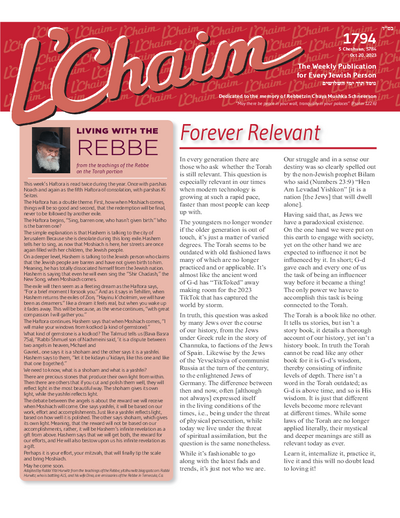
This week’s Haftora is read twice during the year. Once with parshas Noach and again as the fifth Haftora of consolation, with parshas Ki Seitzei.

The Haftora has a double theme. First, how when Moshiach comes, things will be so good and second, that the redemption will be final, never to be followed by another exile.

The Haftora begins, “Sing, barren one, who hasn’t given birth.” Who is the barren one?

The simple explanation is that Hashem is talking to the city of Jerusalem Because she is desolate during this long exile. Hashem tells her to sing, as now that Moshiach is here, her streets are once again filled with her children, the Jewish people.

On a deeper level, Hashem is talking to the Jewish person who claims that the Jewish people are barren and have not given birth to him. Meaning, he has totally dissociated himself from the Jewish nation. Hashem is saying that even he will even sing the “Shir Chadash,” the New Song, when Moshiach comes.

The exile will then seem as a fleeting dream as the Haftora says, “For a brief moment I forsook you.” And as it says in Tehillim, when Hashem returns the exiles of Zion, “Hayinu k’cholmim, we will have been as dreamers.” like a dream it feels real, but when you wake up it fades away. This will be because, as the verse continues, “with great compassion I will gather you.”

The Haftora continues. Hashem says that when Moshiach comes, “I will make your windows from kodkod (a kind of gemstone).”

What kind of gemstone is a kodkod? The Talmud tells us (Bava Basra 75a), “Rabbi Shmuel son of Nachmeini said, ‘it is a dispute between two angels in heaven, Michael and Gavriel... one says it is a shoham and the other says it is a yashfei. Hashem says to them, “let it be kidayn u’kidayn, like this one and like that one (together).”

We need to know, what is a shoham and what is a yashfei?

There are precious stones that produce their own light from within. Then there are others that if you cut and polish them well, they will reflect light in the most beautiful way. The shoham gives its own light, while the yashfei reflects light.

The debate between the angels is about the reward we will receive when Moshiach will come. One says yashfei, it will be based on our work, effort and accomplishments. Just like a yashfei reflects light, based on how well it is polished. The other says shoham, which gives its own light. Meaning, that the reward will not be based on our accomplishments, rather, it will be Hashem’s infinite revelation as a gift from above. Hashem says that we will get both, the reward for our efforts, and He will also bestow upon us his infinite revelation as a gift.

Perhaps it is your effort, your mitzvah, that will finally tip the scale and bring Moshiach.

May he come soon.

Adapted by Rabbi Yitzi Hurwitz from the teachings of the Rebbe, yitzihurwitz.blogspot.com. Rabbi Hurwitz, who is battling ALS, and his wife Dina, are emissaries of the Rebbe in Temecula, Ca.

PDF Preview