Noach
טיב הקהילה English | October 19, 2023
Print This Article
View Original PDF

Noach

טיב הקהילה English | December 31, 2025

ויסגר ה' בעדו
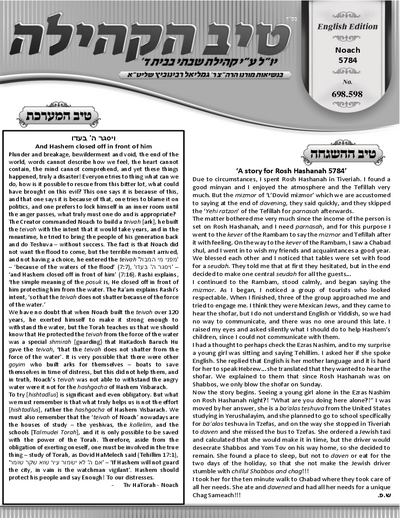
And Hashem closed off in front of him

Plunder and breakage, bewilderment and void, the end of the world, words cannot describe how we feel, the heart cannot contain, the mind cannot comprehend, and yet these things happened, truly a disaster! Everyone tries to thing what can we do, how is it possible to rescue from this bitter lot, what could have brought on this evil? This one says it is because of this, and that one says it is because of that, one tries to blame it on politics, and one prefers to lock himself in an inner room until the anger passes, what truly must one do and is appropriate?

The Creator commanded Noach to build a teivah [ark], he built the teivah with the intent that it would take years, and in the meantime, he tried to bring the people of his generation back and do Teshuva – without success. The fact is that Noach did not want the flood to come, but the terrible moment arrived, and not having a choice, he entered the teivah 'מפני מי המבול' – ‘because of the waters of the flood’ (7:7), 'ויסגר ה' בעדו' – ‘and Hashem closed off in front of him’ (7:16). Rashi explains, ‘the simple meaning of the posuk is, He closed off in front of him protecting him from the water. The Ra’am explains Rashi’s intent, ‘so that the teivah does not shatter because of the force of the water.’

We have no doubt that when Noach built the teivah over 120 years, he exerted himself to make it strong enough to withstand the water, but the Torah teaches us that we should know that He protected the teivah from the force of the water was a special shmirah [guarding] that HaKadosh Baruch Hu gave the teivah, ‘that the teivah does not shatter from the force of the water’. It is very possible that there were other goyim who built arks for themselves – boats to save themselves in time of distress, but this did not help them, and in truth, Noach’s teivah was not able to withstand the angry water were it not for the hashgacha of Hashem Yisbarach.

To try [hishtadlus] is significant and even obligatory. But what we must remember is that what truly helps us is not the effort [hishtadlus], rather the hashgacha of Hashem Yisbarach. We must also remember that the ‘teivah of Noach’ nowadays are the houses of study – the yeshivas, the kollelim, and the schools [Talmudei Torah], and it is only possible to be saved with the power of the Torah. Therefore, aside from the obligation of exerting oneself, one must be involved in the true thing – study of Torah, as Dovid HaMelech said (Tehillim 17:1), 'אם ה' לא ישמור עיר שוא שקר שומר' – ‘If Hashem will not guard the city, in vain is the watchman vigilant’. Hashem should protect his people and say Enough! To our distresses.

-Tiv HaTorah - Noach
ויסגר ה' בעדו
And Hashem closed off in front of him

Plunder and breakage, bewilderment and void, the end of the world, words cannot describe how we feel, the heart cannot contain, the mind cannot comprehend, and yet these things happened, truly a disaster! Everyone tries to thing what can we do, how is it possible to rescue from this bitter lot, what could have brought on this evil? This one says it is because of this, and that one says it is because of that, one tries to blame it on politics, and one prefers to lock himself in an inner room until the anger passes, what truly must one do and is appropriate?

The Creator commanded Noach to build a teivah [ark], he built the teivah with the intent that it would take years, and in the meantime, he tried to bring the people of his generation back and do Teshuva – without success. The fact is that Noach did not want the flood to come, but the terrible moment arrived, and not having a choice, he entered the teivah 'מפני מי המבול' – ‘because of the waters of the flood’ (7:7), 'ויסגר ה' בעדו' – ‘and Hashem closed off in front of him’ (7:16). Rashi explains, ‘the simple meaning of the posuk is, He closed off in front of him protecting him from the water. The Ra’am explains Rashi’s intent, ‘so that the teivah does not shatter because of the force of the water.’

We have no doubt that when Noach built the teivah over 120 years, he exerted himself to make it strong enough to withstand the water, but the Torah teaches us that we should know that He protected the teivah from the force of the water was a special shmirah [guarding] that HaKadosh Baruch Hu gave the teivah, ‘that the teivah does not shatter from the force of the water’. It is very possible that there were other goyim who built arks for themselves – boats to save themselves in time of distress, but this did not help them, and in truth, Noach’s teivah was not able to withstand the angry water were it not for the hashgacha of Hashem Yisbarach.

To try [hishtadlus] is significant and even obligatory. But what we must remember is that what truly helps us is not the effort [hishtadlus], rather the hashgacha of Hashem Yisbarach. We must also remember that the ‘teivah of Noach’ nowadays are the houses of study – the yeshivas, the kollelim, and the schools [Talmudei Torah], and it is only possible to be saved with the power of the Torah. Therefore, aside from the obligation of exerting oneself, one must be involved in the true thing – study of Torah, as Dovid HaMelech said (Tehillim 17:1), 'אם ה' לא ישמור עיר שוא שקר שומר' – ‘If Hashem will not guard the city, in vain is the watchman vigilant’. Hashem should protect his people and say Enough! To our distresses.

-Tiv HaTorah - Noach

PDF Preview